10 Best Food Dehydrators for Large Batches (October 2026) Ultimate Guide
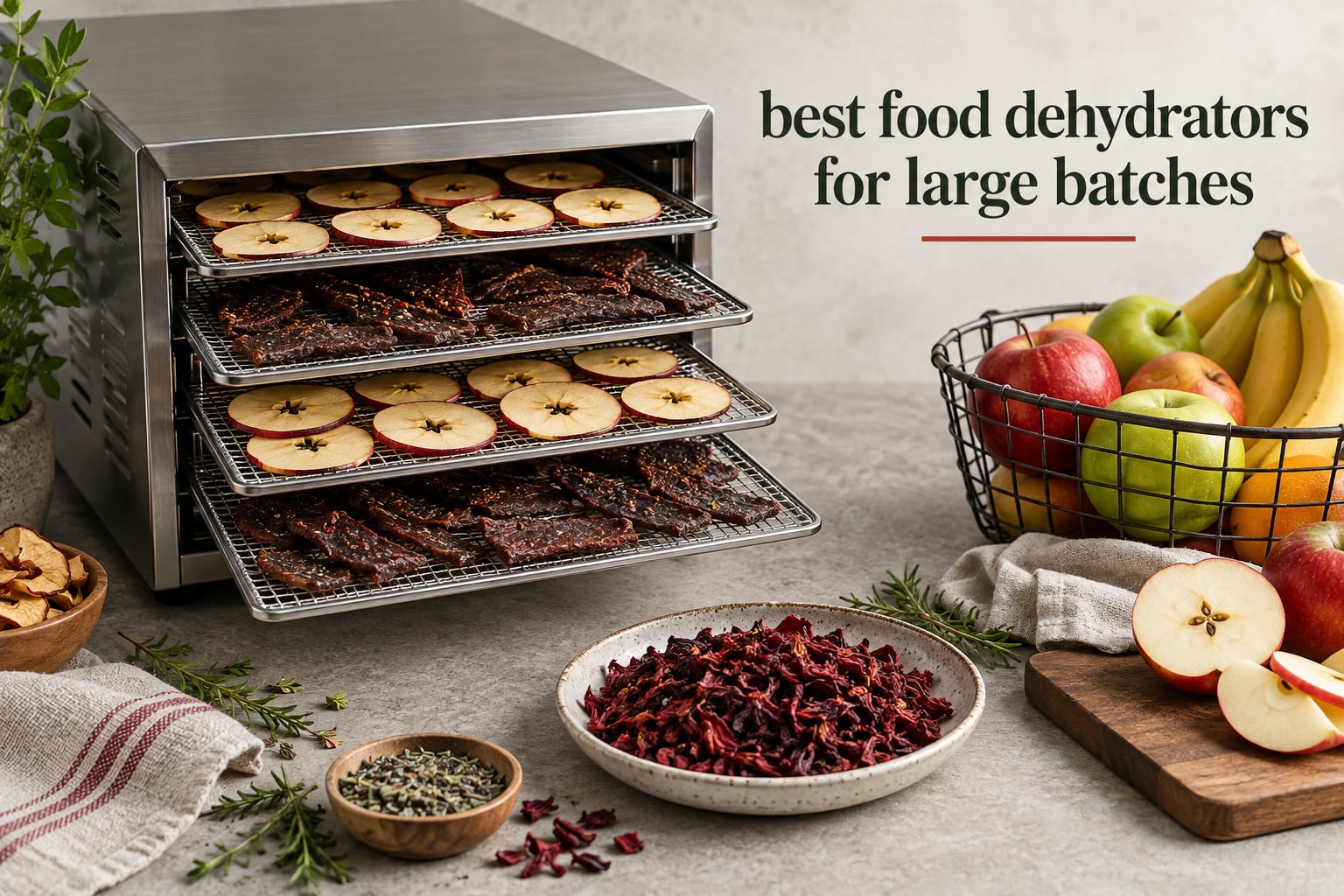
Most people shopping for a dehydrator look at the tray number on the box and stop there. That is the fastest way to end up running three overnight cycles for what should have been one, because a 16-tray unit with small racks can hold less food than a 10-tray unit with large ones. I spent weeks comparing published tray dimensions, airflow layout, wattage and owner reports to separate the machines that genuinely handle heavy loads from the ones that just stack a lot of thin plastic shelves.
A good heavy-duty food dehydrator has roughly 12 square feet or more of usable drying space, six or more full-size trays, and a fan strong enough to move air evenly when every tray is loaded. That combination lets you dry 10 to 20 pounds of wet food in a single cycle instead of swapping shelves all night.
The picks below cover the whole range, from a quiet 8-tray stainless box to an 18-tray cabinet built for round-the-clock runs. I weighted usable square feet above tray count, then airflow design, temperature ceiling, wattage, warranty length and review volume. Every spec quoted here comes from the manufacturer’s published listing or from aggregated owner feedback, and I flag where the two disagree.
If you are still narrowing the field, our jerky-focused dehydrator guide and the jerky and fruit roundup break down temperature and time settings for specific foods. For bigger operations, we also cover commercial dehydrators for beef jerky separately.
Our Top 3 Large-Batch Dehydrators in 2026
The three machines below are the ones I would put in a kitchen with a real harvest coming in. Each solves a different version of the same problem: one gives you the most shelves, one keeps the power draw and cost per tray low, and one does the most work per single load.

Magic Mill Premium 15-Tray
- 15 extra-large stainless trays
- Rear-mounted fan
- no rotation
- 800W
- 48-hour timer
- 95-167F
Ivation 9-Tray Digital
- 9 racks at 13 x 12 inches
- Quiet 600W draw
- 8-step digital thermostat
- Dishwasher-safe trays

Cercker 12-Tray Stainless
- 12 stainless trays at 11.5 inches
- 70-190F range
- Noise at or under 50 dB
- 3-year warranty
One note on the ranking below: the Magic Mill takes the top slot on the strength of its review base and rack count, not because it wins on temperature ceiling. If you need 190 degrees Fahrenheit, the Cercker and the Ausegia both reach it. If you need the fewest compromises on quality per load, the Cercker is the pick I would defend.
Best Food Dehydrators for Large Batches (October 2026)
Every machine in the table below sits above the 5-tray starter size. Read across the usable area and wattage columns together, because those two numbers decide how many hours your food spends in the chamber and how much of it you can fit in the first place.
| Product | Specifications | Action |
|---|---|---|
| Magic Mill Premium 15-Tray |
|
Check Latest Price |
| Ivation 9-Tray Digital |
|
Check Latest Price |
| Cercker 12-Tray Stainless |
|
Check Latest Price |
 Cosori P101 10-Tray Cosori P101 10-Tray |
|
Check Latest Price |
 HOPERAN 12-Tray HOPERAN 12-Tray |
|
Check Latest Price |
 Ausegia 12-Tray Commercial Ausegia 12-Tray Commercial |
|
Check Latest Price |
 Septree 18-Tray Septree 18-Tray |
|
Check Latest Price |
 Excalibur Select Series 8-Tray Excalibur Select Series 8-Tray |
|
Check Latest Price |
 OLIXIS 8-Tray Stainless OLIXIS 8-Tray Stainless |
|
Check Latest Price |
 HOPERAN 16-Tray HOPERAN 16-Tray |
|
Check Latest Price |
1. Magic Mill Premium 15-Tray – The Best Overall Large-Batch Dehydrator
- Rear-mounted fan dries all 15 trays without rotation
- Dishwasher-safe stainless trays and liner
- 48-hour timer plus keep-warm mode
- Automatic shut-off and overheat protection
- 167F ceiling is below 190F commercial units
- New stainless units carry an odor that needs airing out
This is the machine I would hand to someone whose problem is volume rather than precision. Fifteen extra-large stainless racks in an 18 by 14 by 17 inch body is an unusually dense packing of shelf space, and the rear-mounted fan is positioned to push air across the whole stack rather than down through it.
That fan placement is the detail that matters most for large batches. Owners consistently report drying without rotating shelves mid-cycle, which removes the single task that stops most people from running a full chamber overnight. Those same owners describe jerky coming out at a consistent texture from the top shelf to the bottom without a swap.
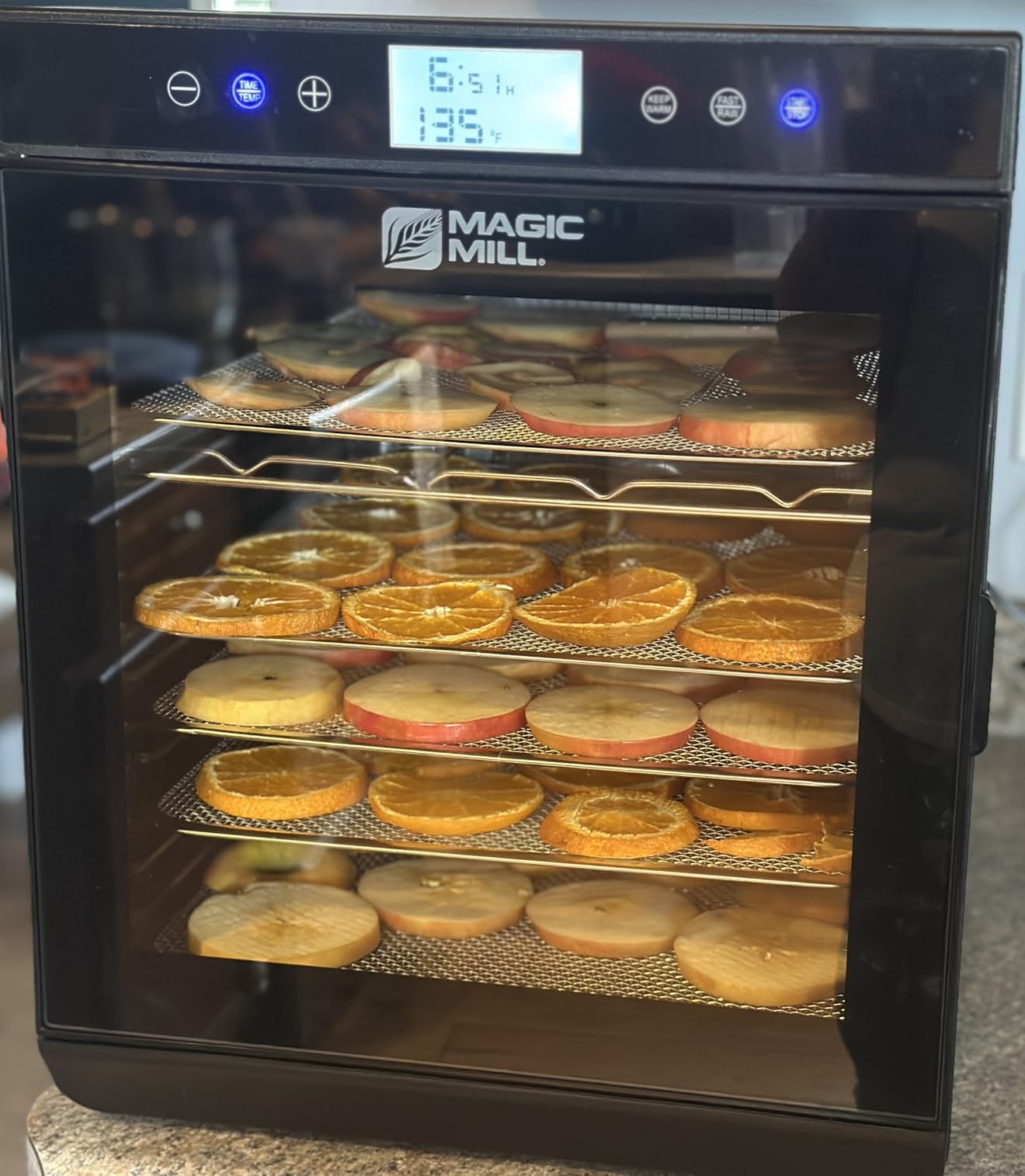
The digital controls cover 95 to 167 degrees Fahrenheit with a 48-hour countdown and a separate keep-warm function. Keep-warm is the underrated feature here: it lets you finish a load, park the machine at a holding temperature and start a second batch the next morning without resetting anything.
At 800 watts this draws less than the three higher-wattage machines in the group, and the 21.4 pound weight makes it one of the easier 15-tray units to reposition. The dishwasher-safe trays and liner mean a full load of wet apple slices can be rinsed straight into a dishwasher cycle rather than hand-scrubbed.
Where the 167F ceiling gets in the way
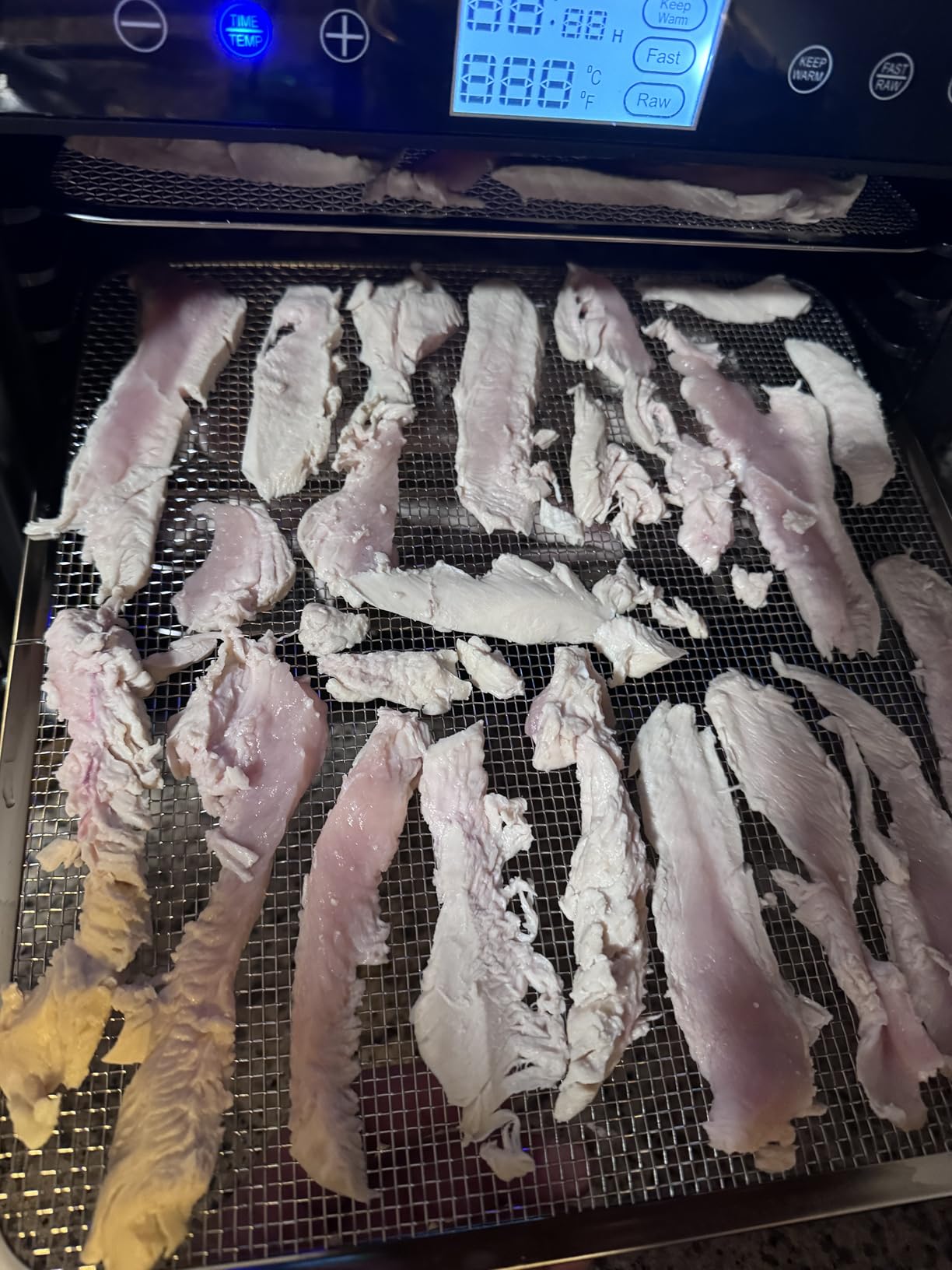
The temperature range tops out at 167 degrees Fahrenheit, which is fine for USDA-recommended jerky drying and for almost all fruit and vegetable work. It becomes a limitation if you are chasing fast dehydration at high heat, or running a biltong-style process that wants a hotter chamber than a standard jerky run.
Second, the manufacturer does not publish tray dimensions or total square footage for this model. That is a real gap when you are sizing a batch, and it is the main reason I would not call it the biggest chamber on the list despite the tray count. Measure the rack footprint yourself before committing if your loads run wide.
Who should buy it and who should not
Buy it if you dry more than once a week, want stainless racks you can wash, and would rather not rotate shelves at any point in a long run. The combination of rack count, 48-hour timer and rear-fan airflow covers garden harvests, weekly jerky and pet treats without a babysitting shift.
Pass if you need a 190 degree ceiling, if you are working with a limited counter depth, or if stainless is not a requirement and you would rather spend the difference on a dual-zone layout. Run a burn-off cycle on a new stainless unit before your first real load, since owners report a faint manufacturing smell that clears after the first few runs.
2. Ivation 9-Tray – Best Value for Steady Home Jerky Runs
- Spacious 13 x 12 inch racks for heavy per-tray loads
- Very low 600W power draw
- Quiet running and dishwasher-safe racks
- Includes fine-mesh and solid sheets for fruit roll-ups
- Plastic racks rather than stainless steel
- Back racks can outrun front racks on some loads
- Awkward drip tray shape
The Ivation earns its place by doing a smaller number of things very cheaply. At 600 watts it is the second-lowest draw in this group, and the nine 13 by 12 inch racks give it a per-tray footprint that punches well above its tray count. Owners report loading 6 pounds or more of jerky at once.
That combination makes it the efficient middle option for a household doing one serious jerky run a week rather than a full harvest. The chamber dries a full load in fewer kilowatt-hours than the 1000W and 2000W machines below, and the whole body is light enough to move between the counter and a shelf when you are not using it.
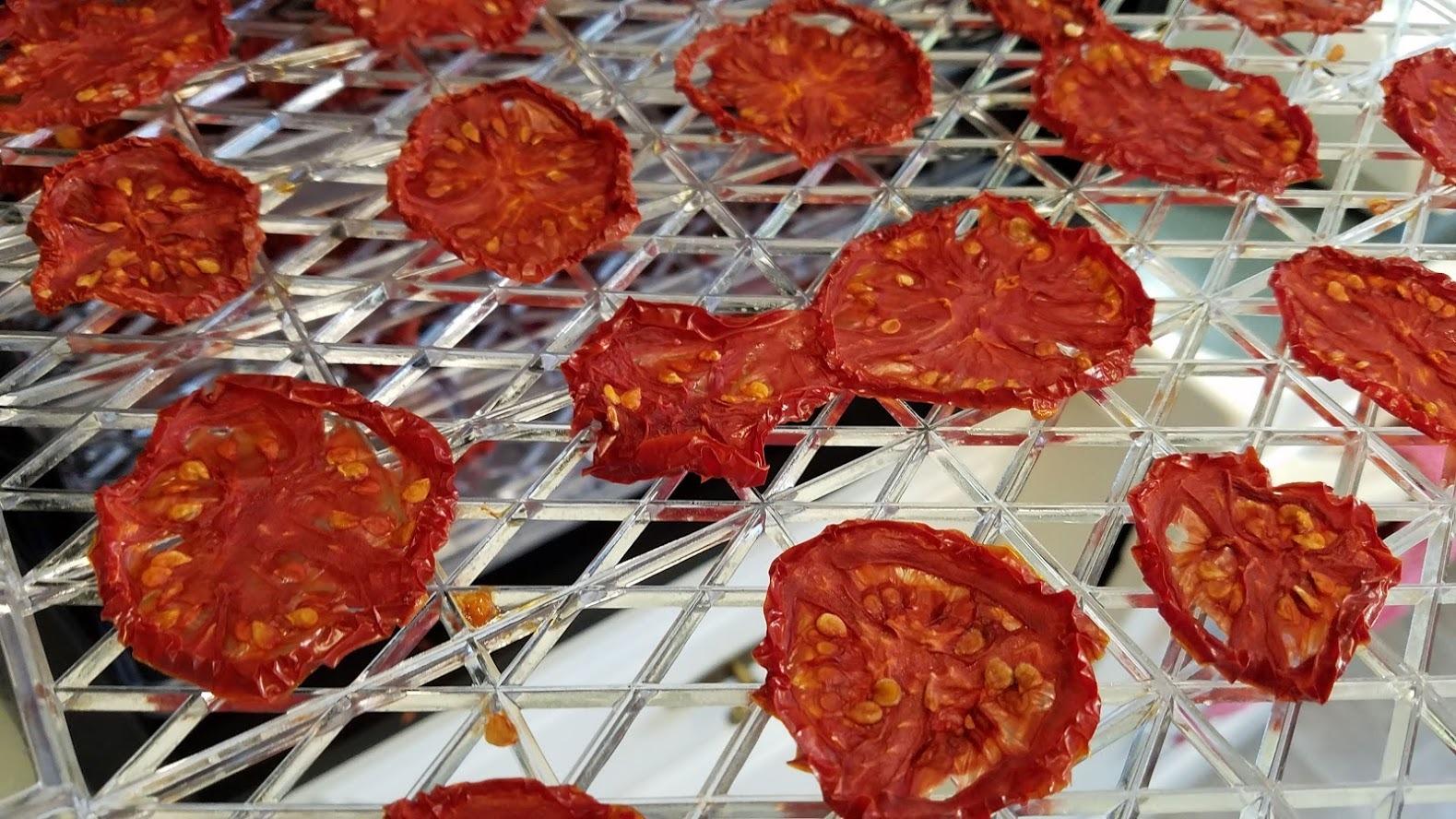
Temperature control runs from 95 to 158 degrees Fahrenheit across eight steps rather than single degrees. For most fruit, herb and vegetable work the stepped scale makes no practical difference. For precise repeatability across batches it is a step down from a machine with one-degree increments.
Two accessories are included that you would otherwise buy separately, a nonstick fine-mesh sheet and a solid sheet for fruit roll-ups. Both are sized to the 13 by 12 inch rack footprint, which is exactly the match you want if you plan to buy silicone fruit leather sheets later.
Where the plastic racks cost you
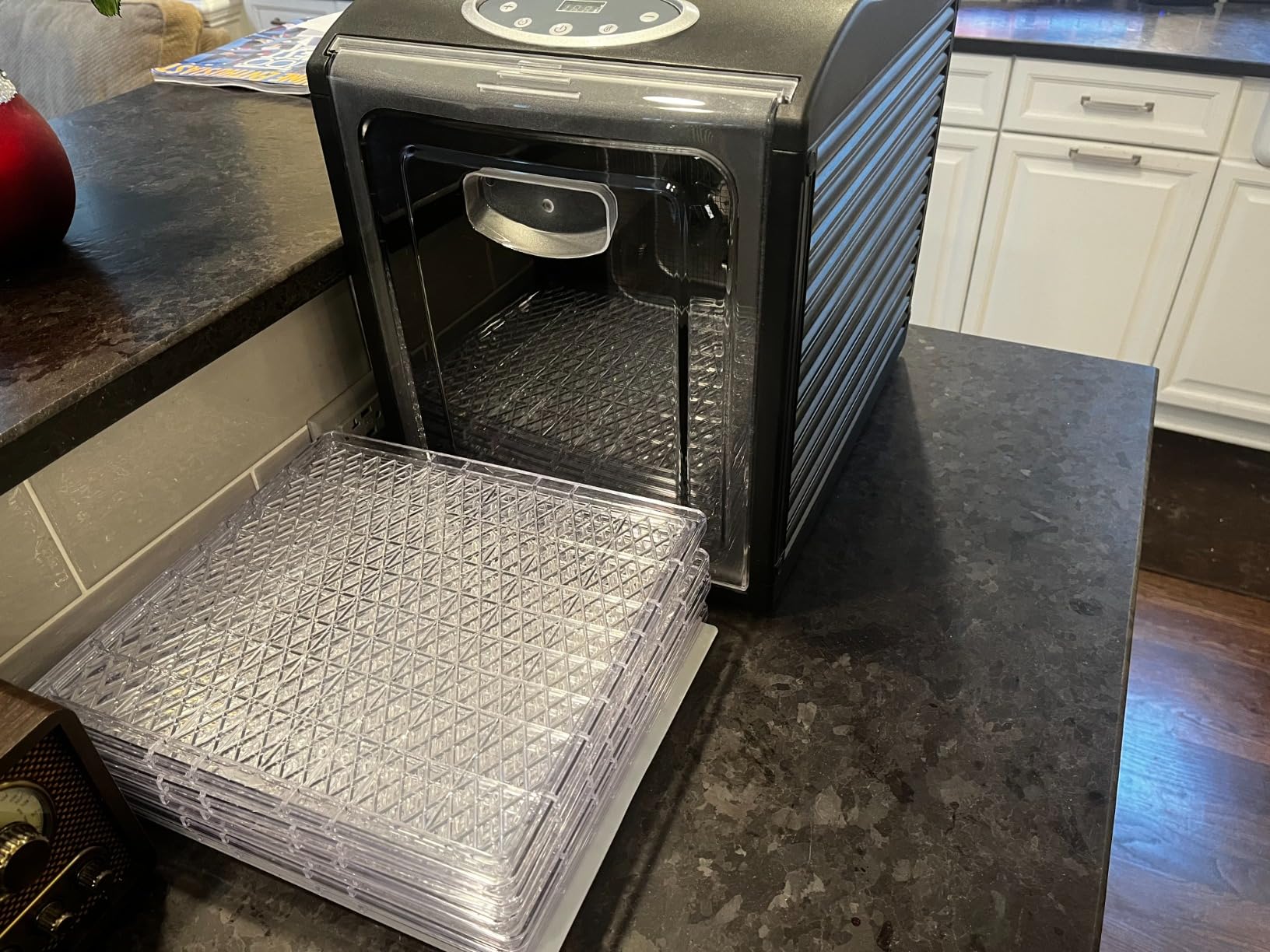
The racks are plastic rather than stainless steel. They wash clean in a dishwasher and come out looking new, which is genuinely convenient, but they will scratch over years of knife contact and they are not oven-safe for reheating crisped jerky.
The more practical issue is airflow consistency. Owners report that racks toward the back of the chamber can dry faster than racks at the front on some loads, so a tray swap partway through a long run is occasionally worthwhile. The rear-mounted fan helps, but it does not fully level out a 9-shelf stack.
Who should buy it and who should not
Buy it if you want a large rack footprint on a modest power draw, you mostly dry meat and fruit rather than thick vegetables, and you would rather load the dishwasher than scrub steel. It is also the one machine here that doubles usefully, since owners use it for curing painted model parts and drying 3D printer filament.
Pass if you run long herb or whole-vegetable loads, where the stepped temperature scale and a shorter timer leave less room, or if you plan to sell finished product and want stainless food-contact surfaces in the build.
3. Cercker 12-Tray – Top Rated Stainless Machine Per Load
- Owners complete 6 to 9 pounds of jerky per week in one load
- Stainless trays dry evenly enough to skip rotation
- Interior light for checking progress without opening
- Quiet at or under 50 dB with a cool outer housing
- Tall body may not clear standard wall cabinets
- Interior light only switches off by unplugging
- Some boxes arrive without all 12 trays
The Cercker is the pick I would defend hardest on raw performance, and it is the only machine here that states a usable per-load result in owner terms. Buyers report completing 6 to 9 pounds of jerky in a single load without swapping shelves, which is the metric that actually matters when you are drying for the week ahead.
The rear two-row fan is specified at 2 m per second air speed at 1600 rpm, and that figure is why the stainless racks reportedly dry evenly top to bottom. Stainless conducts heat differently from plastic, so the even-drying claim is easier to deliver on metal shelves, and owners back it up.
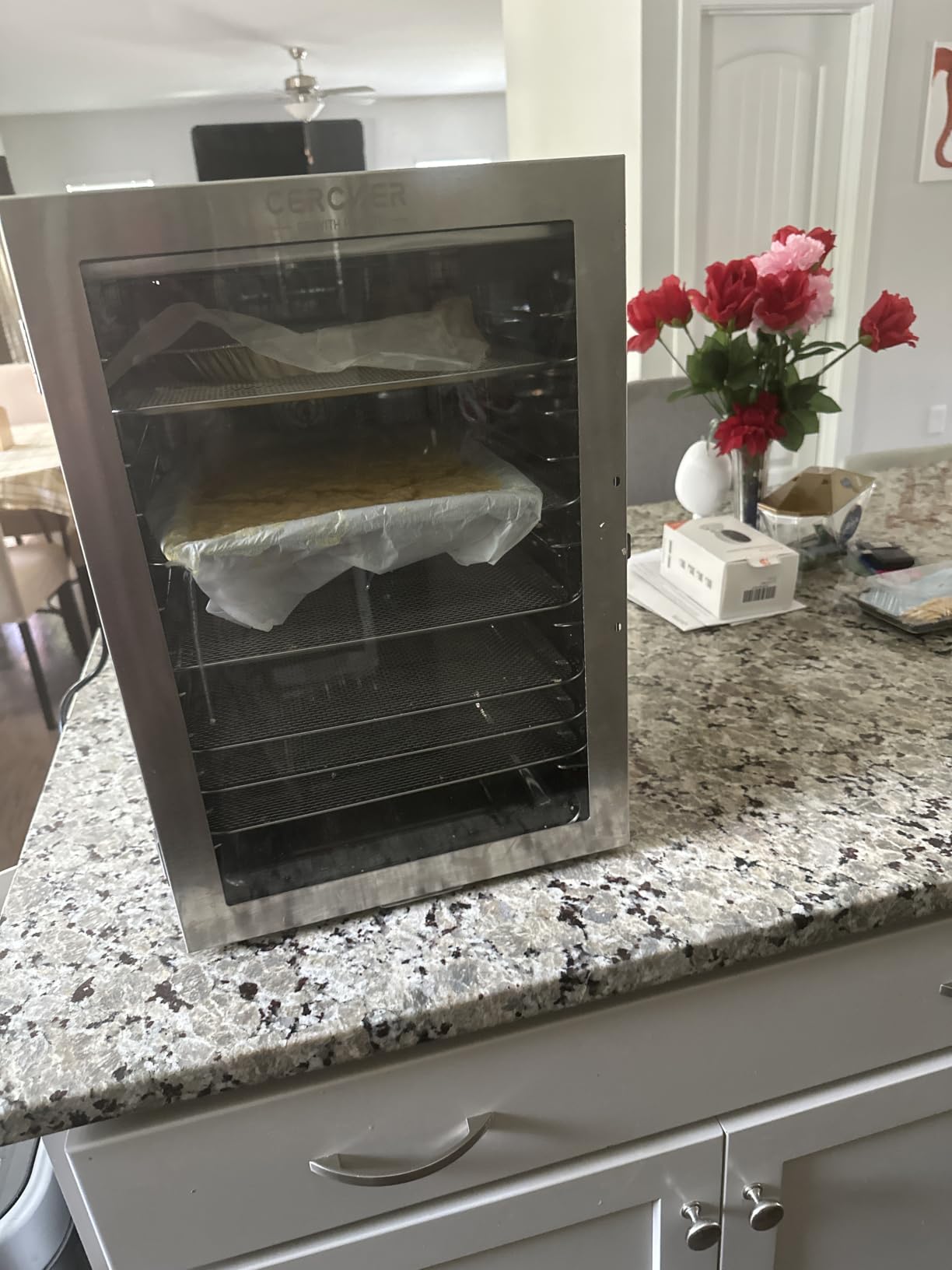
Temperature runs 70 to 190 degrees Fahrenheit in 5-degree increments on a 24-hour timer with half-hour steps. That 190 degree ceiling is among the highest in this group, which gives you headroom for herb drying at the low end and hard drying at the high end from the same machine.
The accessories are unusually generous for a home model. You get a recipe book, drip tray, silicone gloves, a screwdriver and a user manual, and the open-grid stainless shelves are dishwasher safe. The 3-year warranty is the longest stated cover in the roundup alongside the Septree.
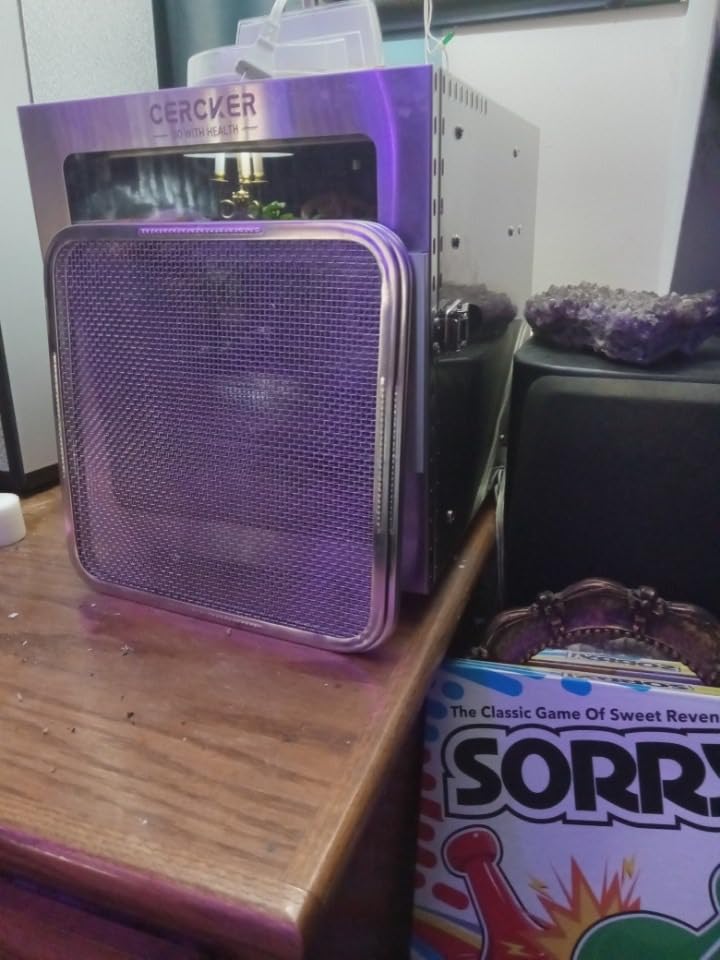
The 24-hour timer is the real constraint
A 24-hour timer with automatic shut-off at the end is shorter than the Magic Mill’s 48 hours and much shorter than the Excalibur’s 80. For jerky, fruit and herbs that is never a problem. For very long herb runs or whole thick vegetables that need more than a day, you are restarting the cycle rather than setting it once.
Two practical notes from owner feedback. The interior light can only be turned off by unplugging the unit, so a full overnight run in a shared room means a lit chamber. And a small number of buyers report boxes arriving with trays missing, so count the shelves the moment it is delivered.
Who should buy it and who should not
Buy it if you want the highest temperature ceiling in a full-size home chamber, you care about warranty length, and you would rather scrub stainless in a dishwasher than handle plastic racks. It suits a serious weekly jerky habit, a market garden’s fruit, and mixed household use where one machine has to cover meat and produce.
Pass if counter clearance is tight, since the body is 12.4 by 16.5 by 17.7 inches and will not slide under standard wall cabinets, or if you need multi-day uninterrupted cycles. New stainless units here also need a burn-off run before the first full load.
4. Cosori P101 – Best for 1-Degree Temperature Precision
Cosori Food Dehydrator, 10 Stainless Steel Trays with 16.2 ft² Drying Space
- Only machine publishing total drying area clearly at 16.2 sq ft
- 1-degree temperature increments for repeatable batches
- Rear horizontal airflow fan
- Food-grade 304 stainless trays with a 2-year warranty
- Heavy at 35.8 pounds and deep at 21.3 inches
- 165F ceiling is below the 190F stainless models
Every sizing conversation in this category ultimately runs into the problem of manufacturers not telling you how much rack area you are buying. The Cosori does, at 16.2 square feet across 10 trays measuring 11.6 by 11 inches, and that single published figure makes it the easiest machine here to plan loads against.
It also ranks first in the Dehydrators category on Amazon, which tells you something useful about parts availability and long-term support for a brand that many hobbyists already own. Owner consensus on r/dehydrating repeatedly names Cosori as one of the safest general-purpose picks, and this model is the reason that shows up.
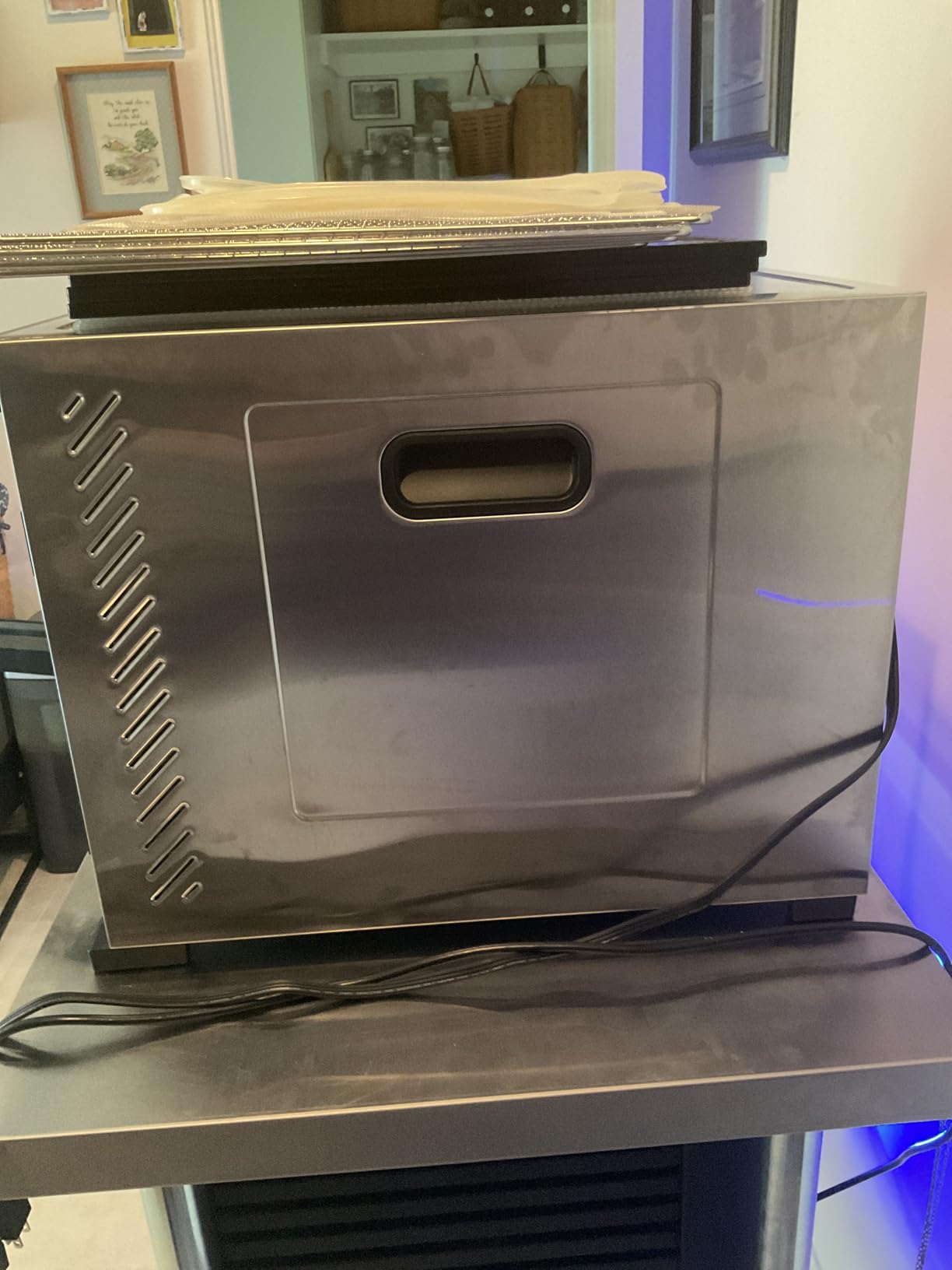
Temperature control runs 95 to 165 degrees Fahrenheit in 1-degree increments on a 48-hour timer with 30-minute steps. That precision is the reason this is the machine I would use when drying the same recipe repeatedly and want the result to match batch to batch, and it is also the answer to a common safety question, since 165 degrees is the stated USDA maximum for jerky.
The 1000W element sits in the upper half of the power range here, and the body is the heaviest of the group at 35.8 pounds. Plan the location before it arrives, because at 21.3 inches deep it also needs the longest runout behind it for airflow.
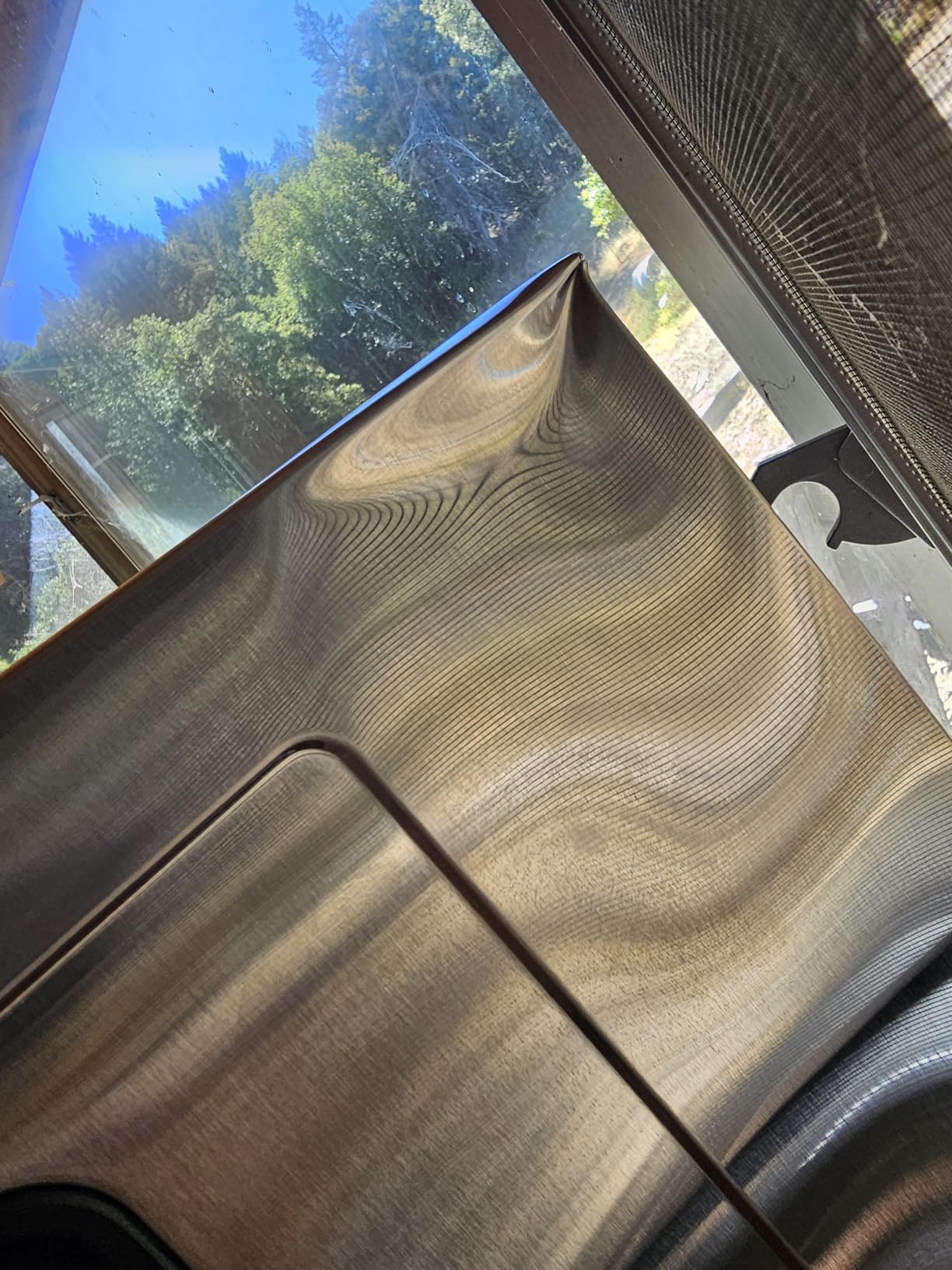
Buying on square feet instead of tray count
This machine is the clearest demonstration of why the sizing math matters. Ten trays sounds modest next to the 16-tray machines in this roundup, but the published 16.2 square feet puts it far ahead of both of them. Compare the 11.6 by 11 inch tray dimensions against the 11 by 8 inch racks on a higher tray count and the difference is obvious.
The 304 stainless trays are food-grade, and the rear horizontal airflow fan is the reason owners report less residual moisture than with vertical-airflow designs. A large drying area plus a rear fan means more food per cycle without the tray rotation that the same volume would otherwise demand.
Who should buy it and who should not
Buy it if reproducibility matters more than raw heat, you want the most clearly documented drying area in the category, or you are feeding a family rather than a market stall. The 48-hour timer and 30-minute steps give fine control over long herb and vegetable runs.
Pass if you need to dry at 175 degrees or above, if you want a machine you can lift onto a high shelf with one hand, or if counter depth is limited. Two years of manufacturer cover is solid but sits below the Cercker and Septree.
5. HOPERAN 12-Tray – Best for Dual-Fan Even Drying
HOPERAN 12 Tray Food Dehydrator Machine for Jerky, Fruit, Herb & Dog Treats
- Dual rear fans give 360 degree airflow without rotation
- Wide 86-196F range covers herbs and jerky
- Quiet under 48 dB for overnight runs
- Dishwasher-safe trays and a glass viewing door
- Smaller rack footprint than the 16 square foot models
- One-star share of 9 percent hints at unit-to-unit variation
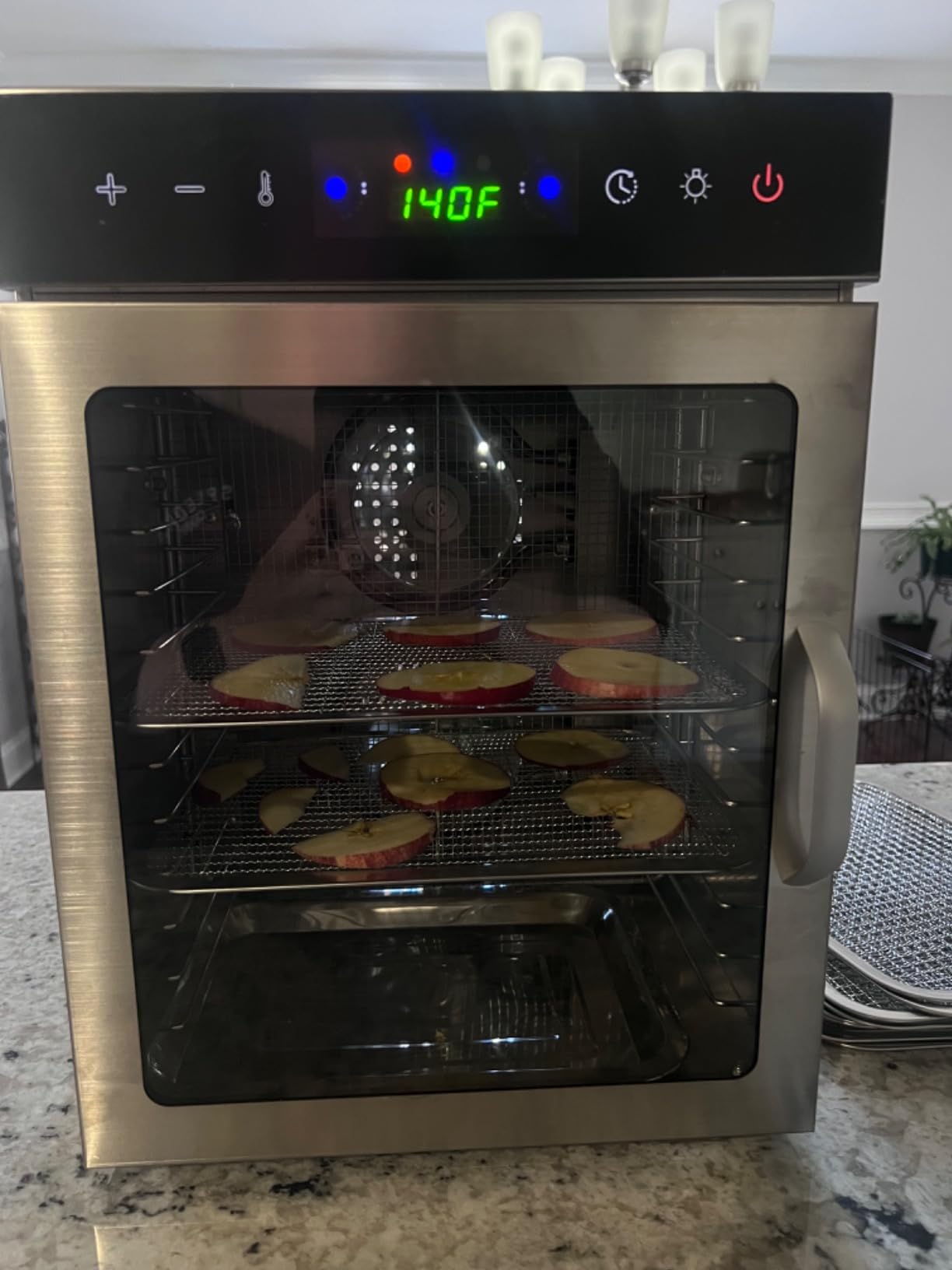
Two rear-mounted fans instead of one is the headline here, and the 360 degree airflow pattern is what removes tray rotation from the routine. If your problem is that you refuse to wake up at 2am to swap shelves, this is the machine built to solve that objection.
The 86 to 196 degree Fahrenheit range is wide enough to cover both ends of the food spectrum in one machine. Herbs want the bottom of that range, jerky and firm vegetables sit at the top, and a narrow-range unit would force you to compromise on one of them.
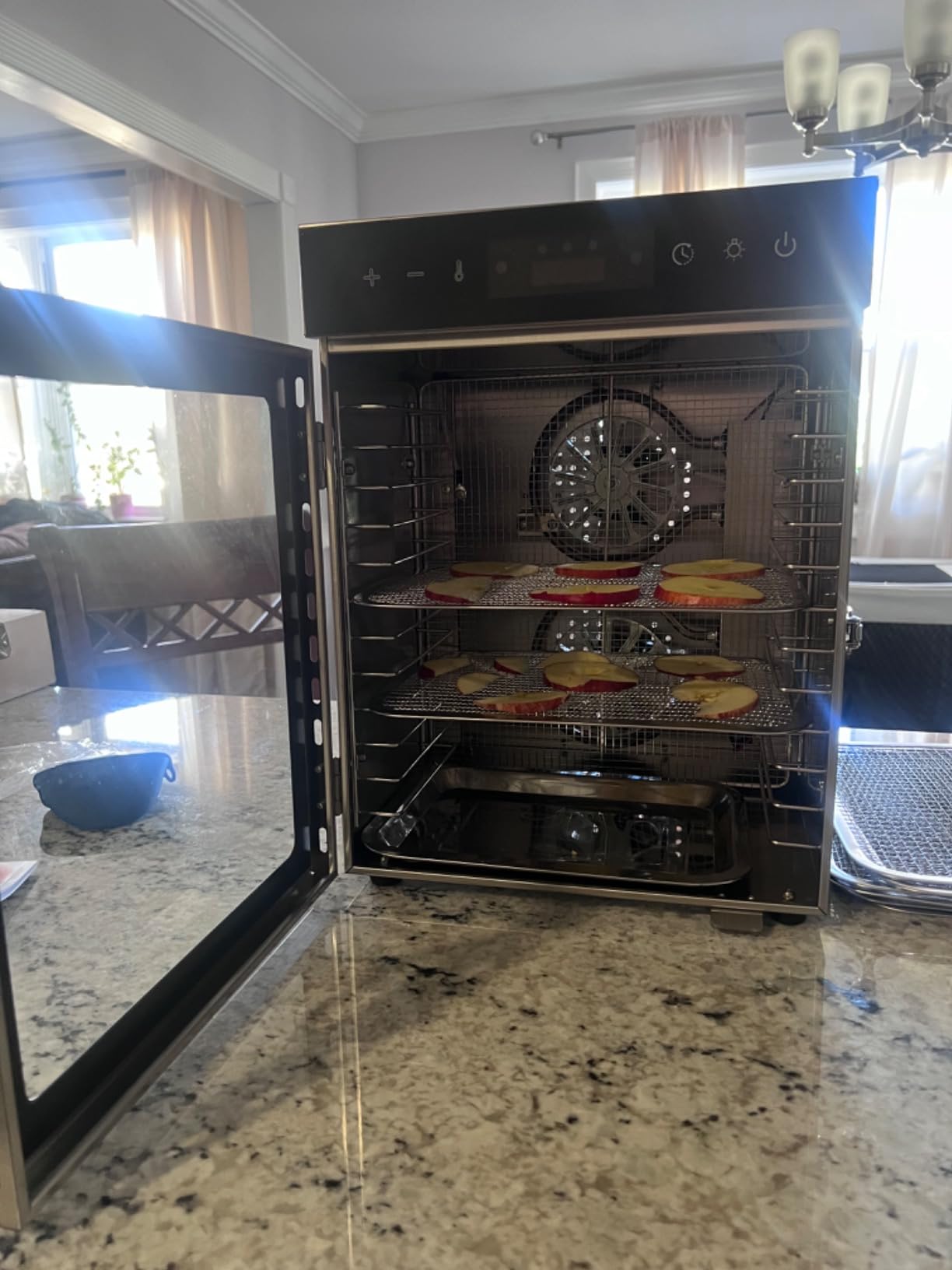
Twelve removable 304 stainless steel trays slide out individually, which makes loading a staggered harvest easy and means you can run partial loads on the shelves you are not using. The trays are dishwasher safe, and a glass door plus operating noise under 48 dB make this one of the quieter machines to run overnight in a lived-in space.
Two silicone mesh screens and a fruit roll sheet are included, so you can start on small fruit and herbs out of the box rather than buying accessories first. At 16 pounds the body is light enough to move between the counter and a shelf, which matters if it shares a work surface with other appliances.
Reading the review distribution honestly
The aggregate sits at 4.4 stars across 327 reviews, and the 9 percent one-star share is the second highest among the stainless models here. That is worth taking seriously rather than dismissing. On a category where replacement fans and heating elements can be hard to source, a heavier share of early complaints is a mild reliability signal.
Against that, the 2-year manufacturer warranty and the removable tray design both reduce the impact of a single failed part, and the 304 stainless grade on removable trays is better than plated racks. Treat it as a well-supported mid-size machine rather than a set-and-forget appliance.
Who should buy it and who should not
Buy it if quiet overnight running and zero tray rotation are your two hard requirements, you want a genuine herb-to-jerky temperature spread, and you prefer 304 stainless trays you can remove and wash individually.
Pass if you are working through a large garden harvest where raw square feet beat airflow refinement, or if you need multi-day timers. The smaller rack footprint means more cycles per season than the Cosori or Ausegia at the same tray count.
6. Ausegia 12-Tray – Best for Oversized Square Trays
- 22.67 sq ft from 12 oversized square trays
- Large flat racks suit full fruit leather sheets
- Quiet under 50 dB with a glass front door
- Auto shut-off one minute early with cold-air cooling
- Runs take roughly 18-20 hours at 175F
- Middle trays can dry less evenly than the top two
- 120V 60Hz operation limits use to the USA and Canada
Square 15.75 inch trays are the feature that separates this machine from the rest. Most home dehydrators use racks around 11 to 13 inches, and those dimensions cap the size of a fruit leather sheet and limit how many full-width strips of jerky you can lay out. This one removes that constraint.
At 22.67 square feet of usable area across 12 trays, it carries far more loading room than the 10-tray Cosori’s published 16.2 square feet, and it is the second largest chamber in this group behind the 18-tray Septree. If you make fruit leather or want full trays of sliced vegetable rather than small batches, the geometry is the argument.
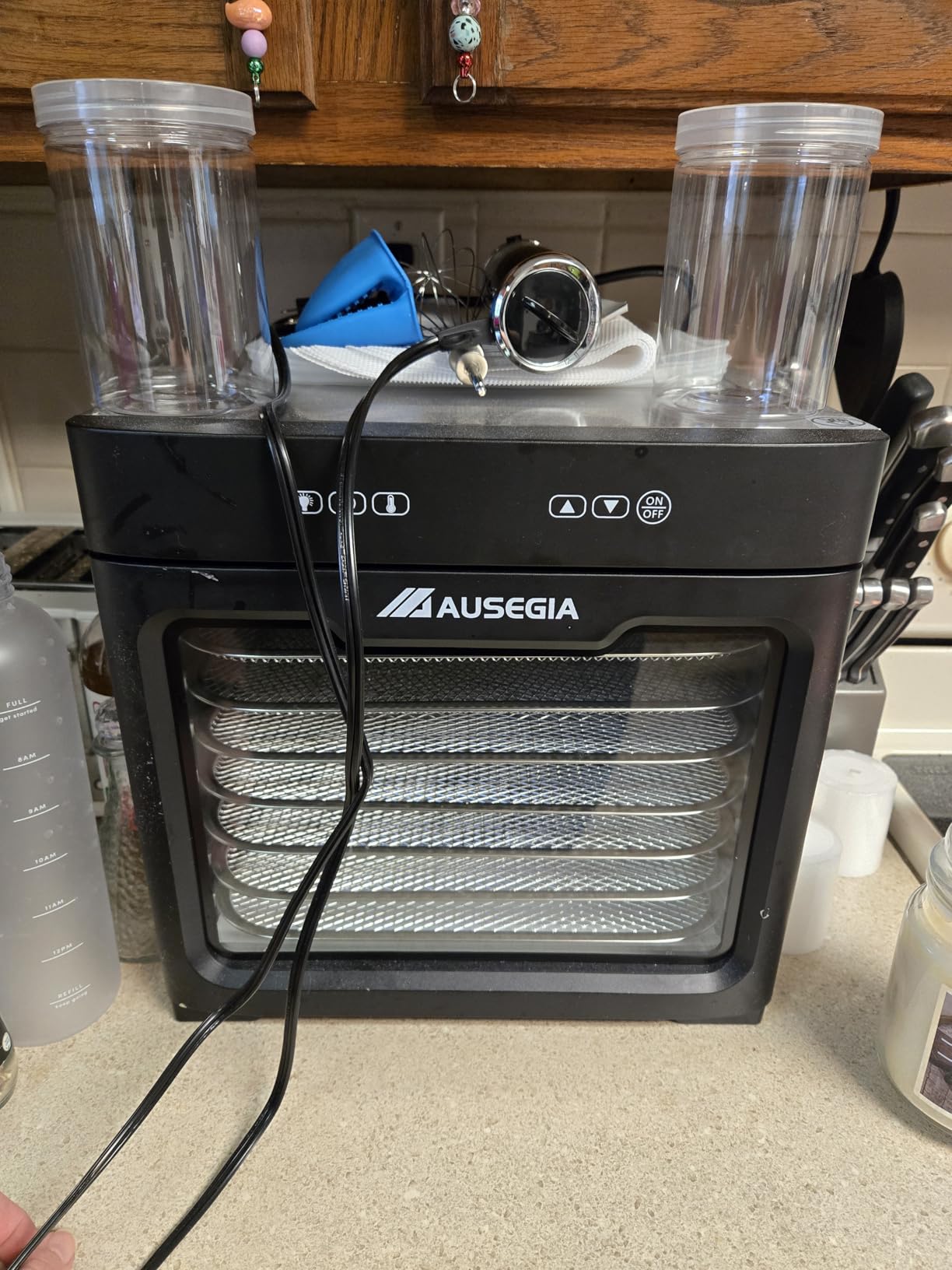
The 1200W element and rear-mounted fan with double-row vents accelerate water vapour discharge, and the digital panel offers 30-minute to 24-hour timer steps from 70 to 190 degrees Fahrenheit. Automatic shut-off fires one minute before the timer ends and runs the fan as a cold-air cool-down, which protects the element on long cycles.
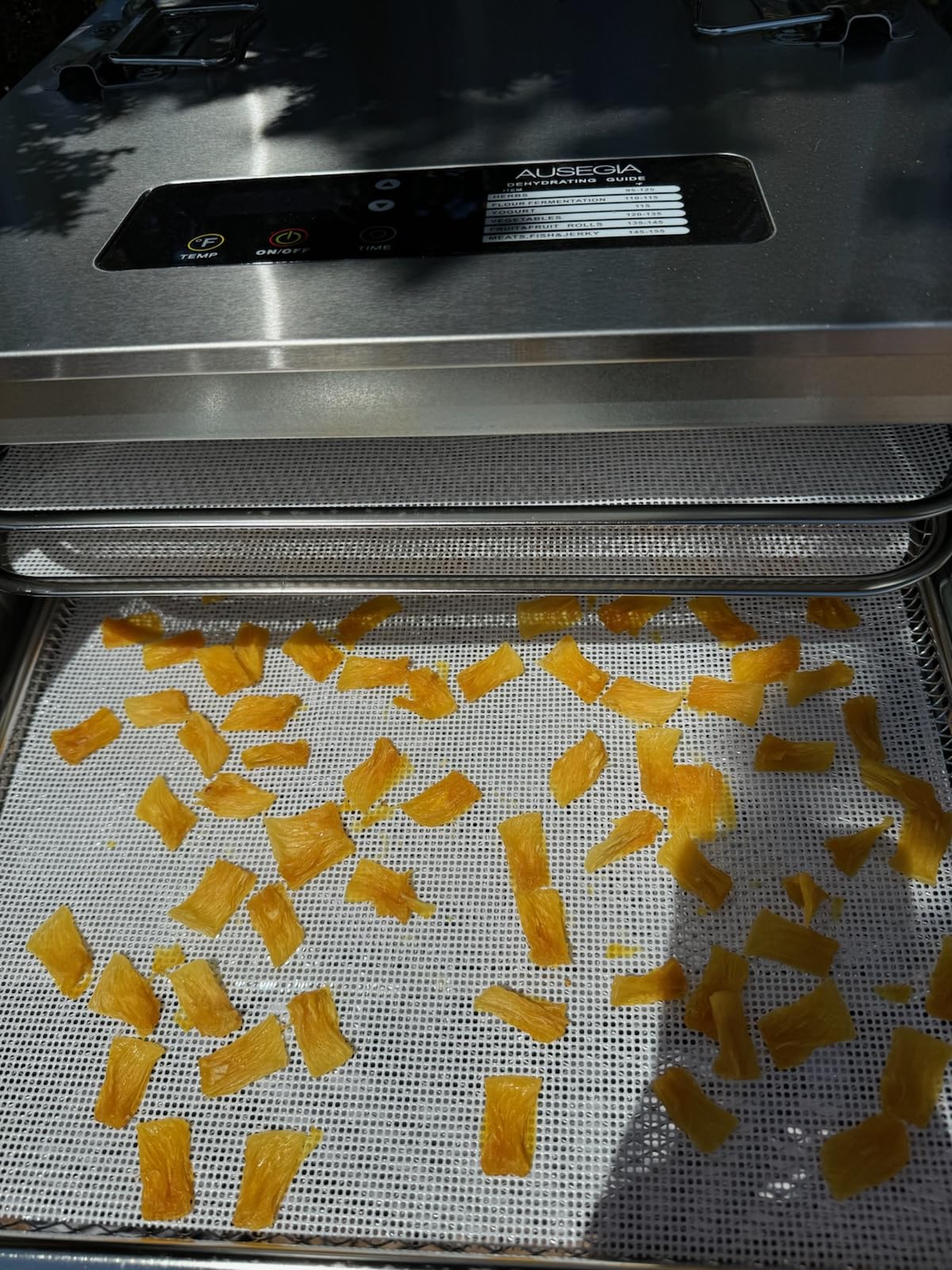
Accessories are unusually practical: a drip tray, six silicone pads, a non-stick sheet, a hanger with 12 hooks and silicone gloves. The hooks let you hang strips vertically, which shortens drying time on thicker cuts.
Longer runs and uneven middle shelves
Owners report cycles running roughly 18 to 20 hours at 175 degrees Fahrenheit, which is longer than several smaller machines here. The 1200W element is spreading its output across a much larger chamber, and a bigger chamber with the same food mass always takes longer to pull water out evenly.
Middle trays also dry less evenly than the top two on some loads and may need swapping. That is the one complaint that would push a person who hates tray rotation away from this machine, and it is worth weighing against the sheet size you gain. The unit is 120V 60Hz and specified for the USA and Canada only.
Who should buy it and who should not
Buy it if you make fruit leather, dry large batches of vegetables, or want big flat racks that fit full-width strips. The 22.67 square feet figure means fewer overnight cycles for a heavy harvest, and the drip tray keeps wet produce from pooling under the racks.
Pass if you want the shortest possible cycle time, need very quiet running in a bedroom-adjacent space, or are outside the USA and Canada. Set aside a full day for a heavy load rather than planning around an overnight run.
7. Septree 18-Tray – Best for Continuous Commercial Runs
Septree Commercial Food Dehydrator 18 Trays, 2000W Large Capacity 34.42ft² Food Dryer Machine for Jerky, Meat, Fruit, Herbs, Full Stainless Steel Industrial Dehydrater Biltong Maker
- Largest drying area in the group at 34.42 sq ft
- 2000W element rated for continuous round-the-clock runs
- 3-year after-sales service
- Includes hanging racks and 20 hooks for vertical jerky
- Very tall at 29.53 inches
- so plan the location carefully
- Highest power draw in the group at 2000W
This is the only machine in the group rated for continuous 7 by 24 hour operation, and that rating is the entire reason to buy it. Everything else about the design follows from it: a 2000W element, an 18-tray stack, a horizontal airflow system and a 3-year service commitment.
Thirty-four square feet of usable area across 18 trays at 15.67 inches is more drying space than any other machine in this group, and it is the difference between a weekend of stacking and one long unattended run. If you are drying a season of garden surplus, a run of venison, or producing for sale, that gap is the whole case for spending up.
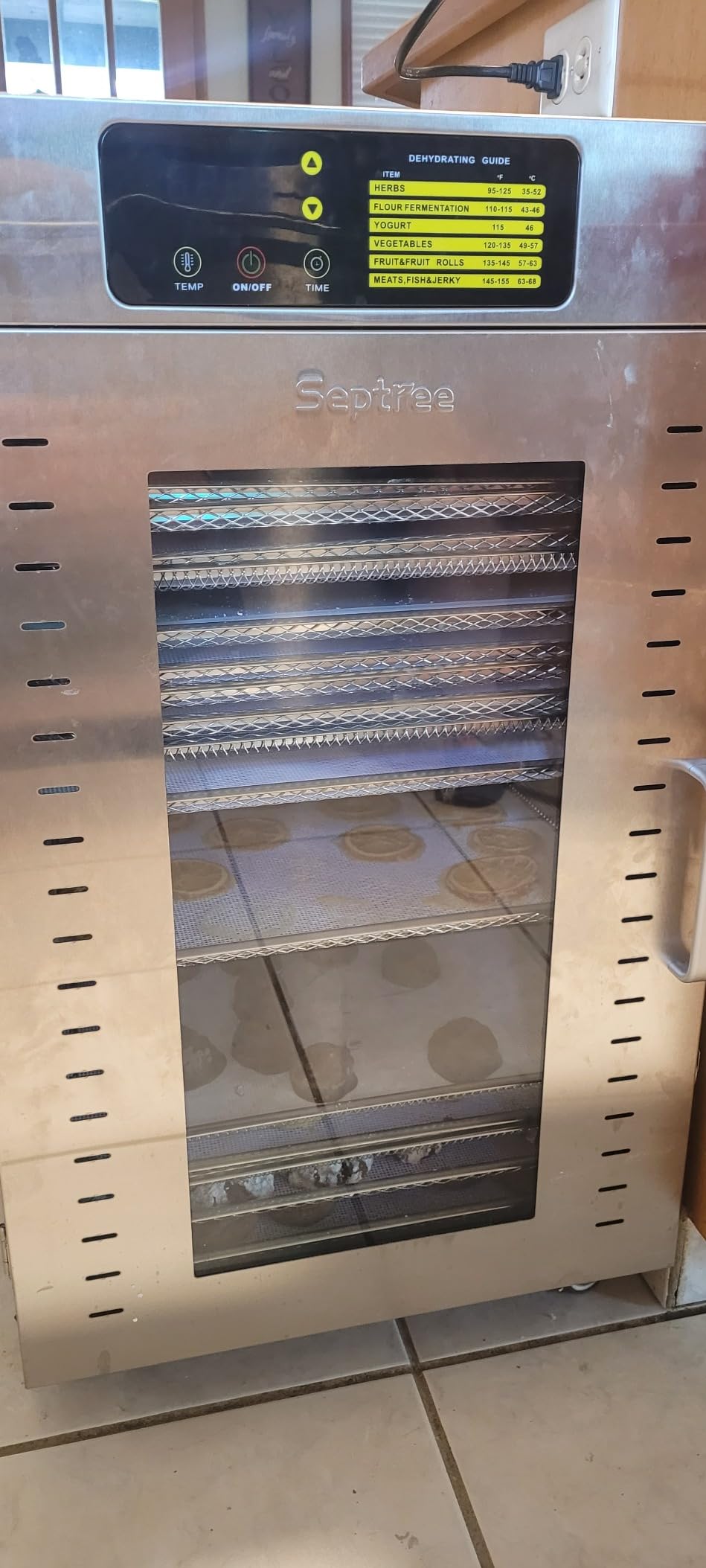
Digital presets cover 70 to 190 degrees Fahrenheit with an integrated half-hour to 24-hour timer and automatic shut-off, plus overheat protection. A glass front door lets you watch several shelves at once without opening the chamber and losing heat, which matters over a two-day cycle.
The accessory list is closer to a commercial kit than a home one: fruit roll trays, hanging racks with 20 hooks, non-stick sheets, a drip tray, gloves, storage containers and a recipe book. The stainless body and liner are both dishwasher safe, and everything is BPA-free food-grade material.
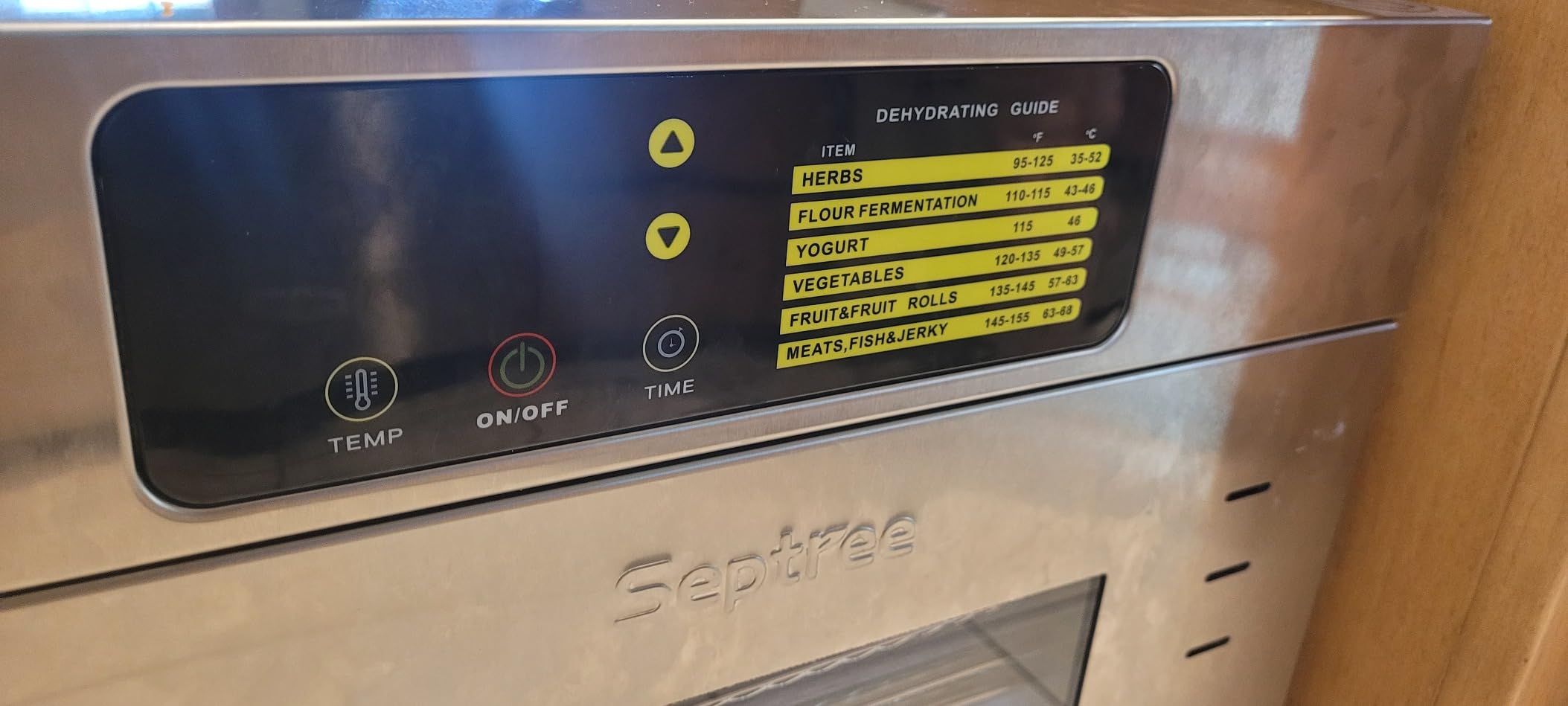
Footprint and power are the real decisions
At 29.53 inches tall by 21.46 deep and 17 inches wide, this does not live on a counter in a normal kitchen. It needs a dedicated stand, a garage shelf or a laundry-room surface, and you should confirm ceiling clearance before it arrives. That single measurement eliminates it for a lot of kitchens before any feature gets considered.
The 2000W draw is also the highest here, and it belongs on a dedicated circuit rather than an extension chain. If you are running long cycles back to back, the power draw is the running cost you are trading for throughput. The unit itself is rated for that duty, which is exactly what a lighter home machine is not.
Who should buy it and who should not
Buy it if you are drying in bulk regularly, need to run a machine through multi-day cycles, or are producing at a level where a failed fan motor would cost you a season. The 3-year cover and continuous-run rating are the strongest reliability signals available in this category.
Pass if you have a limited kitchen and a modest harvest, since a 5-tray to 9-tray machine covers occasional use at a fraction of the space and power. Before the first load, run the burn-off cycle that all new stainless units need, and check the full tray count on arrival.
8. Excalibur 8-Tray – Best for a Compact Counter Footprint
Excalibur Food Dehydrator Select Series for Jerky, Fruit, Vegetables, Herbs, Pet Treats with Adjustable Temperature Control, 8-Tray
- Compact body at 16.5 pounds that still holds 8 trays
- Hyperwave Pulse airflow dries evenly without rotation
- 80-hour timer is the longest in this group
- Glass French doors for progress checks
- Fewer trays than most machines in this roundup
- Chrome-plated racks rather than solid stainless
- 165F ceiling and a 1-year warranty
The Excalibur is among the most compact bodies on this list and the one that most rewards careful reading. Eight trays sounds thin next to 12 or 18, but the body measures 17.32 by 13.39 by 14.08 inches and weighs 16.5 pounds, so it clears under-cabinet spaces and moves between rooms without being a chore.
It also carries the longest timer here, with a digital setting up to 80 hours. That range answers the complaint owners raise most often about shorter cycles, where a multi-day herb or whole-vegetable run has to be restarted instead of set once and forgotten.
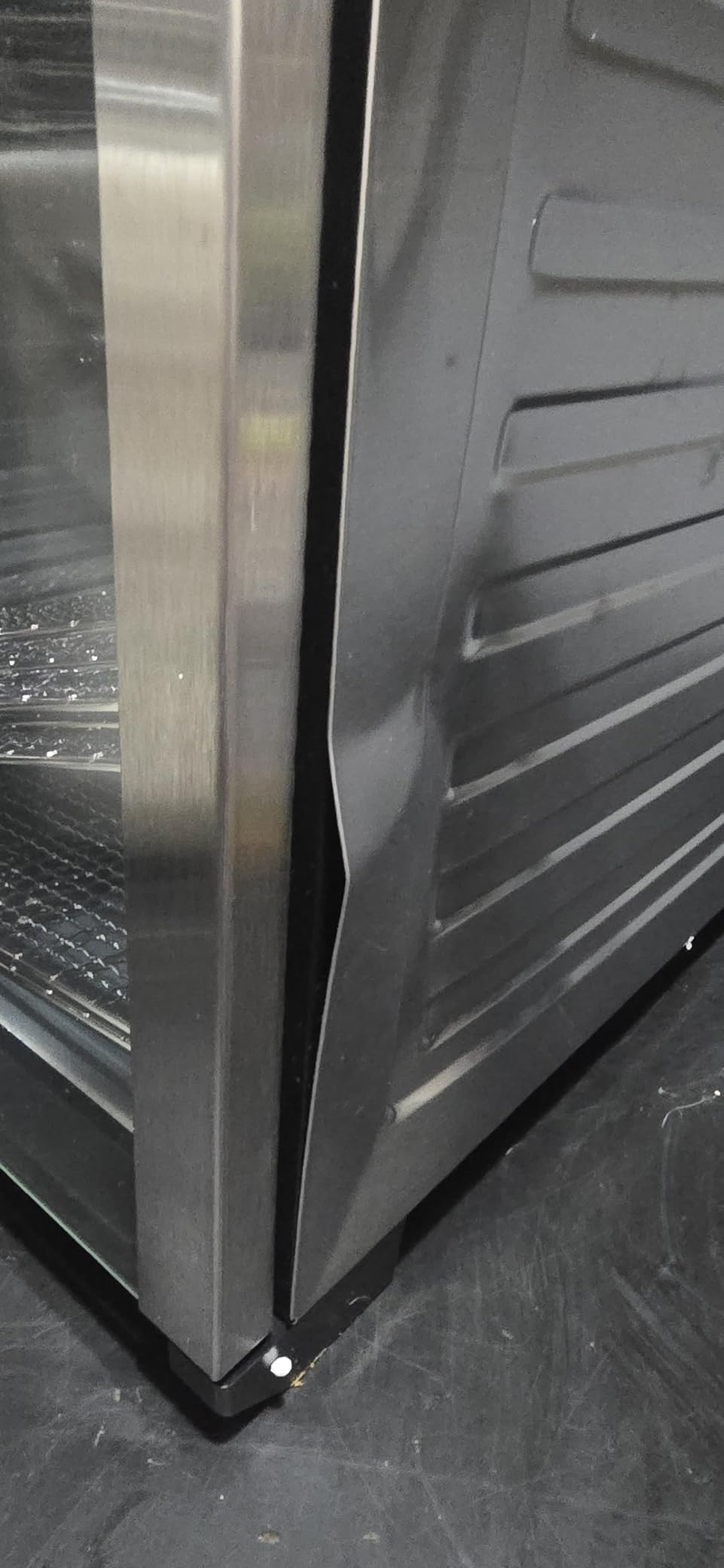
Hyperwave Pulse technology with Horizontal Parallax Air Flow is the brand’s version of the rear-fan layout the bigger machines use, and owners report even drying without tray rotation. A polypropylene mesh screen and a crumb tray are included, and the glass French doors let you check the load from both halves of the chamber.
Temperature runs 85 to 165 degrees Fahrenheit on an intuitive control panel. For fruit, herbs, vegetables and pet treats, which is most of what home users dry, 165 degrees is entirely workable. It is a limit only if you are deliberately chasing harder, faster drying.
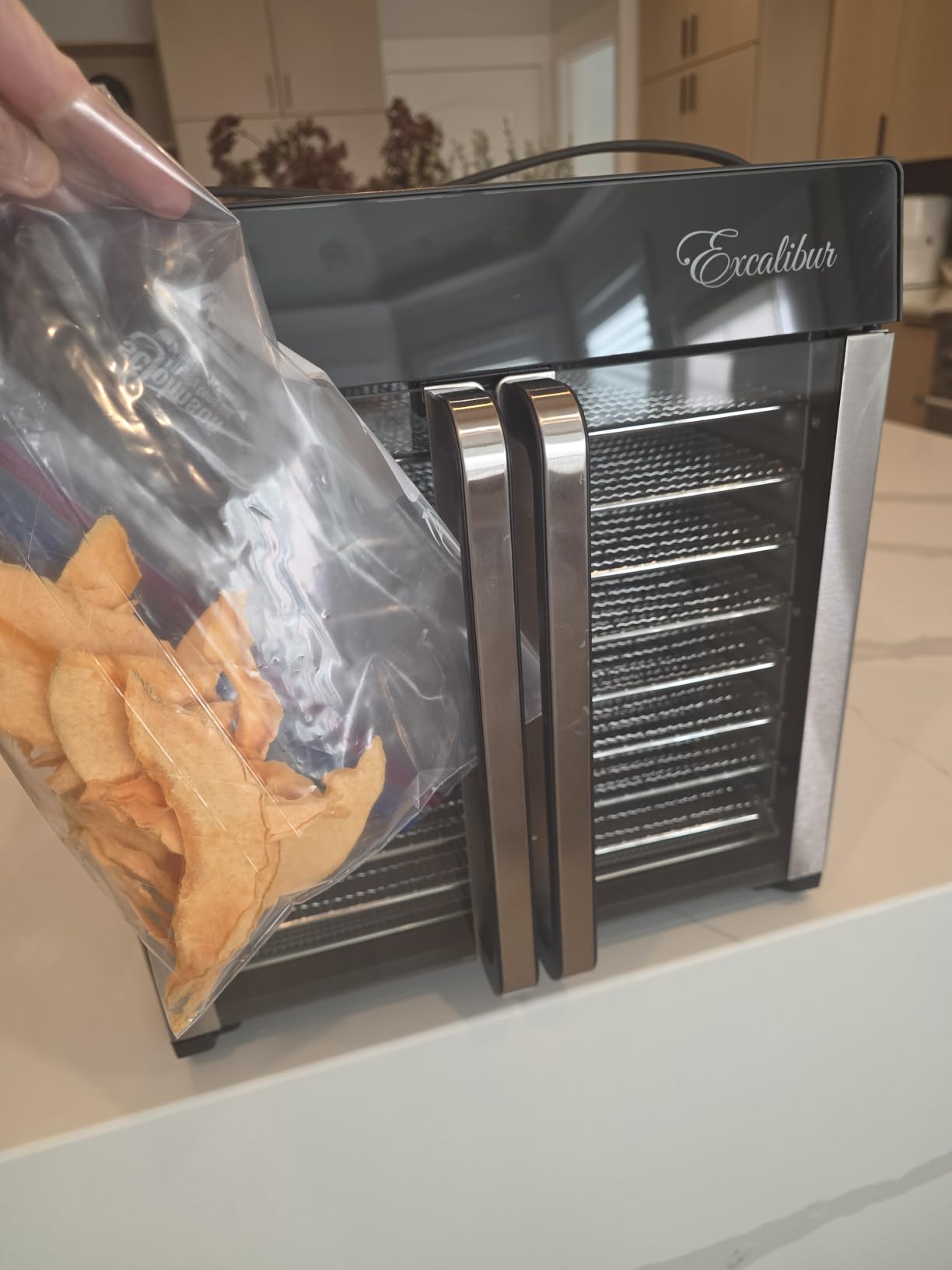
Plated racks and a one-year cover
The racks are chrome-plated rather than solid stainless. That is a meaningful downgrade for anyone running knife work across the trays every week, since plating wears through first, and it is the main quality gap between this machine and the all-stainless options here.
The one-year manufacturer warranty is also the shortest stated cover in the roundup. For a 16.5 pound appliance with a fan and heater that see continuous use, three years would be more reassuring, and that is worth weighing before you commit.
Who should buy it and who should not
Buy it if your drying happens a few times a week rather than every day, if counter space is the binding constraint, or if you need a long timer for herb runs. Excalibur is repeatedly named on r/dehydrating as one of the safest general picks, and this is the model that keeps that name attached to a small footprint.
Pass if you are clearing a garden surplus or producing for sale, where eight trays means too many cycles. If you do choose it and the trays show plating wear, plan on replacing the rack set rather than living with it.
9. OLIXIS 8-Tray – Best for a Published Per-Tray Weight Limit
OLIXIS Food Dehydrator Machine, 500W Jerky Dehydrators with 8 Stainless Steel Large Trays, 185°F Temperature Control & 24H Timer Food Dryer for Fruit Meat Herb Dog Treats, Silver
- Only machine here publishing a 3.3 lb per-tray weight limit
- Stainless racks with an 8.2 sq ft total area
- Under 45 dB running with a built-in light and 48-hour timer
- 185F ceiling gives headroom over 165F compact models
- Lowest 500W wattage here
- so full loads take longer
- Smallest total drying area of the stainless models
- Review base of 119 is the thinnest in the group
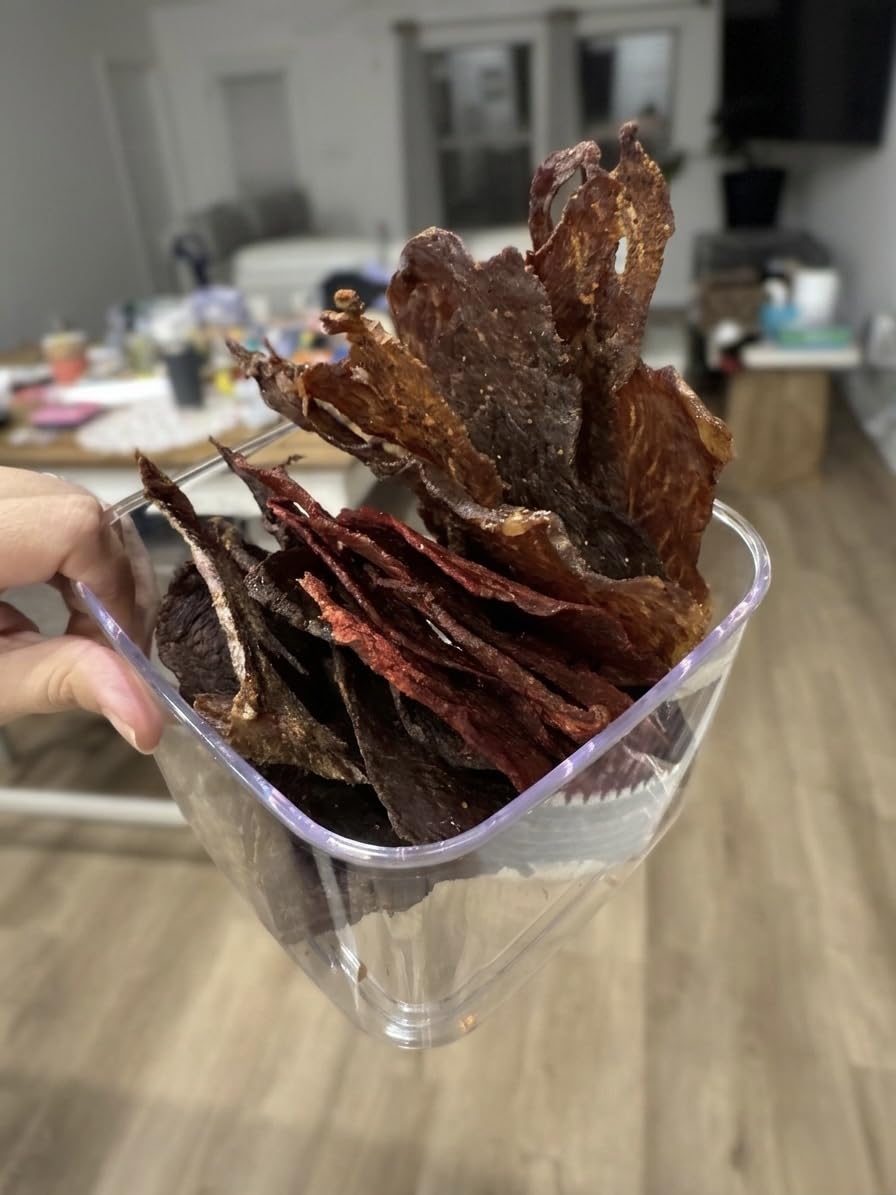
Most manufacturers refuse to publish how much weight a tray holds, which makes load planning guesswork. OLIXIS is the exception here, listing 3.3 pounds per tray across 8 stainless racks at 11.7 by 12.6 inches, for a stated total of 8.2 square feet. That is a number you can plan an actual load around.
It also runs at under 45 dB, among the quietest in the group, with a built-in interior light and a 48-hour timer. If your dehydrator runs in a room where conversation or sleep matters, that operating figure is the whole buying case.
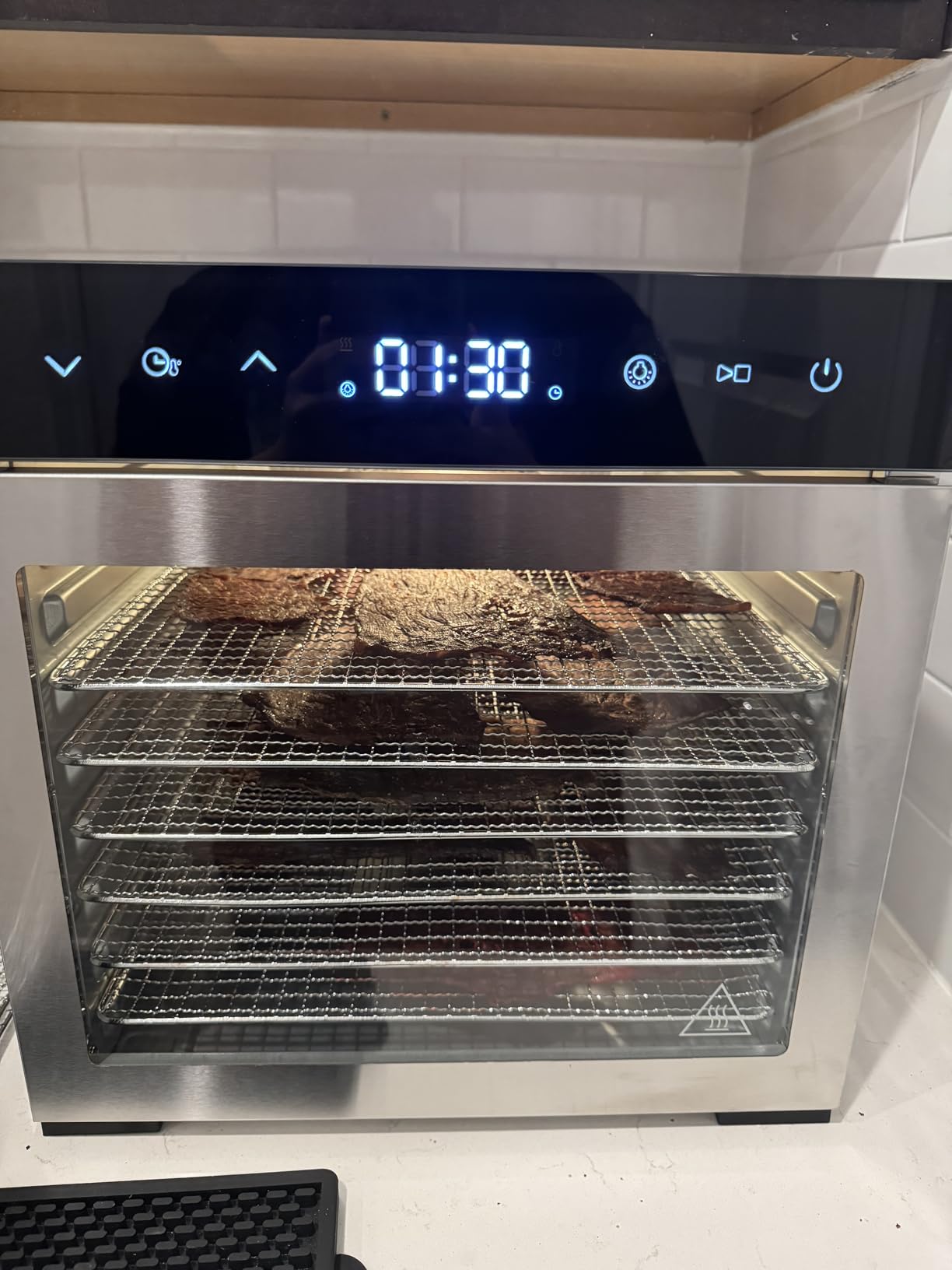
The 500W element is the lowest draw here by a wide margin, and that is the trade-off. A small element in a small chamber heats quickly and runs cheaply, but a fully loaded chamber takes longer to pull water out than the 1200W and 2000W machines with much more air to move.
Temperature reaches 185 degrees Fahrenheit, which is 20 degrees above the compact models with 165 degree ceilings and closer to the commercial range. Horizontal airflow with a dedicated drying fan distributes heat across the racks, and overheat protection is built in.
Where the 500W element shows
Owners attribute slower drying directly to the wattage, and at 8.2 square feet this is the smallest stainless-bodied chamber in the group. If your batches are small and frequent, that is a fair trade. If you are working through a harvest, the cycle time adds up quickly compared with the Ausegia or Septree.
The other consideration is evidence. At 119 reviews this has one of the thinnest review bases of the ten, and in a category where fan motors and heating elements are the known failure points, a larger sample gives you a better read on long-term durability. The 185 degree ceiling and the quiet running are real advantages; treat the reliability picture as less settled.
Who should buy it and who should not
Buy it if you want a documented per-tray weight limit, very quiet running, and a genuine 185 degree ceiling on a compact body. It suits a small household that dries in measured loads rather than bulk harvests.
Pass if you need more than 10 square feet of rack space, if cycle time is your main frustration, or if you want a deep review base behind your purchase. At 8.2 square feet this sits closer to a serious starter unit than a large-batch machine.
10. HOPERAN 16-Tray – Best for Preset Programs and Tray Count
HOPERAN 16-Tray Stainless Steel Food Dehydrator, 800W with 4 Presets
- Highest tray count of any 800W machine here
- Four presets for jerky
- fruit
- vegetables and flowers
- 195F ceiling is among the highest in the group
- Dual 800W rear fans with 360 degree airflow at or under 45 dB
- Narrow 11 x 8 trays hold less per layer than 15 inch squares
- Tall 20.08 inch body at 27.5 pounds
- Review base of 117 is the smallest here
The highest tray count on the list comes with a trade-off that the specs make obvious: 16 racks measuring 11 by 8 inches. That is the smallest rack footprint of any 16-tray machine, so you get more shelves to stagger loads across but less total square footage than the 10-tray Cosori.
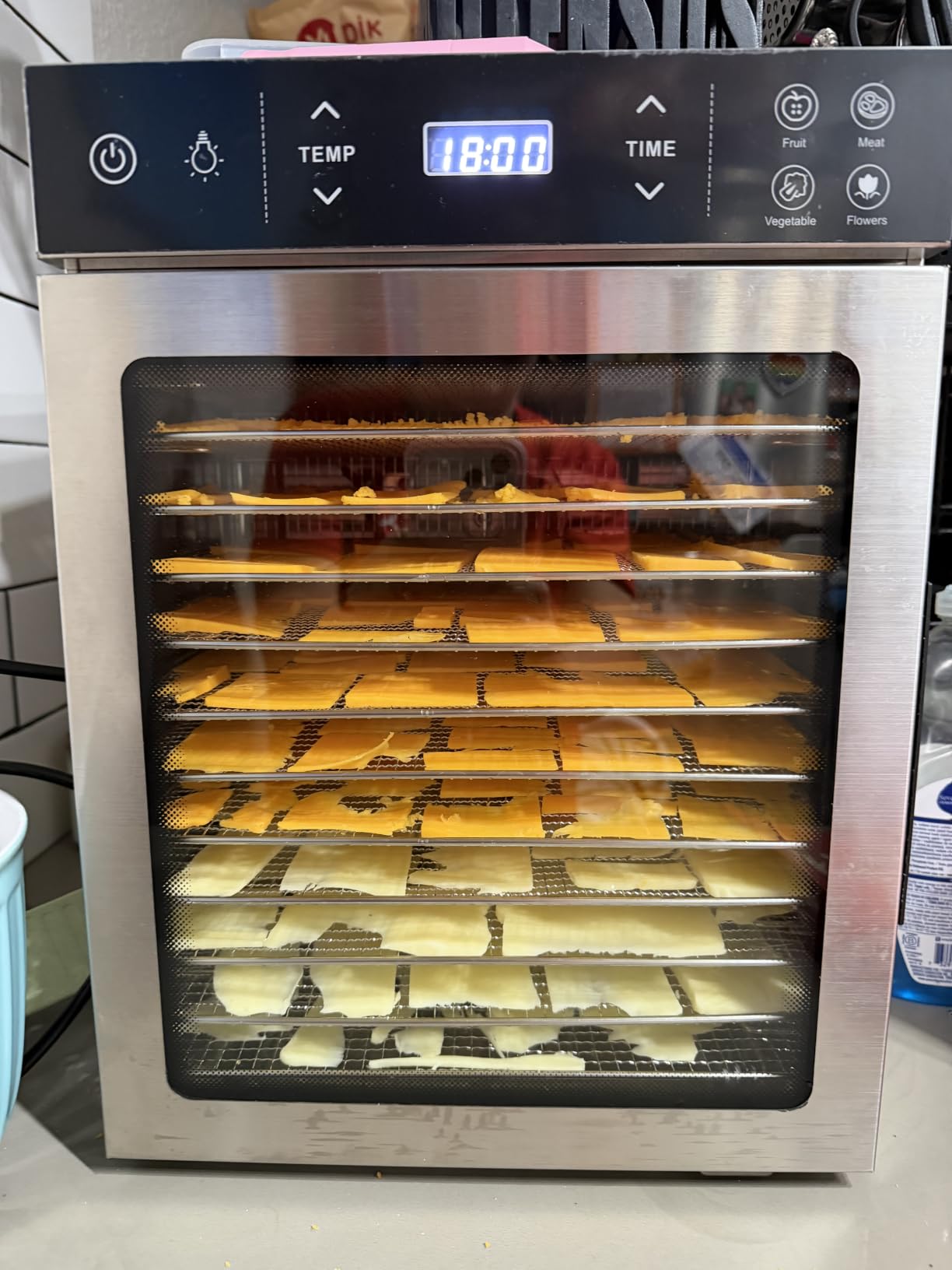
What you gain instead is organisation. Four presets for jerky, fruit, vegetables and flowers mean a beginner can set a load correctly without learning the temperature range, and the automatic power-off at the end of the cycle removes one decision from an overnight run.
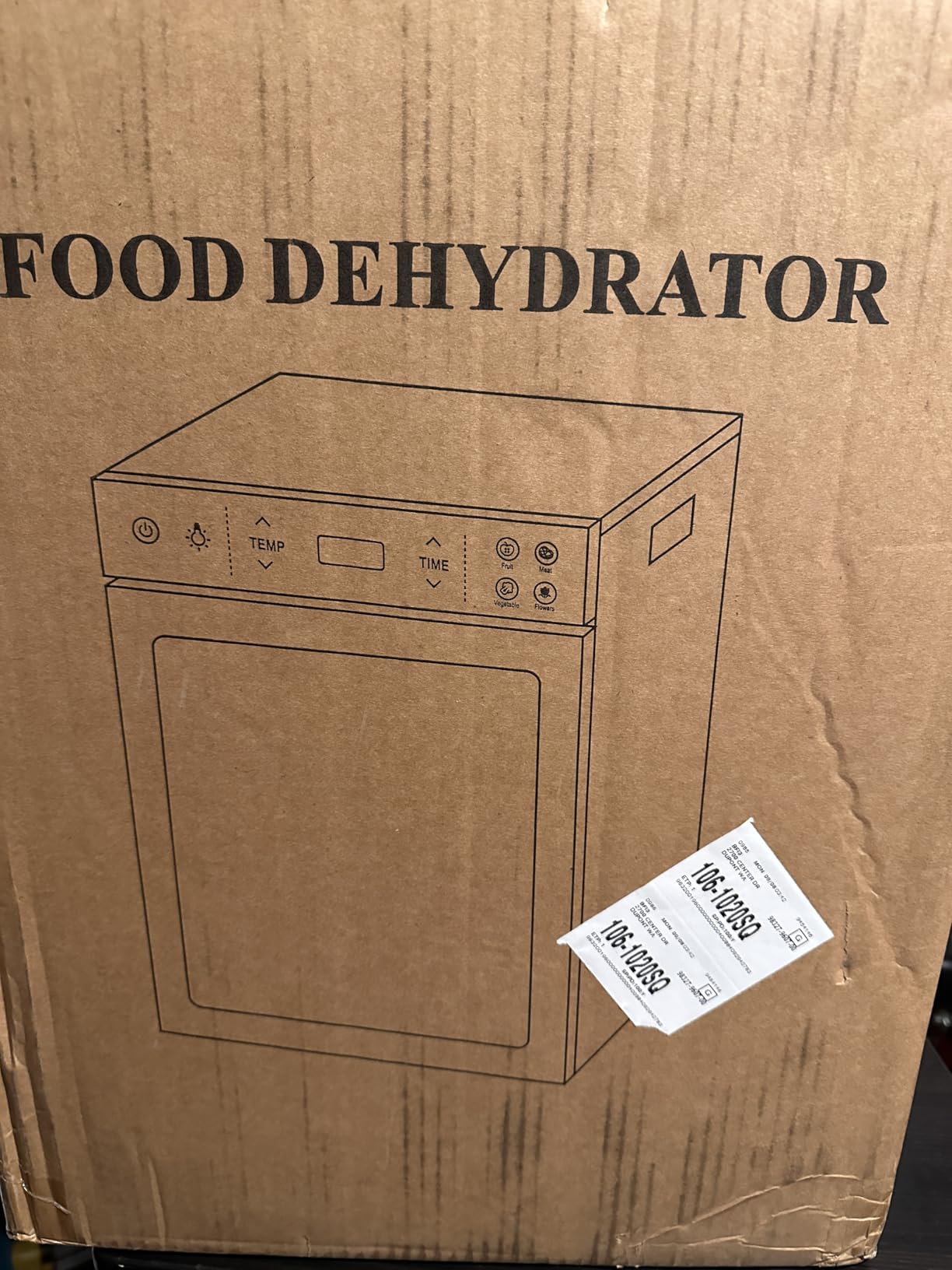
Two 800W rear-mounted fans deliver 360 degree horizontal airflow, claimed by the manufacturer to dry 30 percent faster than a single-fan arrangement. Operating noise is rated at or under 45 dB, which puts it alongside the OLIXIS as the quietest running here, and there is a glass door and interior light for monitoring.
The complete kit includes 16 trays, two mesh screens, a fruit roll sheet, a drip tray, a recipe book and silicone gloves. The drip tray matters more than it sounds on wet produce loads, because a full chamber of tomatoes or berries will release a surprising amount of liquid partway through a run.
Narrow racks, tall body, thin review base
An 11 by 8 inch rack limits the width of a fruit leather sheet and the length of a full jerky strip laid side by side. If your recipe depends on wide flat sheets, the Ausegia’s 15.75 inch squares serve you better despite having four fewer shelves.
The body is also 20.08 inches tall at 27.5 pounds, so this is a tall machine that stays put once placed. And with 117 reviews it has the smallest sample here, which matters most for the two components that fail first in this category, the fan motor and the heating element.
Who should buy it and who should not
Buy it if you want the most shelves to stagger small loads across, if preset programs matter to you or to anyone else who will use the machine, or if you want a 195 degree ceiling on a dual-fan body at a modest 800W draw.
Pass if you need maximum square footage per tray, if a tall narrow body does not fit your space, or if you want a deep review base. For a single weekly jerky run this handles the job well, but a harvest will finish sooner on the Cosori or the Septree.
How We Picked These Dehydrators
The ranking rules were fixed before any machine was scored, and the first rule did most of the work.
Usable drying area outranks tray count. We multiplied published tray dimensions where they were available and treated any machine that would not publish them as unquantified rather than assuming it was large. That rule alone reshuffles the list, because it moves the Cosori and the Ausegia up and the 16-tray HOPERAN down.
Airflow layout decides whether large loads are practical. Rear-mounted fans with horizontal airflow let a full chamber dry without rotation. Vertical airflow designs push air down through stacked shelves, and the middle trays end up needing a swap, which is the task that makes people avoid large machines.
Temperature ceiling and timer length were scored against real food needs. 165 degrees covers standard jerky drying, but herbs, biltong and tough vegetables want 180 to 190. Timer length matters for long herb and whole-vegetable runs where a 24-hour cap forces a restart.
Review volume was used as a reliability proxy, not a quality score. High review counts give a better read on failure patterns over years, and thin samples on models with unproven fan and heating element suppliers are worth knowing about before you buy.
Warranty length, wattage for electricity planning, noise rating, and whether trays are solid stainless, plated or plastic completed the picture. Forum discussion on r/dehydrating shaped which complaints we weighted most heavily, particularly tray rotation, uneven middle shelves and parts availability.
Buying Guide: What Actually Matters for Large Batches
Square feet beat tray count every time
Do the multiplication before you fall for a tray number. The two machines most likely to disappoint you at the same tray count are the ones with the smallest racks, and the two most likely to impress you are the ones with oversized square trays. Only four machines in this roundup publish total drying area outright, which is why the sizing section above leads with the calculation.
Horizontal airflow is the feature that saves you work
A rear-mounted fan pushing air across every shelf means a loaded chamber dries evenly without a mid-run swap. A top-mounted or centre-column fan pushes air vertically past each tray in turn, and the middle shelves consistently dry last. Every machine here claims a horizontal layout, but owner reports are where they separate: the Ivation is the one to treat carefully, because buyers describe back racks outrunning front racks on some loads. I would not buy a large machine without rear-fan airflow.
Temperature ceiling, and when 165 is enough
The 165 degree ceiling on the Cosori, Magic Mill and Excalibur matches the stated USDA maximum for jerky and handles fruit, vegetables and herbs comfortably. Move up when you are drying herbs at the low end and tough cuts at the high end in the same week, or when biltong or jerky work benefits from more heat headroom. The Ausegia, Septree, Cercker and HOPERAN 16 reach 185 to 195 degrees.
Watts, runtime and what a batch actually costs
Energy use is easy to work out: multiply watts by hours and divide by 1000. A 48-hour jerky run at 800W draws 38.4 kWh, a 24-hour run at 1000W draws 24 kWh, and a 24-hour cycle on the 2000W commercial model draws 48 kWh. The 500W OLIXIS sits at 12 kWh for the same 24 hours. Bigger chambers cost more per cycle, and they buy you fewer cycles.
Wattage also predicts drying speed, because the element has to heat the chamber and the air in it before it starts moving water. A small element in a small chamber is efficient. A small element in a large chamber is slow. Match the element to the chamber size, which is the case for the 1200W Ausegia and the 2000W Septree.
Timer length and how long your food really needs
Most fruit leather takes 6 to 12 hours, fruit slices 8 to 16, herbs 2 to 6, vegetables 8 to 24, and lean meat jerky 8 to 16 at 160 to 165 degrees. Plant-based meat and thicker game cuts run longer. A 24-hour timer covers nearly all of that; it is whole thick vegetables, long herb runs and tough wild game that push past it, and those are the loads that benefit from the Magic Mill’s 48 hours or the Excalibur’s 80.
Stainless grade and tray material
304 stainless is the grade worth paying for on food-contact trays, and it is what the Cosori and the HOPERAN 12-Tray specify. Chrome-plated racks such as the Excalibur’s wear through with repeated knife work. Plastic racks wash easily and weigh less, but they scratch and will not take oven crisping. Whichever you choose, check that silicone fruit roll sheets and mesh screens match your exact tray dimensions before buying, since a mismatch makes them useless.
Counter space, noise and where the machine lives
Measure the location before you order. The Septree stands 29.53 inches tall, the Cercker will not clear standard wall cabinets, and the Cosori is both the heaviest at 35.8 pounds and the deepest at 21.3 inches. Leave clearance behind the unit for rear vents, and consider that large machines end up in a garage, basement or laundry room rather than on the counter.
Noise is a live decision if the machine runs overnight. The OLIXIS and the HOPERAN 16-Tray run at or under 45 dB, while the Cercker and Ausegia sit at or under 50 dB. If the machine lives in an open-plan kitchen, a lit interior chamber that has no off switch, as on the Cercker, is worth considering before you commit.
Cleaning, burn-off and parts
Dishwasher-safe trays are the single biggest quality-of-life feature in this category, and all but one of the models here has them. For a fully loaded wet-produce run, budget for emptying the drip tray partway through rather than waiting for the end.
Run a burn-off cycle on any new stainless machine, an empty chamber at its highest temperature for an hour or so, before your first real load. Owners repeatedly report a faint smell on new stainless units that clears after the first few runs, and you do not want that flavour in your first batch.
Lastly, think about parts. A fan motor or heating element is the most common failure in this category, and availability for replacement trays, fans and elements varies widely between brands. A longer warranty is partly a signal that the brand expects to supply parts for years. If you plan to produce for sale, also check your local cottage food rules and the throughput your state allows before scaling up. Pairing a dehydrator with a good vacuum sealer is the usual next step for shelf-stable storage, and our jar attachment sealer picks cover the canning side.
Frequently Asked Questions
What is a good heavy-duty food dehydrator?
A good heavy-duty food dehydrator has roughly 12 square feet or more of usable drying space across six or more full-size trays, a rear-mounted fan for horizontal airflow so loaded shelves do not need rotating, and a heating element matched to the chamber size. Look for solid stainless or 304 stainless trays, a 48-hour or longer timer, automatic shut-off and overheat protection, and a published tray dimension so you can plan loads.
How many pounds of food can a large dehydrator dry at once?
Multiply the number of trays by the weight you can load per tray. The published figure to use is the one the manufacturer states: OLIXIS, for example, lists 3.3 pounds per tray on 11.7 by 12.6 inch racks. A 10 square foot machine with racks of that size holds around 8 trays and a comparable total load, while a 22 square foot commercial machine with 15.75 inch square trays holds far more in a single cycle. Allow for airflow gaps and keep slices thin.
Do large dehydrators need tray rotation?
Not if they use a rear-mounted fan with horizontal airflow. Machines like the Magic Mill 15-Tray, Cercker 12-Tray, HOPERAN 12-Tray, Ausegia, Septree and Excalibur push air across every shelf, so a full chamber dries evenly without a mid-cycle swap. Designs with a top or centre fan move air vertically, and the middle trays dry last, so those loads do need rotating.
How much electricity does a food dehydrator use?
Multiply the wattage by the hours and divide by 1000. A 500W model on a 24-hour cycle uses 12 kWh, an 800W model on a 48-hour cycle uses 38.4 kWh, a 1000W model on 24 hours uses 24 kWh, and a 2000W commercial unit on 24 hours uses 48 kWh. Bigger chambers cost more per cycle but finish a harvest in fewer cycles.
What is better than a dehydrator?
It depends on the food. A low-temperature freeze dryer keeps more colour, flavour and nutrients in fruit and finished meals, but costs several times more and takes far longer. Canning in a pressure canner is faster for high-acid fruit and pickles but does not apply to low-acid vegetables or meat. Freezing is still the best method for short-term storage. For shelf-stable jerky, herbs and fruit leather at scale, a dehydrator remains the most practical choice.
Is a stainless steel dehydrator better than plastic?
Stainless lasts longer, holds heat more evenly, tolerates knife contact and repeated dishwasher cycles, and does not absorb odour. Plastic racks are lighter, cheaper and wash easily, but they scratch over time and will not take oven crisping. If you are clearing a garden harvest or producing for sale, stainless is worth the premium. For occasional fruit and herb work, plastic racks are perfectly serviceable.
Which Dehydrator Is Right for You?
If you want the best all-round large-batch dehydrator in 2026, the Magic Mill 15-Tray is the one to buy: more racks than every machine here except the 18-tray Septree and the 16-tray HOPERAN, rear-fan airflow that skips rotation, dishwasher-safe stainless and a 48-hour timer, backed by the largest review base of the ten.
For the most food per single load, choose the Cercker 12-Tray. It reaches 190 degrees, owners report 6 to 9 pounds of jerky in one go without swapping shelves, it runs quietly, and it carries the longest warranty alongside the commercial Septree.
If raw drying area is what you are trying to get the most of, the Ausegia’s 22.67 square feet across 15.75 inch square trays beats every other 12-tray machine here, and the Septree’s 34.42 square feet goes further again for a full harvest or a production run.
If your constraint is the room itself, the Excalibur 8-Tray fits under cabinets at 16.5 pounds and still offers the longest timer in the group. If your constraint is noise in a lived-in space, the OLIXIS runs at under 45 dB with a published 3.3 pound per-tray limit so you can size each load.
Before any of them arrive, measure the spot for depth and height, run a burn-off cycle on a new stainless machine, and check the tray count on delivery. Once it is set up, our beef jerky drying guide covers temperature and time for the cut sizes most people start with.