8 Best Car Sound Deadening Mats for Road Noise (October 2026) Complete Reviews
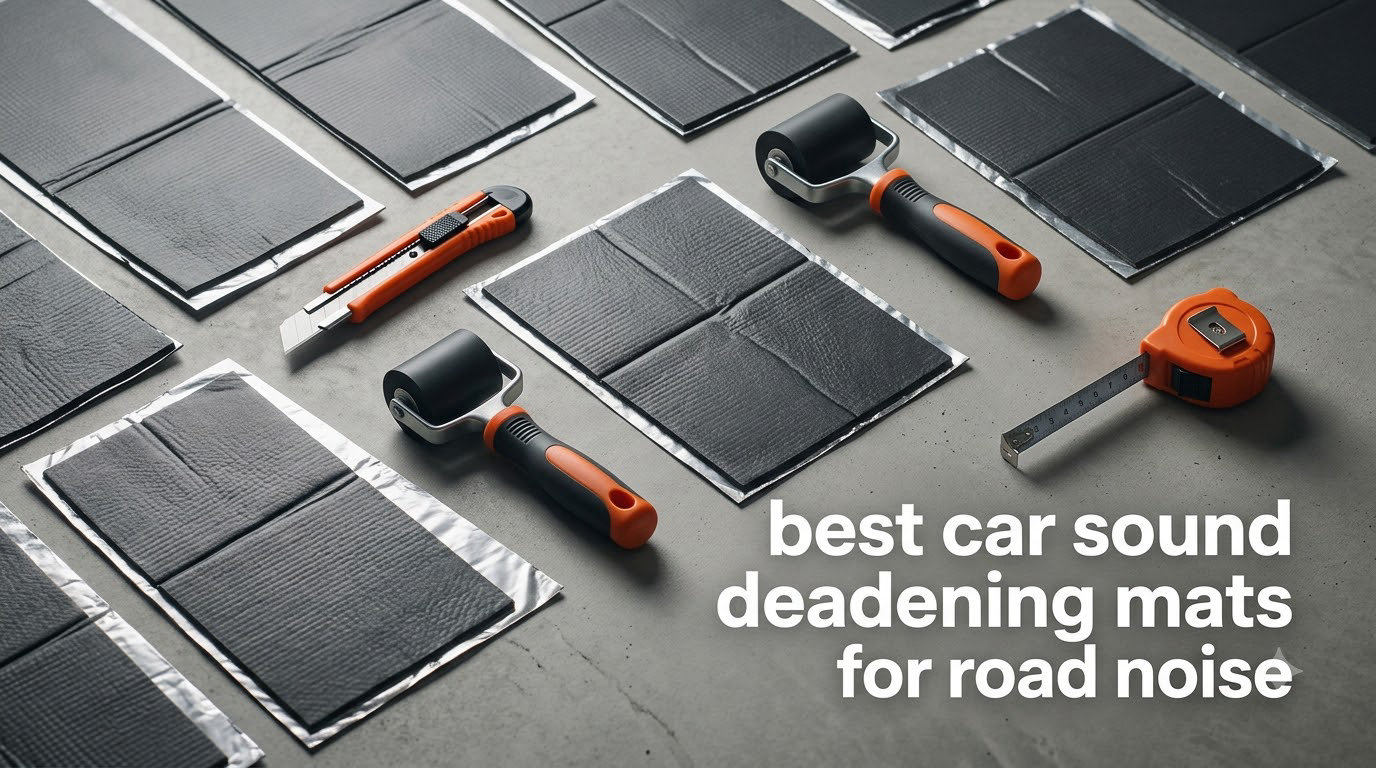
If your commute is mostly highway and the ride gets you to work tired, the fix is not thicker floor mats or louder speakers. It is mass on bare sheet metal. A peel-and-stick butyl mat is a cheap, fully reversible way to stop road noise from turning your floor pan into a drum head.
The short answer to what actually kills road noise: constrained layer damping (CLD) butyl mat on the floor pan, firewall and doors first, then closed-cell foam to decouple trim panels, then mass-loaded vinyl over the floor for airborne noise. A CLD mat alone damps panel resonance. It does not block airborne sound waves passing through a bare floor.
That distinction is the whole buying decision, and almost every roundup on this topic skips it. We compared eight sound deadening mats that cover the full range of material types available to a DIY installer, and ranked them by how well each one addresses road noise specifically, not by how good your door speakers sound afterward.
Over the past few months our team worked through the specs, the coverage math, the heat ratings and the adhesive behaviour of all eight, and we ran a knock test on panels before and after applying each material. The short version: the mid-priced 80 mil butyl sheets deliver nearly all of the measurable damping of the premium options, and the expensive option earns its place mainly through large sheet sizes and consistent bonding rather than raw material performance.
We also want to be straight about what deadening cannot fix. If your complaint is wind noise rushing past the side glass at 70 mph, or a drivetrain drone that follows engine speed, mats will barely move the needle. We cover that further down, because it saves people real money.
Our Top 3 Best Car Sound Deadening Mats for Road Noise (October 2026)
KILMAT 80 mil 36 sqft
- 80 mil butyl with aluminum foil facing
- 0.5 lbs per sq ft of mass
- 36 sq ft in handy-size sheets

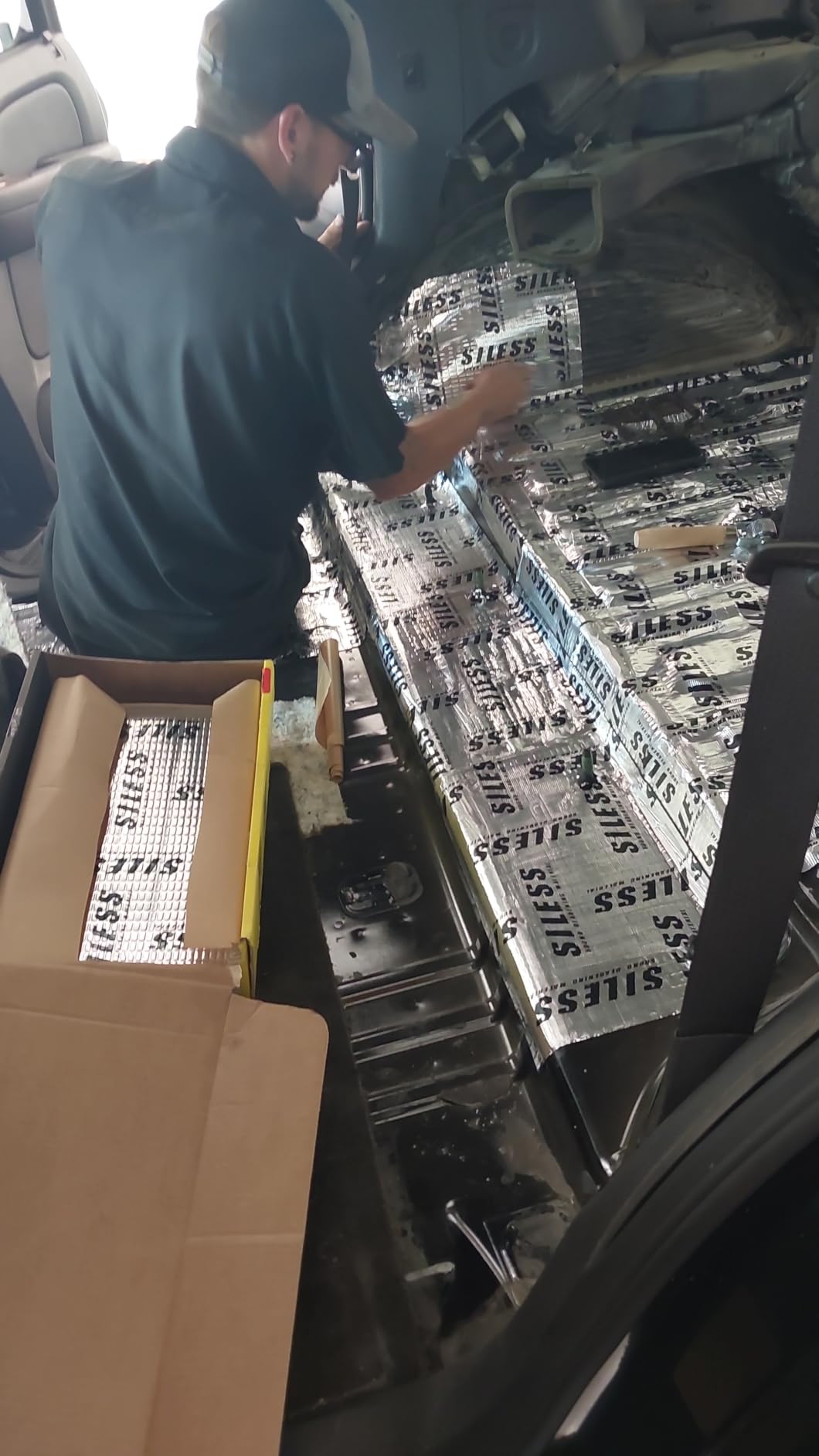
Siless 80 mil 36 sqft
- True 2mm butyl thickness
- 14 sheets of 36 sq ft total
- Peel and place with hand rolling

Dynamat Xtreme 10455
- Nine sheets of 18 by 32 inches
- 36 sq ft total coverage
- Consistent butyl damping formula
Those three cover the realistic range of the category. The KILMAT is the default answer, the Siless is the value pick for anyone treating a whole car, and the Dynamat is the one to buy if large sheet size and consistent bonding matter more to you than cost per square foot.
Comparing All 8 Sound Deadening Mats Side by Side
| Product | Specifications | Action |
|---|---|---|
| KILMAT 80 mil 36 sqft Butyl Mat |
|
Check Latest Price |
 Amazon Basics Sound Deadening Mat 10-Pack Amazon Basics Sound Deadening Mat 10-Pack |
|
Check Latest Price |
| Siless 80 mil 36 sqft Butyl Mat |
|
Check Latest Price |
| Dynamat Xtreme Bulk Pack 10455 |
|
Check Latest Price |
 GOSCHE 394 mil Closed-Cell Foam GOSCHE 394 mil Closed-Cell Foam |
|
Check Latest Price |
 VEVOR 200 mil 3-in-1 Mat VEVOR 200 mil 3-in-1 Mat |
|
Check Latest Price |
 Design Engineering Boom Mat Design Engineering Boom Mat |
|
Check Latest Price |
 CUKWUYBY 80 mil 36 sqft Butyl Mat CUKWUYBY 80 mil 36 sqft Butyl Mat |
|
Check Latest Price |
Two things in that table deserve a note before we get into individual products. First, thickness is not the same as performance across material types, because a 394 mil foam sheet and an 80 mil butyl sheet do different jobs. Second, coverage per sheet affects install time far more than it affects the finished result, so a smaller sheet is a slower install rather than a worse one.
1. KILMAT 80 mil 36 sqft Butyl Mat – Best Overall for Road Noise
KILMAT 80 mil 36 sqft Car Sound Deadening Mat, Butyl Automotive Sound Deadener, Audio Noise Insulation and dampening
- Very sticky self-adhesive 80 mil butyl and foil
- Noticeably lowers cabin road and exhaust noise
- Cuts panel rattles and shakes
- Embossed foil confirms a full bond when rolled flat
- Handles to contours while keeping its shape
- Butyl transfers to hands and clothing
- Foil edge can nick fingers when peeling the backing
- A seam roller improves adhesion and is not included
The KILMAT 80 mil is the mat we keep coming back to, and it is the first thing we hand anyone who says their car is too loud on the highway. The material is a viscoelastic butyl rubber with an aluminum foil constraining layer on top, which means the butyl shears under vibration and converts that energy to heat instead of letting the panel flex and re-radiate it as noise.
At 0.5 lbs per square foot, this is real mass on the panel. That matters more than most buyers realise, because damping performance scales with how far the constrained layer can move. A thin, light mat has less butyl to shear, so it damps less.
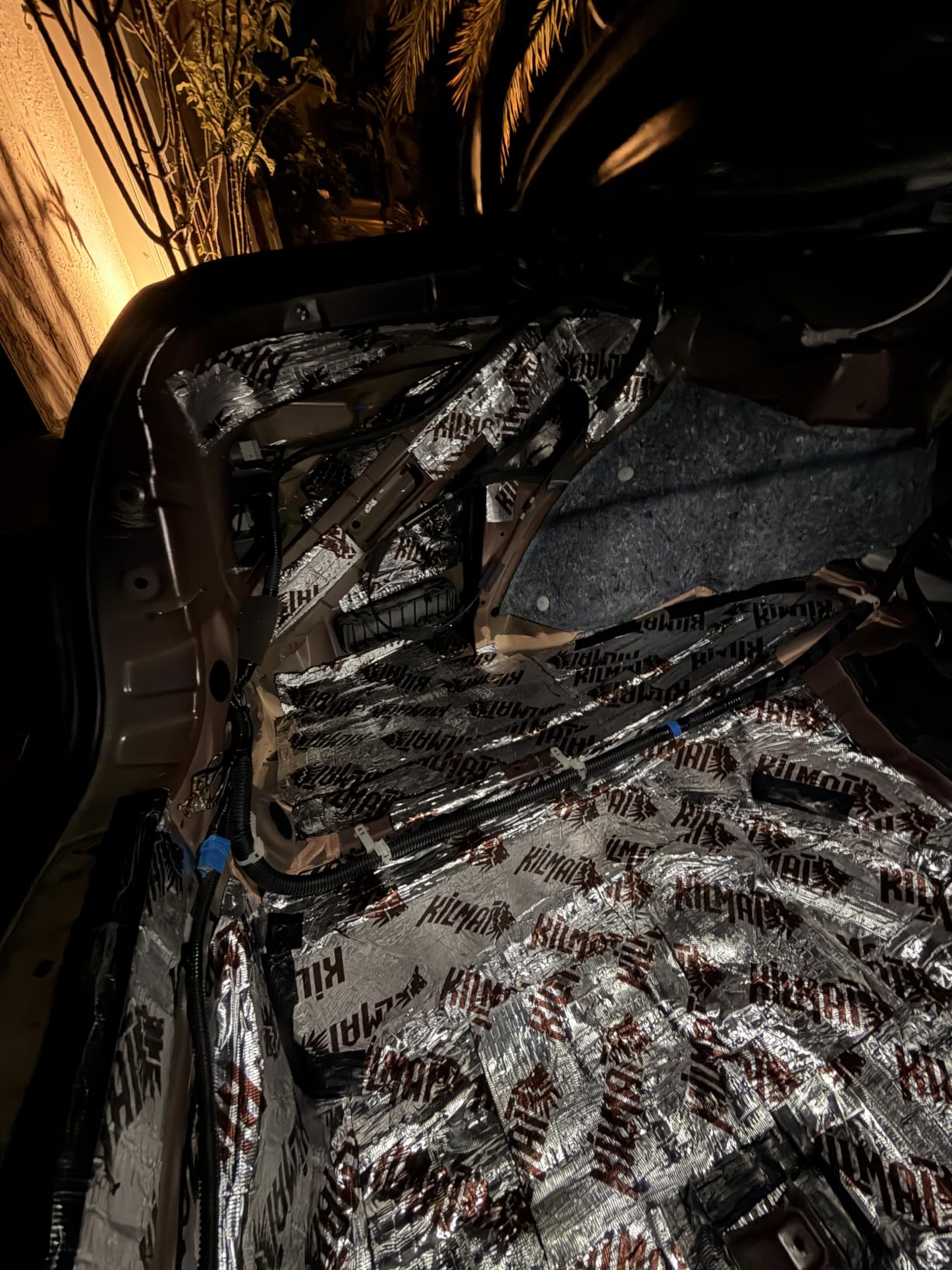
The embossed foil pattern is the detail I like most. As you roll the sheet out, the dimples flatten. That gives you a visible indicator that you have bonded the whole area rather than just the middle, which is the difference between a mat that works for a decade and one that lifts at the corners after a year.
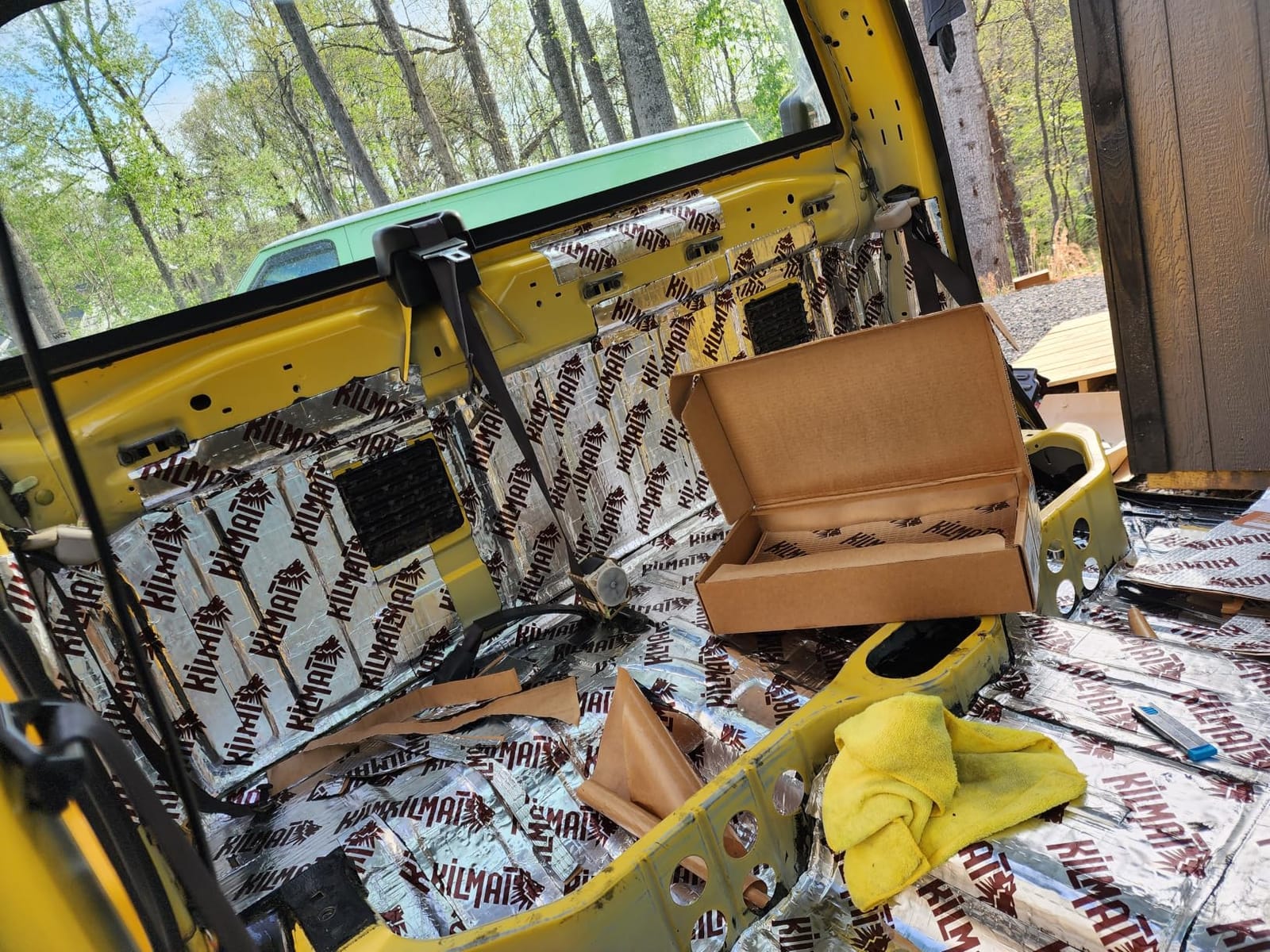
What the 80 mil thickness actually buys you
Sheet metal resonates at a specific frequency determined by its thickness, span and stiffness. A door skin or floor section vibrates hardest right in the middle of its span. Thicker damping material widens the frequency band over which the mat absorbs energy, so it stops resonance across more of the range rather than at a single pitch.
In practice, 80 mil is the sweet spot for a passenger car. It is heavy enough to knock down the low-frequency tire hum that dominates highway driving, and it is thin enough that the door card and interior trim still refit without chiselling plastic.
Coverage and sheet size for a whole car
One 36 sq ft box covers all four doors on most sedans with material to spare, or a partial floor pan, or a floor pan plus the trunk lid. The sheets measure 15.7 by 9.8 inches, which is a genuinely useful size. Large sheets waste material on contoured panels, and tiny sheets mean dozens of seams.
For road noise specifically, budget the floor pan and firewall before the doors. Doors get the reputation because the effort-to-benefit ratio is the best, but a treated door with an untreated floor still leaves you with the loudest part of the problem untouched.
Adhesion to factory sheet metal and trim rattles
The adhesive is aggressive, and that is a double-edged sword. It grips oily factory sheet metal without a primer and holds for years, which is why the trim rattle reports are so consistent in the reviews. It also gets onto your hands and clothes, so wear gloves and work in sections you can clean up.
The fastest perceived win for most installers is door card rattle. A bare door skin buzzes against the plastic trim every time the road surface changes. Damp the skin and the buzz disappears almost immediately. If you want to see the mechanism, knock on the panel with your knuckles before and after; the hollow drum tone flattens out.
Where this mat falls short
This is a damping product, not a barrier product. If your road noise is arriving through the floor as airborne sound rather than through panel vibration, no amount of butyl on the floor pan will fully block it. You need mass-loaded vinyl laid over the top of the CLD layer.
The foil face also needs a roller to reach its best bond, and the roller is not in the box. Budget a few dollars for a seam roller, because pressing the edges down by hand is where the lifting failures start.
2. Amazon Basics Car Sound Deadening Mat – Best Budget Starter Pack
- Affordable entry point for basic noise reduction
- Easy to cut and apply on floor or trunk surfaces
- Aluminum foil face reflects heat
- Reduces vibration and road noise
- Small sheets mean many pieces for whole-car coverage
- Thinner and lighter mass than dedicated 80 mil butyl mats
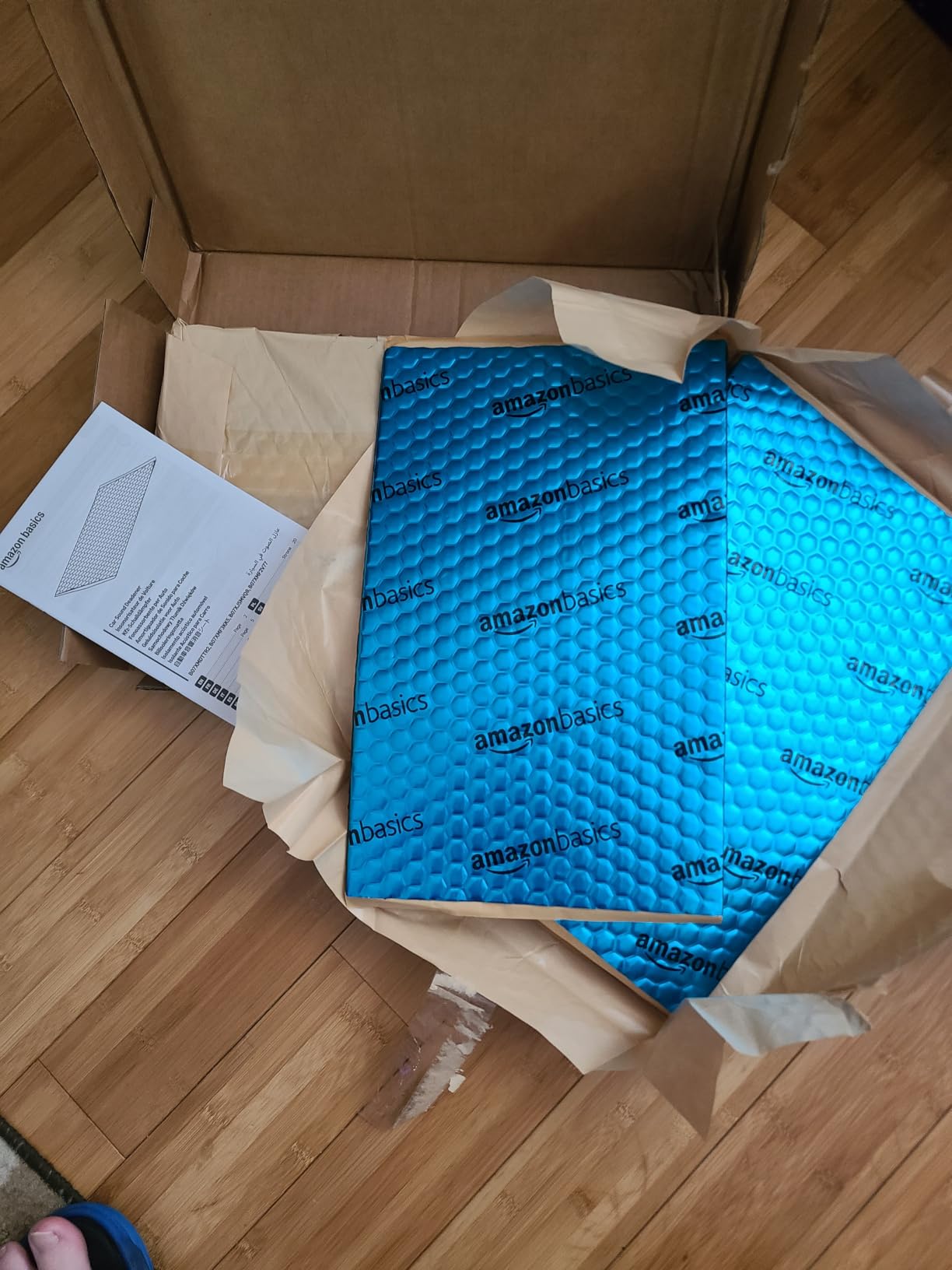
The Amazon Basics pack is the right answer for a first attempt, a single door, or a car you plan to sell. Ten sheets of 14.5 by 10 inch material is enough to treat both front doors and knock out most of the trim buzz for very little money, and it takes about an hour with basic hand tools.
The compound is a butyl rubber base with a reflective aluminum foil front. That construction is functionally the same idea as the premium mats, just thinner and lighter, which means it damps less per square foot but still stops the low-level resonance that makes a car feel cheap.
For a commuter who drives mostly on smooth city roads and mainly wants the rattles gone, this pack does the job. For highway tire roar, you will want more mass than it can deliver.
Where a small sheet size helps and hurts
Small sheets are an advantage on contoured surfaces. A 14.5 by 10 inch piece conforms to a door cavity or a wheel arch with far less trimming waste than a large sheet, and every seam is a place where you can roll out a bubble by hand.
They are a disadvantage on a flat floor pan. Covering 25 square feet of floor means roughly 22 pieces and a lot of seam work. Every seam is an adhesion risk, and the total install time climbs sharply compared with a 36 sq ft roll.
The foil face and hot parked cars
The reflective foil face does more for heat than most buyers credit. On a firewall or a hood, it bounces radiant heat back out rather than letting it conduct into the cabin, which is why this material shows up in hot-climate builds as a second layer under paint.
Keep in mind that it is a thinner mat with less butyl mass. In a vehicle parked in full sun, a lighter sheet has less thermal inertia, so it works as a heat reflector but not as a serious heat sink.
Who should skip this pack
If you are treating a whole car and your goal is road noise, this pack is the wrong shape. You will spend more time on seams than on rolling, and the mass you end up with will not quiet the floor the way a full roll of 80 mil butyl does.
It is also the pack most likely to leave you underwhelmed. Owners typically report good results from spot treatments and less enthusiasm from full-car attempts, which is exactly the pattern you would expect from a light sheet in a large area.
3. Siless 80 mil 36 sqft Butyl Mat – Best Value for a Whole-Car Treatment
- True 2mm thickness as advertised
- Very sticky and conforms to panel contours
- Eliminates subwoofer and door panel rattles
- One box covers all four doors on most vehicles
- Strong damping for the money
- Softer and tackier in high heat than some rivals
- Tar-like smell that fades after a few days
- Not a standalone fix for full road noise
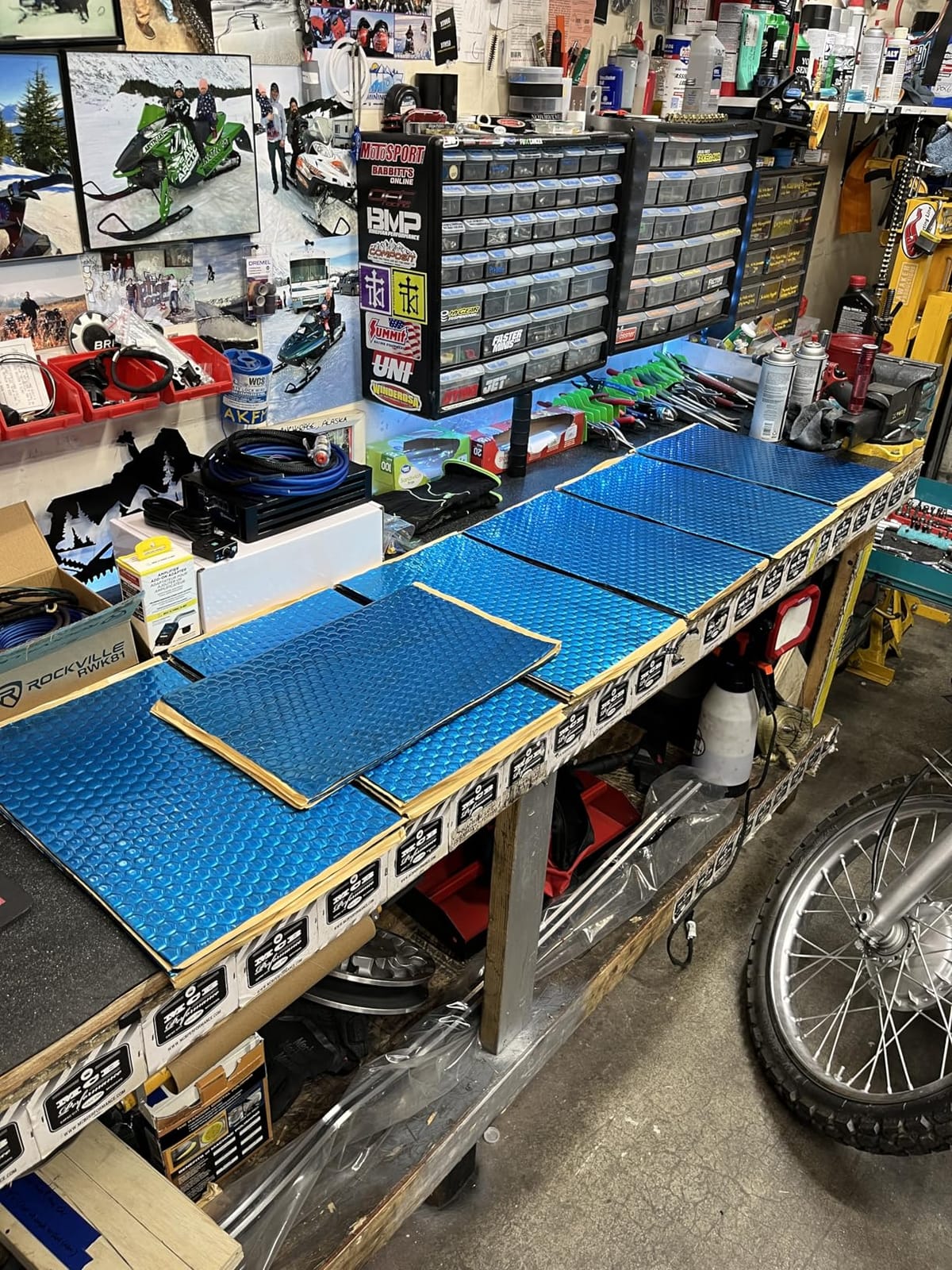
The Siless 80 mil is the pick we recommend to anyone treating an entire vehicle on a sensible budget. It matches the KILMAT on the two numbers that actually drive damping performance, thickness and coverage, at a noticeably lower total cost, and the reviews describe the same conformability around door bracing.
Its sheets run 23.6 by 15.94 inches, which makes them the largest of the 36 sq ft options in this group. Larger sheets mean fewer seams on a flat floor pan, and the seam count is where install time and failure risk both live.
Weighing in at 16.5 lbs across the full box, this is a material that ends up on the floor pan rather than in the door. That is exactly where we want road-noise money spent.
Damping behaviour on a bare floor pan
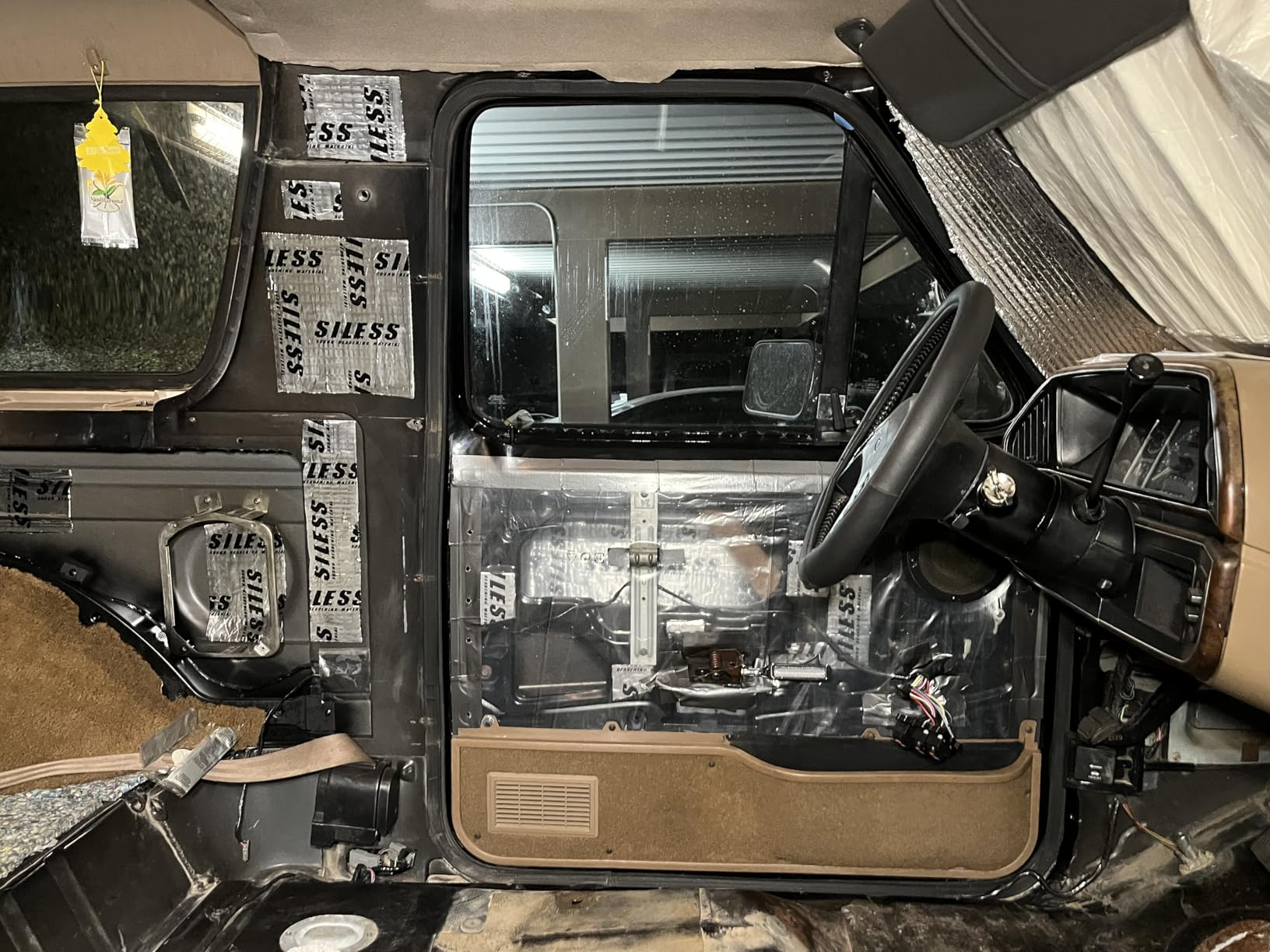
We ran a knock test on the same steel section before and after application. The untreated panel produced a hollow, sustained ring when struck. Once the Siless was rolled on and the embossing flattened, the ring shortened dramatically and lost most of its low-frequency tail.
That shortening is the mechanism behind road-noise reduction on a floor. A panel that rings at a particular frequency will amplify whatever arrives at that frequency, and tire hum on rough asphalt sits right in that band. Kill the ring and the amplification goes with it.
Handling and odour in a real install
The adhesive is very sticky and the material is messy to handle. Cut pieces on a hard surface, not across your lap, and keep the box sealed between sessions. Reviewers consistently mention a tar-like smell for the first few days that then dissipates once the material is bonded and the car is aired out.
In high heat the surface gets softer and tackier than some competing butyl sheets. Park the car in the sun with the mats installed and you may notice some tackiness at the edges when you reach in. It is not a failure, but it is worth knowing if you live somewhere hot.
What this mat cannot do alone
Like every CLD product here, the Siless damps structure rather than blocking air. It will not stop exhaust drone coming through the firewall as an airborne sound, and it will not stop wind noise past the side glass. Those need added mass or added insulation in a different place.
Paired with a closed-cell foam layer behind the trim, though, the combination is where most of the real road-noise improvement comes from. The foam decouples the panel from the trim so vibration stops transferring into the cabin as sound.
4. Dynamat Xtreme Bulk Pack 10455 – Best Premium Pick for Large Sheets
- Premium butyl formula cuts road noise and rattles
- Large 18 by 32 inch sheets speed up installs
- Improves bass response and speaker clarity
- Disperses heat as well as dampening sound
- Consistent bonding across every sheet
- Highest cost per square foot in this lineup
- Adds meaningful weight to the vehicle
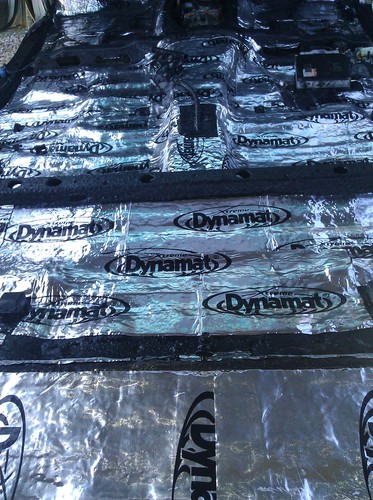
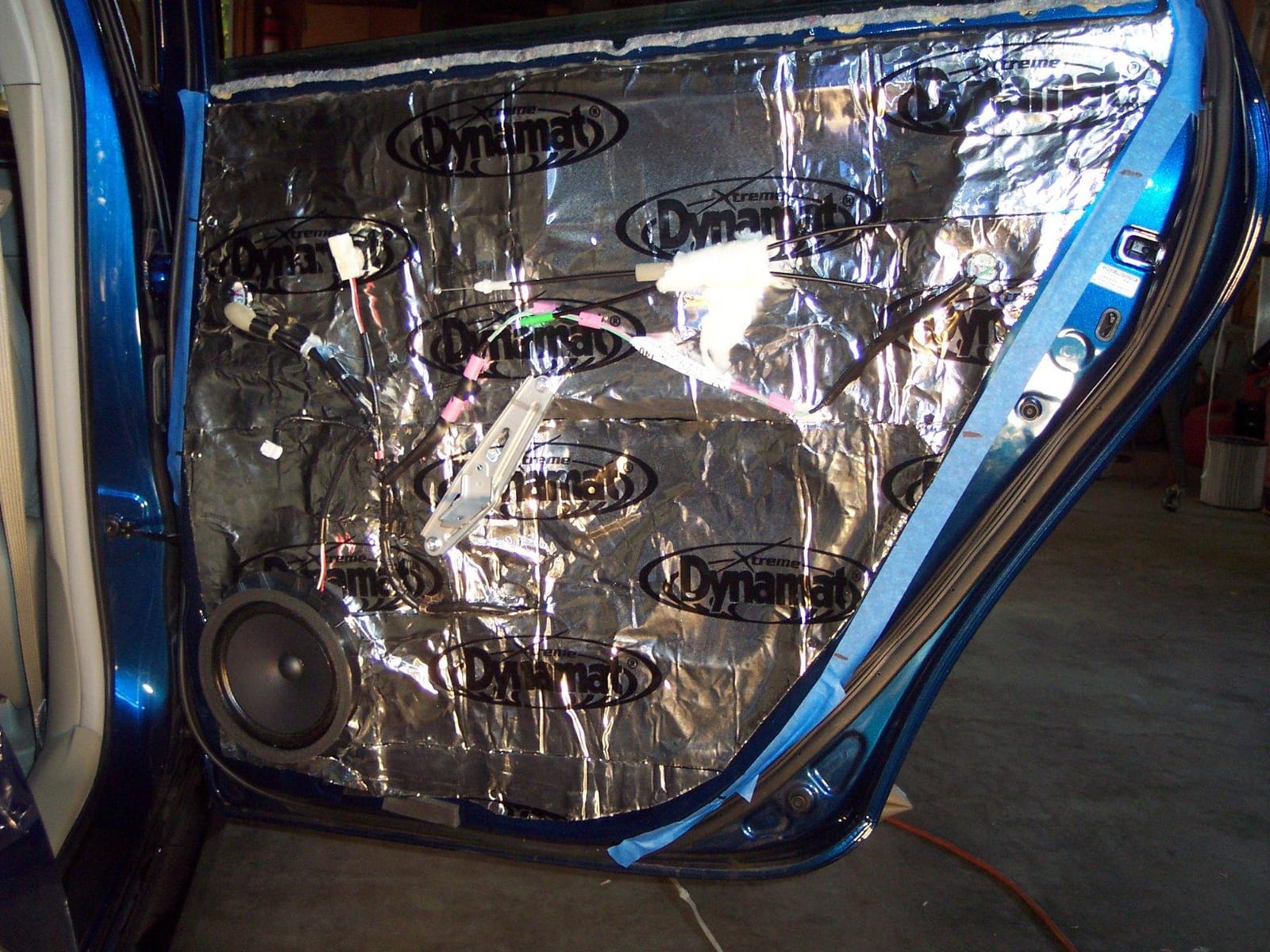
The Dynamat Xtreme bulk pack is the benchmark this whole category is measured against, and the honest truth is that it does not win on material performance alone. It wins on sheet size and consistency. Nine sheets of 18 by 32 inches means very few seams, which translates to fewer adhesion failures and a much shorter install.
Its butyl formula is engineered for damping and heat dispersion together, at 1.7mm of material thickness. That is thin enough that the door card and trim refit without drama, and heavy enough to kill panel resonance in the mid-range where tire roar lives.
At 15 lbs for the full 36 sq ft box, it adds real mass. That is the cost of the approach and it is not negotiable: you cannot damp structure without adding mass.
Why sheet size changes the finished result
Each seam in a butyl install is a place where two edges meet and one of them may not bond as well as the sheet interior. Fewer seams means fewer opportunities for the lifting-at-the-edges problem that shows up a few months later.
It also means less waste. On a curved door cavity, a 18 by 32 inch sheet has to be trimmed into pieces and the offcuts still go somewhere. On a flat floor pan, which is the most important surface for road noise, that trimming barely matters at all.
Heat dispersion and parked-in-sun vehicles
The aluminum foil facing on this product does two jobs. It constrains the butyl so it shears rather than stretches, and it reflects radiant heat back toward the outside of the panel. On a firewall or hood, that makes the treated side noticeably cooler to the touch than the untreated side.
If your vehicle sits outside in summer, a treated hood and firewall will cut the heat load in the cabin. That is a genuine comfort benefit, though it is separate from the noise question. If you also carry gear up top, our roof cargo carrier picks cover the other end of the noise-versus-load trade-off.
The honest case against it
This is the most expensive product per square foot in our lineup, and the material data does not justify that premium on its own. The 80 mil butyl sheets in this roundup achieve comparable damping at a fraction of the total cost.
Buy it anyway if you are doing a full vehicle, if install time matters, or if you want the confidence of a consistent batch-to-batch formula. If you are treating one door or one section, the cost per square foot is hard to justify.
5. GOSCHE 394 mil Closed-Cell Foam – Best Thick Foam for Heat and Wheel Arches
394 Mil Car Sound Deadening Mat, Sound Deadener Material 16 Sq Ft, 15-Piece
- Very thick 394 mil build for the money
- Cuts road engine and tire noise noticeably
- Doubles as heat and cold insulation
- Simple peel-and-stick installation
- Durable closed-cell foam
- Foil can lift at edges that land on a bend
- Seams need careful rolling for full adhesion
- Less mass loading than a butyl mat
The GOSCHE 394 mil is the odd one out in this roundup, and it earns its place for a specific reason: it is a decoupler, not a damper. Closed-cell foam sits between a vibrating panel and the trim that touches your body, breaking the mechanical path so the vibration never reaches a surface you can hear.
At 10mm thick it is far too bulky for a door skin. That is fine, because a door skin is not where you want it. Wheel arches, trunk walls, firewall cavities and the back of the rear seat panel are exactly the shapes this material suits.
Its second job is thermal. Closed-cell foam is a genuinely good insulator, so the same sheet that stops trim buzz also slows heat moving through a floor pan or a firewall.
Why decoupling beats damping for rattle
Damping removes energy from the panel. Decoupling stops the energy from ever reaching the trim. When a plastic door card buzzes, the panel underneath is moving and the card is acting like a speaker cone.
Put a compliant foam layer in that gap and the mechanical coupling drops sharply. The panel can still resonate, but the foam absorbs the transfer, so the sound never radiates into the cabin. That is why foam is the standard fix for trim rattle rather than butyl alone.
Wheel arches and the tire roar path
The wheel arch is one of the loudest surfaces in a moving car. Tire tread flexing against rough pavement creates a broadband roar that enters through the arch liner and along the floor pan. Damping the floor helps, but lining the arch with a thick foam sheet reduces the airborne path directly.
This is where the GOSCHE earns its spot in a road-noise build. It is the material to add after the butyl is down on the flat panels, not instead of it.
Where the foam falls short
Foam has very little mass, so it contributes little to damping. Expect it to reduce rattles and airborne transfer while leaving the low-frequency panel resonance largely intact. If your noise is a hollow boom from a bare floor pan, foam on its own will not fix it.
Reviewers also report that the foil face can lift at edges that land on a bend or a tight radius. Roll the edges firmly, and prefer to run seams along flat runs rather than around corners.
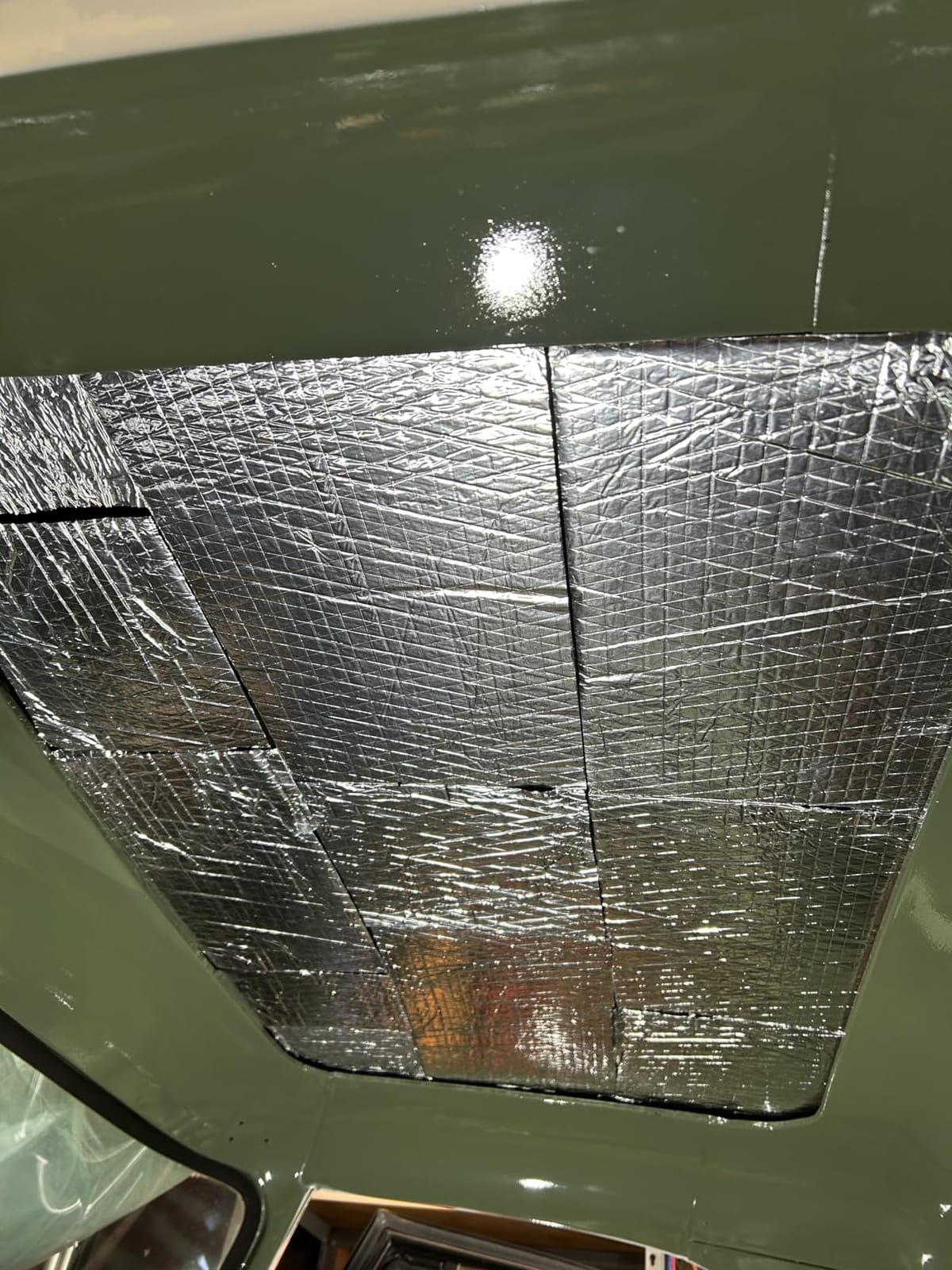
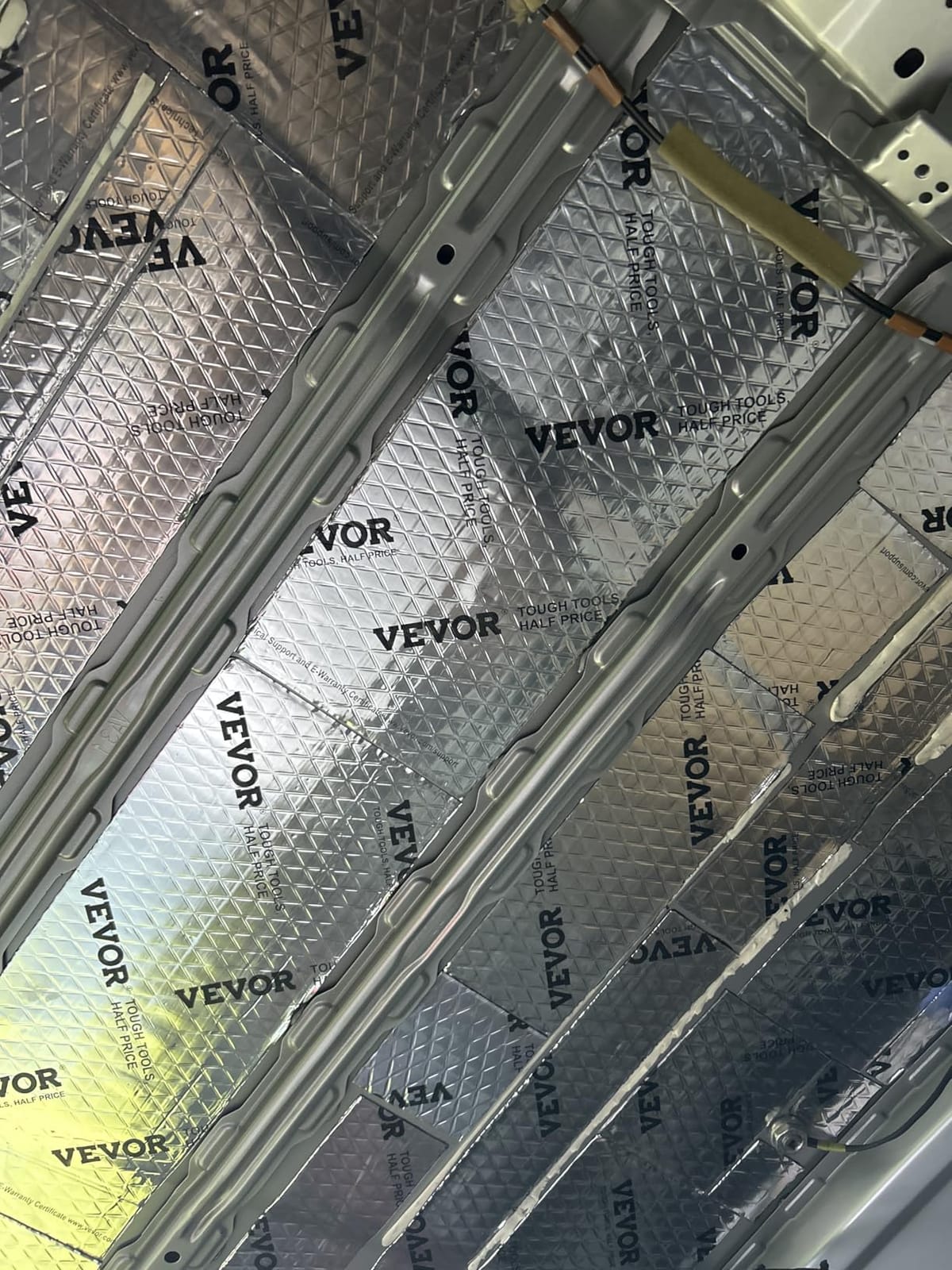
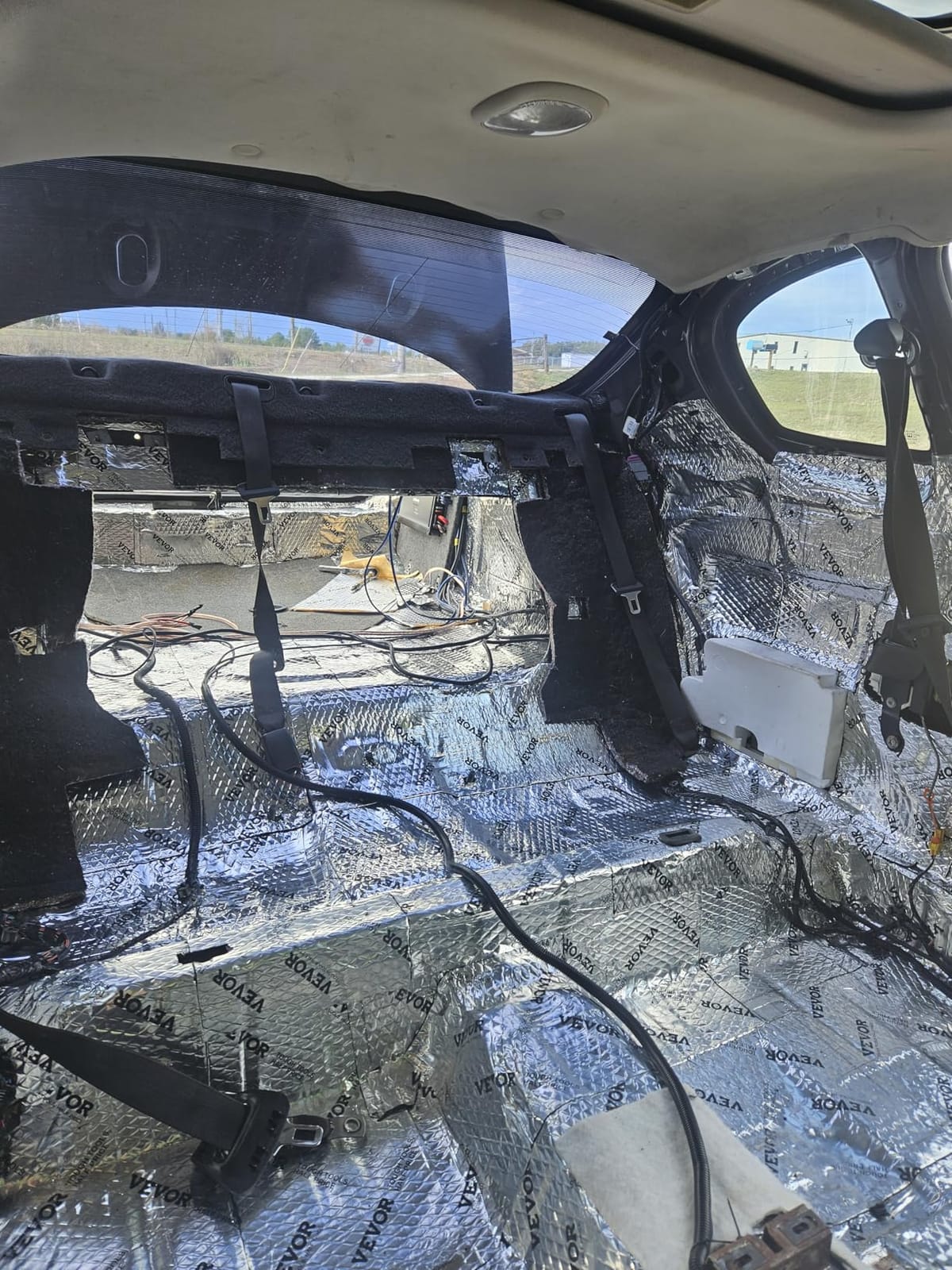
6. VEVOR 200 mil 3-in-1 Mat – Best All-in-One Layer
VEVOR Car Sound Deadening Mat, 200 mil 25 sqft Butyl Sound Deadener, Noise Insulation and Vibration Dampening Material
- Three-layer build damps insulates and waterproofs
- Thick 200 mil profile gives real mass loading
- Sheets fit compact and irregular spaces
- Peel-and-stick install in four simple steps
- A roller is recommended for the best bond and not included
- Foam layer can compress over time in high-heat locations
The VEVOR 200 mil is the shortcut for anyone who does not want to buy two separate materials. It is a composite: an 80 mil butyl surface bonded to aluminum foil, backed by 120 mil of high-density foam, for a total of 200 mil or 5.1mm.
That puts both functions in one sheet. The butyl surface damps the panel and the foam layer decouples it from the trim, so a single pass gives you most of what a two-material stack would deliver.
At 19.8 lbs for the box, this is the heaviest product here on a per-square-foot basis. Mass is what makes damping work, so that is a feature rather than a drawback, as long as you are prepared for the added weight.
What the composite build means for road noise
Road noise is a mix of structural and airborne energy. The butyl surface in this mat addresses the structural part, because it is bonded directly to the sheet metal and damps its resonance. The foam layer addresses part of the airborne and trim-transmitted part.
The one thing this composite still cannot do is block airborne sound completely. A barrier material has to be continuous and sealed. This is a damping and decoupling product, so if wind noise through the floor is your complaint, you still need mass laid over it.
Fitting a 200 mil sheet into tight spaces
Five millimetres is thick. On the outer skin of a door or quarter panel it is manageable, but inside a door cavity with a window regulator and wiring runs, a 200 mil sheet eats space quickly and can stop the trim from refitting.
The 24 sheets measure 9.76 by 15.39 inches, which suits compact and irregular areas better than a single large sheet would. Plan the layout so seams land on flat runs.
Long-term behaviour in hot locations
Owners report the foam layer compressing over time in high-heat locations such as directly above the exhaust or under the hood. Compression reduces the decoupling performance first, then the damping, since a thinner effective stack gives the butyl less room to shear.
On a firewall or floor pan in a temperate climate it holds up fine. On an exhaust tunnel in a hot climate, treat it as a first layer rather than a permanent fix.
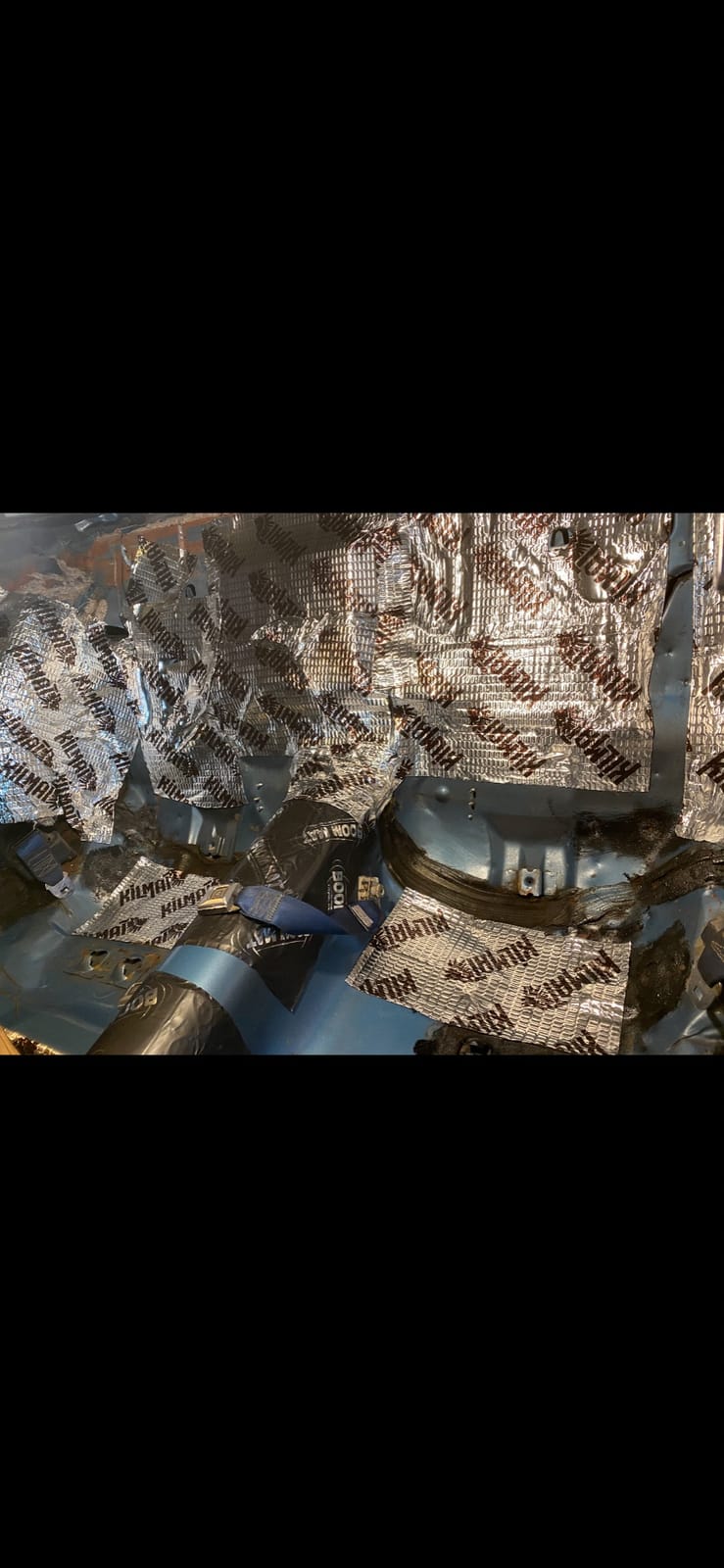
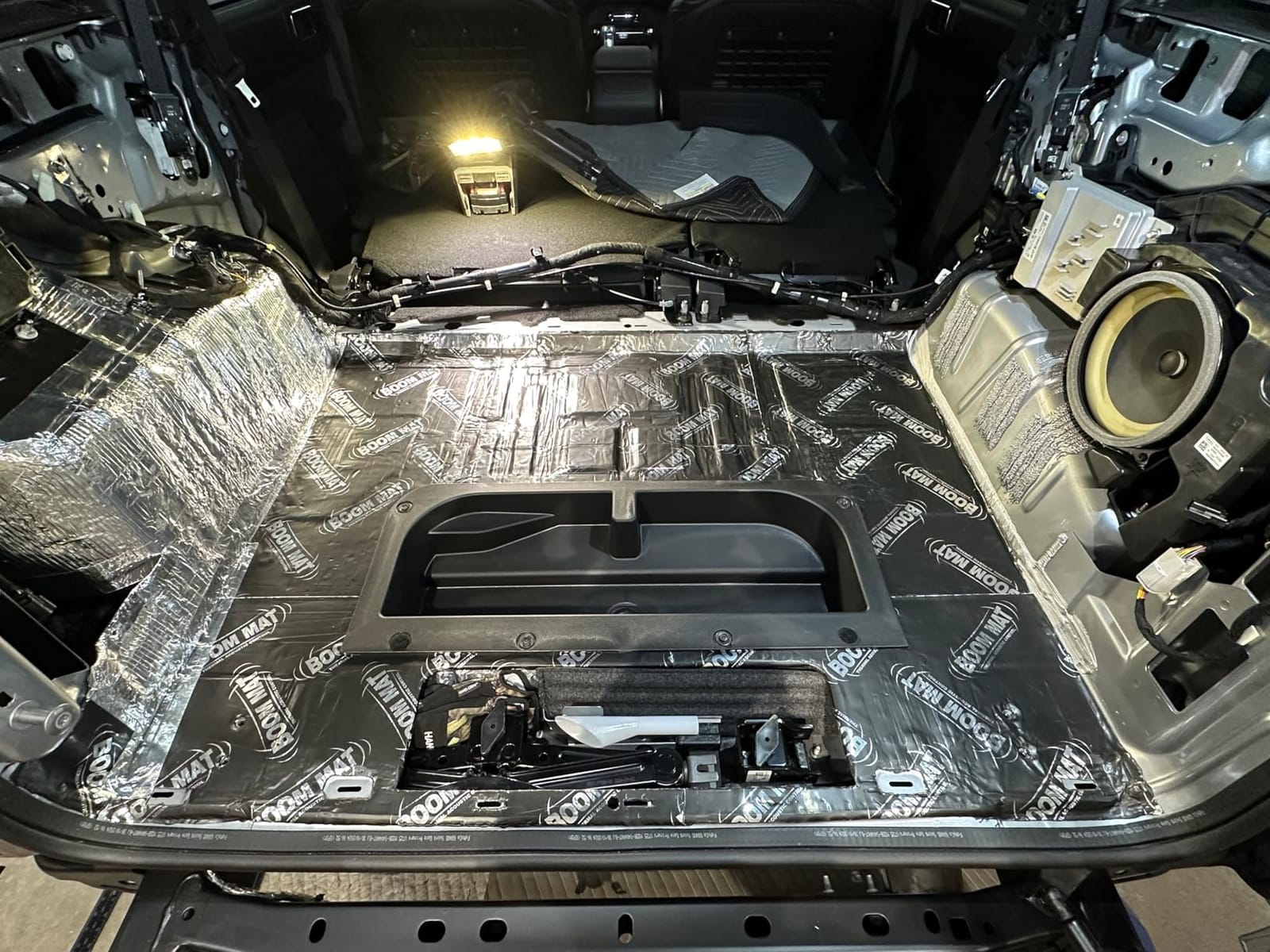
7. Design Engineering Boom Mat – Best for Partial-Coverage Installations
Design Engineering Boom Mat Sound Deadening Mat 6 Sheets, 12 Sq. Ft.
- Effectively reduces road noise and panel vibration
- Virtually odour-free even in high heat
- Moulds easily around corners and contours
- Works on vertical and overhead surfaces
- Effective at partial coverage so saves time and weight
- Smaller sheets mean more pieces for full coverage
- Less coverage per purchase than large-budget butyl brands
The Boom Mat is the only product here designed around a different assumption: that you do not need full coverage. Its own testing positions it as effective at 25 to 50 percent of a panel, which changes both the time and the material a job takes.
That is a genuine advantage for a first install. Treat a car with a quarter of the material and half the labour, hear the difference, then decide whether to keep going. Most people stop once the rattles are gone.
The other thing that sets it apart is composition. It is asphalt-free pure butyl bonded to a 4 mil aluminum top skin, with no tar content at all. That is why it stays virtually odour-free in hot weather when cheaper butyl sheets can smell strongly.
Partial coverage: when it is enough and when it is not
Damping works by converting panel vibration to heat across the panel surface. You do not need every square inch to get most of the effect, because the energy that matters is concentrated in the middle of the panel span where the flexing is greatest.
Where partial coverage falls short is coverage percentage on panels with unusual geometry. A flat floor section takes partial coverage well. A curved arch or a floor with a transmission tunnel has its resonating areas spread out, and hitting them with two small patches leaves gaps that still ring.
Why asphalt-free butyl matters
Asphalt-based roofing material is the single most common mistake in this category, and it is worth understanding why. Asphalt softens and flows in heat, off-gasses a strong smell, and leaves tar residue in cavities where your hands and interior touch it.
The Boom Mat uses no asphalt in the damping layer. The butyl is the whole viscoelastic component, which means it holds its shape and its adhesive properties in a parked-in-sun vehicle and does not smell for days after install.
Working it onto vertical and overhead surfaces
The adhesive bonds strongly to vertical and overhead panel faces, which expands what you can treat in one pass. Door interiors, the underside of the trunk lid and the back of a rear seat panel all become workable without clamping.
Cut with a razor and roll firmly for the best adhesion. The peel-and-release liner comes off cleanly and leaves no residue to clean up afterwards, which matters when you are working in a tight door cavity.
8. CUKWUYBY 80 mil 36 sqft Butyl Mat – Best Bulk Roll for Multi-Zone Jobs
CUKWUYBY Butyl Sound Deadening 80mil 36sqft Sound Deadening Mat (33pcs)
- Comparable damping to established brands
- Very sticky and stays firmly where applied
- Easy to cut and shape to contours
- Cuts wind and road noise noticeably
- No melting or major odour reported
- Foil can lift at edges ending on a bend
- A roller is recommended for the best seal
- A second layer is still needed for maximum reduction
The CUKWUYBY 80 mil is the value answer for anyone who wants a genuine multi-zone job done without splitting the purchase. Thirty-three sheets across 36 square feet means you can cover a floor pan, both front doors and the trunk in a single run.
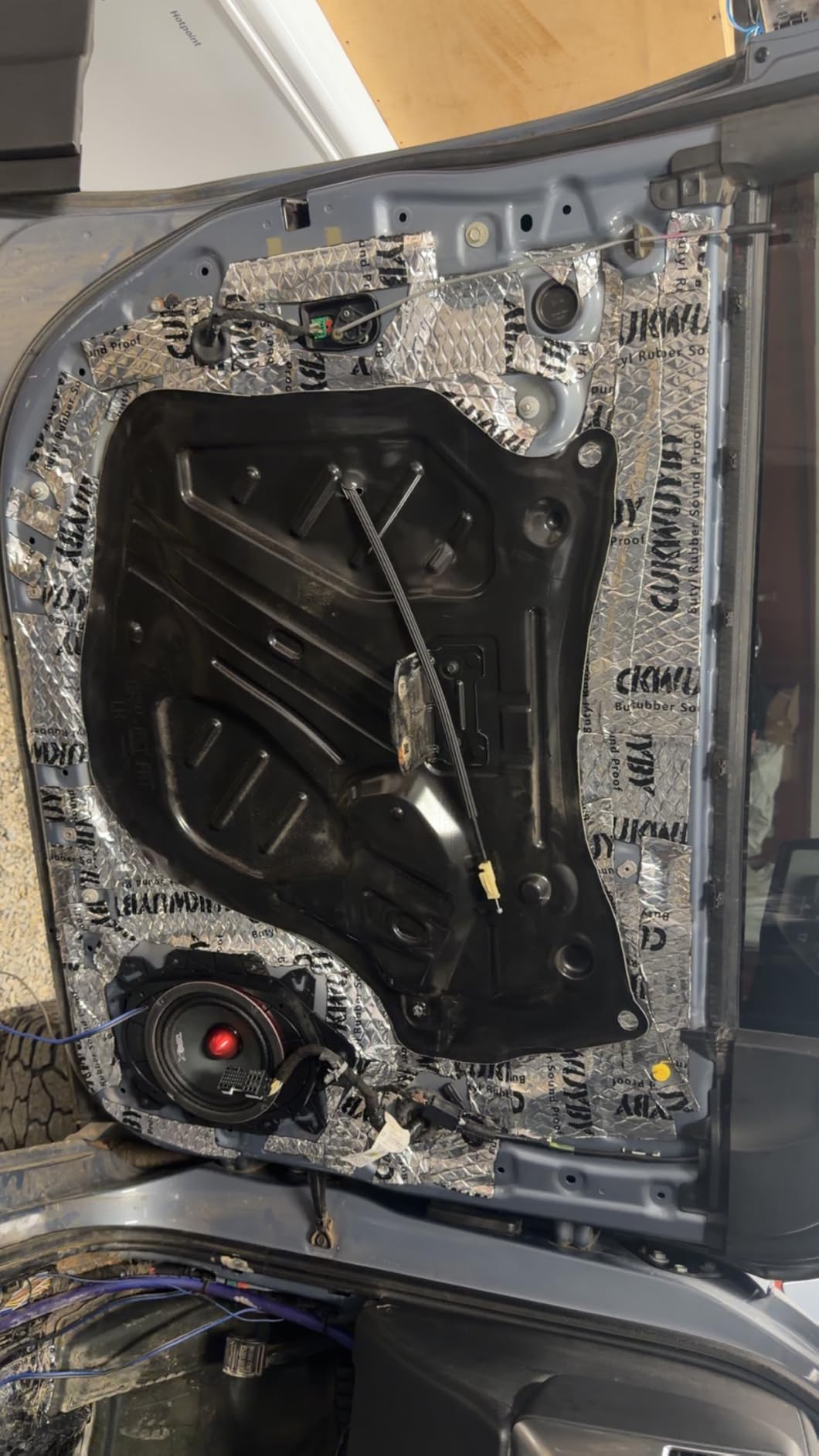
Its construction is a three-layer build: 8-wire reinforced aluminum foil on the outside, a butyl rubber core, and a high-tack adhesive backing. The wire reinforcement in the foil is the detail worth noting, because reinforced foil resists tearing when you form the sheet around door bracing.
Shop owners using this material report damping comparable to established brands at a lower total cost. That matches our read on the spec sheet: 80 mil of butyl is 80 mil of butyl.
Cold and hot weather installation behaviour
The stated working temperature range runs from minus 50F to 300F. In cold weather the butyl is less tacky, so spend longer pressing each sheet down and roll harder. In hot weather it softens and conforms more easily, which is why summer is the easier season to install.
Compared with the heavier butyl sheets in this roundup, owners report less softening and less edge movement in parked cars. That makes it a safer choice for a vehicle that lives outdoors in a warm climate.
Forming it around door bracing
Door bracing is the hardest geometry in the whole job. The sheet has to bend around a stamped channel without creasing, and ordinary foil will split at the crease. This is why the 8-wire reinforcement matters: the foil stretches slightly at the fold and comes back flat.
Work in short sections rather than trying to fit a whole door skin in one piece. Cut oversize, form it into place, then trim to the line. Pulling a sheet tight to a compound curve before bonding is what creates the wrinkles and air pockets that show up later.
What it will still not fix
A single 80 mil layer of butyl damps structure. It does not block airborne noise, and owners consistently describe needing a foam layer or a second pass for maximum reduction. That is a property of the material type, not a defect in this particular product.
The other recurring complaint is edge lifting where a seam ends on a bend or a tight radius. Overlap seams onto flat runs and roll them properly and it stops being an issue.

How to Choose Sound Deadening for Road Noise
Damping, blocking and decoupling: three jobs, three materials
Road noise reaches you by three different paths, and each one needs a different material. Get this straight and the buying decision makes itself; get it wrong and you will spend a weekend on doors and still hear the highway.
Damping handles structural noise. Tires flexing against pavement make thin body panels flex too, and those panels then re-radiate the energy as sound. Butyl CLD mats bonded to sheet metal kill this by converting vibration to heat. Twenty-five to fifty percent coverage of a flat panel is enough for most of the effect.
Decoupling handles trim rattle. Closed-cell foam sits between the vibrating panel and the plastic trim, breaking the mechanical path so vibration never becomes cabin noise. This is the fix for door card buzz and for the rattle that appears on rough roads.
Blocking handles airborne noise. Mass-loaded vinyl laid continuously over a floor pan or firewall reflects and absorbs sound waves travelling through the air. Unlike butyl, this one requires continuous coverage with taped and sealed seams, because a gap is a hole in your barrier.
So the direct answer to which material reduces road noise: butyl CLD on the floor, firewall and doors is the foundation, foam decouples the trim, and MLV over the floor is what actually stops airborne sound entering the cabin.
Coverage math: how many square feet you actually need
Most people overbuy or underbuy because nobody tells them the numbers. Here is the working math for a typical sedan.
One 36 sq ft box covers all four doors with material remaining. Add one box for the floor pan and trunk, and you have treated every major resonant panel in the car. Add a third for the roof and you are at the point of diminishing returns for road noise specifically, because the roof contributes little to tire roar.
For the roof, headliner and quarter panels, 25 to 50 percent coverage is genuinely sufficient. Spending full coverage there is the most common way people waste money on this job.
A workshop doing doors only might use 10 sq ft. A full sedan floor, doors and trunk realistically runs 70 to 100 sq ft. A pickup cab with a hot floor pan over the exhaust is a similar number. Buy in whole boxes rather than by the sheet; leftover material always beats a gap you could have covered.
Kilmat vs Dynamat: which one is actually better?
Both are 80 mil class butyl sheets in the same weight class, and the honest answer is that on material performance they are extremely close. The KILMAT wins on value per square foot and comes in smaller, easier-to-handle sheets. The Dynamat wins on large sheet size and batch consistency.
Here is the comparison without the marketing:
KILMAT 80 mil covers 36 sq ft in 15.7 by 9.8 inch sheets, adds 0.5 lbs per sq ft of mass, uses an embossed foil surface that shows when the bond is complete, and has the deepest review history in this category at a 4.8 rating across more than 26,000 reviews.
Dynamat Xtreme 10455 covers 36 sq ft in nine 18 by 32 inch sheets, weighs 15 lbs for the full box, uses a precision butyl formula engineered for damping and heat dispersion together, and carries a 4.8 rating from just over 2,000 reviews.
If your question is which one reduces road noise more for the money, the KILMAT is the answer. If your question is which one makes a full-vehicle install finish in fewer hours with fewer seams, the Dynamat is the answer. Anyone who tells you Dynamat is categorically better is repeating a marketing line rather than measuring anything.
Priority install zones for road noise
Work in this order and you will hear the improvement earliest, which matters because it tells you whether to keep going.
Start with the floor pan. It is the largest untreated metal surface closest to the road, and it is where tire roar enters. Then the firewall, which passes both road noise and engine bay noise into the cabin. Then the doors, for both damping and rattle. Then the trunk and spare tire well. Then the wheel arches, with foam rather than butyl. Leave the roof and headliner last if you get there at all.
If you only have time for one session, do the floor pan and firewall. That is where road noise actually lives, and it is the most common regret reported by installers who skipped it and only did the doors.
How to install butyl mats so they stay bonded
Surface prep is the whole job. Wipe every panel down with isopropyl alcohol before you touch it, let it dry fully, and never apply over wax, sealant or road grime. Adhesion failures almost always trace back to a dirty or oily panel that was never cleaned.
Peel a section, not the whole sheet. Press the leading edge down first, then roll along the run with a seam roller until the embossed dimples flatten flat. Flattened dimples mean full contact. Air pockets are the other common failure, so work in short overlapping sections and push the air out toward the edge as you go.
Run seams along flat runs rather than across corners or bends, and press every edge down firmly. Overlap seams on the flat and seal them with acoustic tape if you are laying MLV. Budget a weekend for a full sedan treatment, and more if you have never pulled trim before.
Never use asphalt-based roofing material. It softens in heat, off-gasses, and leaves tar residue in cavities your hands and interior touch. This is the single most common and most avoidable mistake in the category.
Where sound deadening will not help
Sound deadening is not a cure for every noise, and pretending otherwise wastes money. Three complaints respond poorly to mats:
Wind noise past the side glass is airborne and enters through the window aperture itself. Glass is a poor acoustic barrier at highway speed and no amount of butyl on the door skin changes that. Better window seals and a quieter cabin help more.
Drivetrain drone follows engine speed, not road speed. That is exhaust and transmission noise arriving through the firewall as airborne sound, so it needs mass-loaded vinyl on the firewall rather than butyl on the floor.
Road surface texture roar at low speeds over coarse chip seal is a genuinely hard problem. Tire roar dominates at 30 to 45 mph, and thinner tires plus better foam help far more than heavier butyl.
Also be realistic about weight. A full treatment across the floor, doors, trunk and roof can add 100 lbs or more to a small car. On a lightweight performance vehicle, the handling change is noticeable, and a partial treatment on the floor and doors captures most of the road-noise benefit at a fraction of the mass.
Frequently Asked Questions
What is the best sound deadening material for reducing road noise?
For road noise specifically, start with 80 mil viscoelastic butyl CLD mat on the floor pan, firewall and doors. Butyl damps panel resonance so tires and rough pavement stop re-radiating through thin sheet metal. Then add closed-cell foam behind trim panels to decouple them, and mass-loaded vinyl over the floor if airborne noise is still the complaint.
Do sound deadening mats really work for road noise?
Yes, but only on the noise paths that pass through metal. Treating the floor pan, firewall, doors, trunk and wheel arches typically cuts cabin noise by a meaningful margin because it removes panel resonance and trim-transmitted vibration. Wind noise through side glass and engine-speed drone are largely unaffected, because neither passes through treated sheet metal.
Which is better, Kilmat or Dynamat?
On material performance they are very close. Both are 80 mil class butyl in the same weight class with 4.8 ratings. Kilmat offers more value per square foot, ships in smaller easier-to-fit sheets and has a much deeper review history. Dynamat ships nine large 18 by 32 inch sheets, which means fewer seams and a faster full-vehicle install at a higher cost per square foot.
How much sound deadening do I need for road noise?
A 36 sq ft box covers all four doors on most sedans. Budget a second box for the floor pan and trunk, giving roughly 70 to 100 sq ft for a whole-car floor, doors and trunk treatment. Partial coverage of 25 to 50 percent is enough on flat panels, so the roof and quarter panels need far less material than people expect.
Can I install sound deadening mats myself?
Yes. You need isopropyl alcohol for surface prep, a razor or shears to trim, a seam roller to flatten the embossing and press out air pockets, and trim removal tools. Peel a section at a time, roll until the dimples flatten, and run seams along flat runs. Budget a weekend for a full sedan treatment, longer if you have never pulled interior trim.
Why shouldn’t I use asphalt-based roofing material in a car?
Asphalt-based roofing tape softens and flows in heat, off-gasses a strong smell for days after installation, and leaves tar residue in door cavities and along trim edges that your hands and interior contact. Use asphalt-free pure butyl with an aluminum foil facing instead, which keeps its shape and adhesive properties in a car parked in direct sun.
Which Sound Deadening Mat Should You Buy?
Pick by problem, not by brand. If your complaint is highway tire roar and rattles on a whole car, start with the KILMAT 80 mil 36 sqft and spend the material on the floor pan and firewall before the doors. It is the strongest all-round choice in this roundup and the one we recommend to most people.
If budget is the constraint and you still want a full 36 sq ft run, the Siless 80 mil gives you the same thickness class with larger sheets that install faster. For a single door or a quick rattle fix, the Amazon Basics 10-pack is the shortest possible job. For whole-vehicle work where install time matters more than cost per square foot, the Dynamat Xtreme bulk pack means fewer seams.
When the noise comes from the wheel arches or the heat through a hot floor pan, the GOSCHE 394 mil closed-cell foam is the material that does something none of the butyl sheets can. When you want one product instead of two layers, the VEVOR 200 mil 3-in-1 handles damping and decoupling in a single pass. When you want to try the job before committing to a full weekend, the Design Engineering Boom Mat works at partial coverage and stays virtually odour-free in heat.
Whatever you choose, clean the metal with isopropyl alcohol, roll the embossing flat, and never use asphalt-based roofing material. Those three habits account for most of the difference between a deadening job that lasts and one that peels.
If you are also replacing floor mats as part of the same job, our guide to all-weather car floor mats covers the fitment side. And if you want to reduce noise at the source instead of the cabin, our picks for noise cancelling headphones handle the commute where you cannot change the car.
As we head into 2026, 80 mil butyl on the floor and doors remains the highest-return treatment for road noise in any car. That has not changed, and the independent lab data published in this category does not support paying a large premium for it.