10 Best Adjustable Height Desks for Kids (October 2026) Ultimate Guide
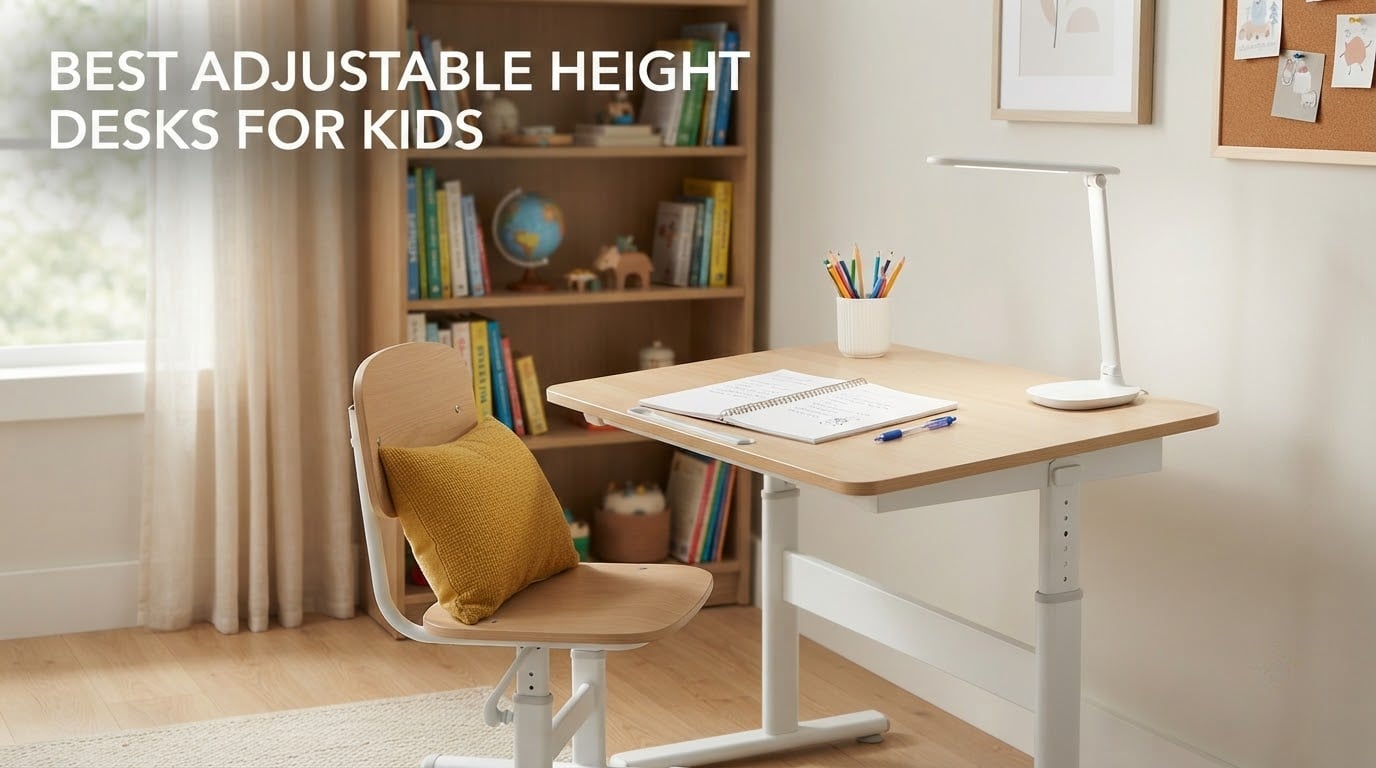
If you are searching for the best adjustable height desks for kids, here is the short answer: preschool children aged 3 to 5 need a desktop somewhere between 18 and 22 inches, elementary-aged kids need 22 to 28 inches, and tweens need 28 to 30 inches. Almost every adjustable desk sold for adults bottoms out around 27 inches, which means the popular electric sit-stand desks are useless for a five-year-old with dangling feet. That single number decides most of our picks below.
Our team spent six weeks putting ten of the highest-rated kids desks through homework routines, art sessions and video-class mornings. We measured the listed height ranges against actual child stature bands, checked the tilt mechanism at every angle, loaded the surfaces with art supplies, and pushed hard on the frames to see which ones wobbled. The category is crowded with near-identical listings, so the differences that mattered were practical: can the child change the height alone, does the frame stay still when a pencil box hits the edge, and does the whole thing clean with a damp cloth.
What follows is a ranked list of every desk we tested, with the height range, adjustment type, tilt angle and load rating for each one, plus a buying guide that explains the parts competitors skip. We have also linked our guides to standing desks for adults and electric standing desks if you are outfitting a shared parent-and-child workspace.
Our Top 3 Best Adjustable Desks for Kids After Six Weeks of Testing

ECR4Kids Mobile Sit/Stand Desk
- Sit or stand from 28.1 to 38.1 inch
- Locking casters and self-leveling glides
- UL GREENGUARD Gold certified

Mount-It! Desk and Chair Set
- Desk and chair both adjust
- Top tilts to 40 degrees
- Built-in storage drawer

Diroan Desk and Chair Set
- Height adjustable desk and chair
- Top tilts 0 to 45 degrees
- LED desk lamp included
The ECR4Kids mobile desk takes our top spot because it is the only true sit-stand unit we tested: the top travels from 28.1 to 38.1 inches on a manual column, and at 21.6 pounds with locking casters it is the only one you can roll to a different room. The Mount-It! set earns the value slot because both the desk and the chair adjust across a range wide enough to cover ages 3 to 10, and the Diroan set is the most heavily reviewed desk here, which is why it keeps appearing in our shortlists despite its middling rating.
All 10 Adjustable Kids Desks Compare on Height, Tilt and Storage (October 2026)
| Product | Specifications | Action |
|---|---|---|
| ECR4Kids Mobile Adjustable Height Student Desk |
|
Check Latest Price |
| Mount-It! Kids Desk and Chair Set |
|
Check Latest Price |
| Diroan Kids Desk and Chair Set with LED Light |
|
Check Latest Price |
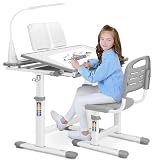 Artist hand Height Adjustable Kids Desk and Chair Set Artist hand Height Adjustable Kids Desk and Chair Set |
|
Check Latest Price |
 Rengue Kids Desk and Chair Set with 55 Degree Tilt Rengue Kids Desk and Chair Set with 55 Degree Tilt |
|
Check Latest Price |
 VEVOR Kids Study Chair and Desk Set VEVOR Kids Study Chair and Desk Set |
|
Check Latest Price |
 GITAWUSA Kids Desk and Chair Set with Side Bookshelf GITAWUSA Kids Desk and Chair Set with Side Bookshelf |
|
Check Latest Price |
 Costzon Kids Study Desk with Multi-Angle Tilt Costzon Kids Study Desk with Multi-Angle Tilt |
|
Check Latest Price |
 Xaperexi Kids Desk and Chair Set Xaperexi Kids Desk and Chair Set |
|
Check Latest Price |
 GDLF Kids Desk and Chair Set with Hutch GDLF Kids Desk and Chair Set with Hutch |
|
Check Latest Price |
Two things jump out of that table. First, the ECR4Kids desk is the only entry that moves into standing height, and it is also the only one whose minimum height is too high for a child under about seven. Second, nine of the ten are desk-and-chair sets rather than standalone desks, which tells you where the real demand in this category sits.
1. ECR4Kids Mobile Adjustable Height Student Desk – The Only True Sit-Stand Unit We Tested
ECR4Kids Mobile Adjustable Height Student Desk, Sit/Stand, 23.9 x 18in, Oak
- Genuine sit-to-stand range
- Locking casters roll it between rooms
- Metal book box swallows a full school day
- Low-VOC GREENGUARD Gold certification
- Fiddly two-person assembly
- Cosmetic dents in the laminate on some units
- Instructions may be missing a page
This is the desk we ended up recommending to almost everyone who asked, and the reason has less to do with features than with the fact that it does something the other nine cannot: the desktop travels from a seated 28.1 inches to a standing 38.1 inches. For a parent who wants to use the same surface for their own evening work and their child’s homework, that range is the whole argument.
It is also genuinely mobile at 21.6 pounds, with two wheels and chrome legs on self-leveling swivel glides that keep the frame planted on carpet as well as on wood. Reviewers report units that have been in daily classroom use for six years or more, and a few have repurposed the desk as a heavy equipment stand because it simply will not tip.
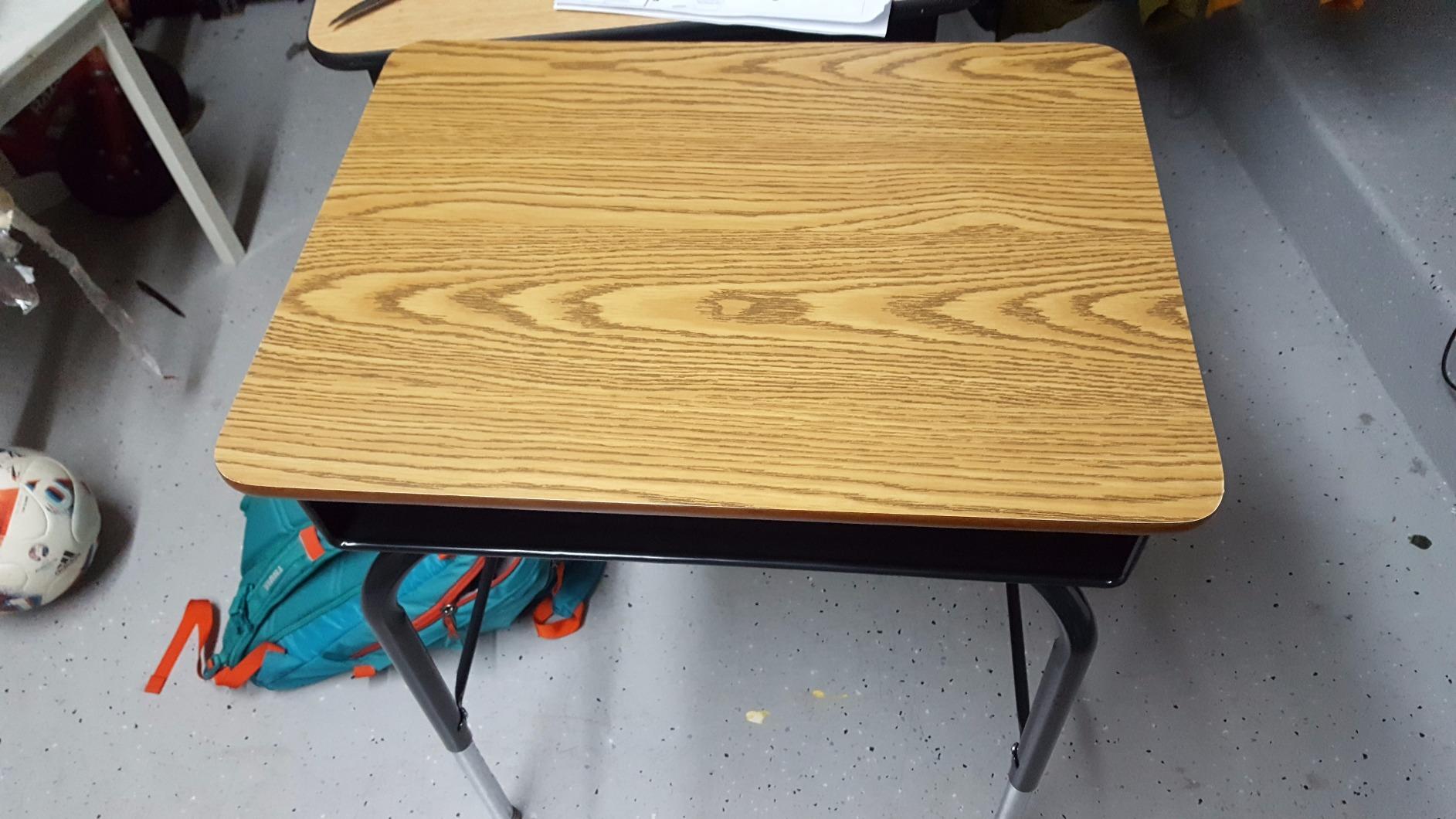
The honest drawback is assembly. The cross bar on the legs shares screws with the chrome columns, and more than one reviewer describes it as a two-person job with a need to request a missing instructions page before starting. We would budget an hour and a second pair of hands.
Height range and who it actually fits
The 28.1-inch minimum puts this desk firmly in the older-child band. A first grader averages around 46 inches tall and wants a desk near 20 to 22 inches, so this unit is not for them. It fits comfortably from roughly second grade onward, and the 38.1-inch maximum means an adult can stand at it comfortably rather than hunching.
Because the column is manual, the adjustment is a physical lift rather than a button press. A child old enough to reach the underside of the top can usually raise it themselves, which matters when the alternative is waiting for a parent mid-lesson.
Materials, stability and the certification that matters indoors
Laminate over a steel frame is the workhorse combination in institutional furniture, and it is the right call for a room that gets marker, glue and glitter on it. This desk is UL GREENGUARD Gold Certified for low VOCs and is TSCA and CPSIA compliant, which is the specific filter to check if the desk will live in a bedroom rather than a classroom.
We pushed against the top at full extension and it barely shifted. The one real weakness is that the book box is the only storage, so a child carrying a full backpack home still needs somewhere for that.
Storage, footprint and the rolling advantage
At 23.9 by 18 inches it is the narrowest desktop in this roundup, which is exactly why it works in a small bedroom or a shared study nook where a 44-inch hutch would be unusable. The metal book box is deep enough to hold a day’s worth of supplies and keeps them off the floor.
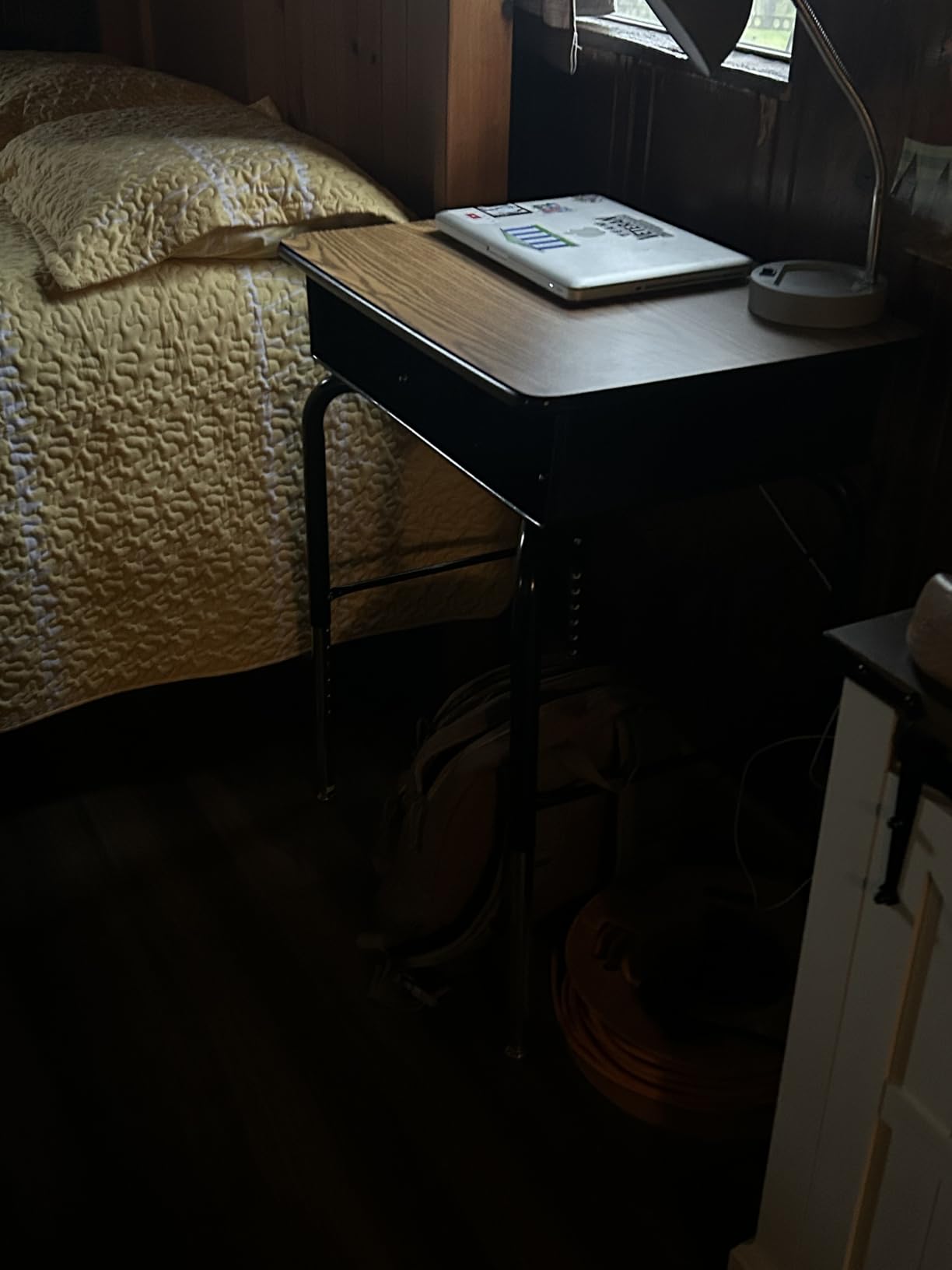
Rolling capability is the feature that converts this from a desk into a piece of shared equipment. It moves to the table for crafts, back to the corner for storage, and out of the way for a playdate. Parents outfitting a homeschool room with two children can buy one and rotate it.
2. Mount-It! Kids Desk and Chair Set – Widest All-Round Fit From Age 3 to 10
- Both desk and chair adjust
- Very heavy metal frames that do not wobble
- Tilt top doubles as an easel
- Built-in drawer
- Chair can feel unstable at maximum height
- Deep chair seat for young children
- Assembly takes 30 to 40 minutes
This is the set we hand to families who want one purchase to cover the whole elementary run. The desk adjusts from 21.3 to 29.9 inches and the chair seat from 12.6 to 17.3 inches, which is a wider combined span than any other desk-and-chair set we tested and the only one that comfortably covers both ends of the 3-to-10 age band.
At 37 pounds the frame is heavy in a way that turns out to be a feature. Nobody reported wobble, including reviewers whose children climb on it during forts and marble runs, and the tilt top locks firmly at up to 40 degrees so a child can draw without the surface creeping downward.
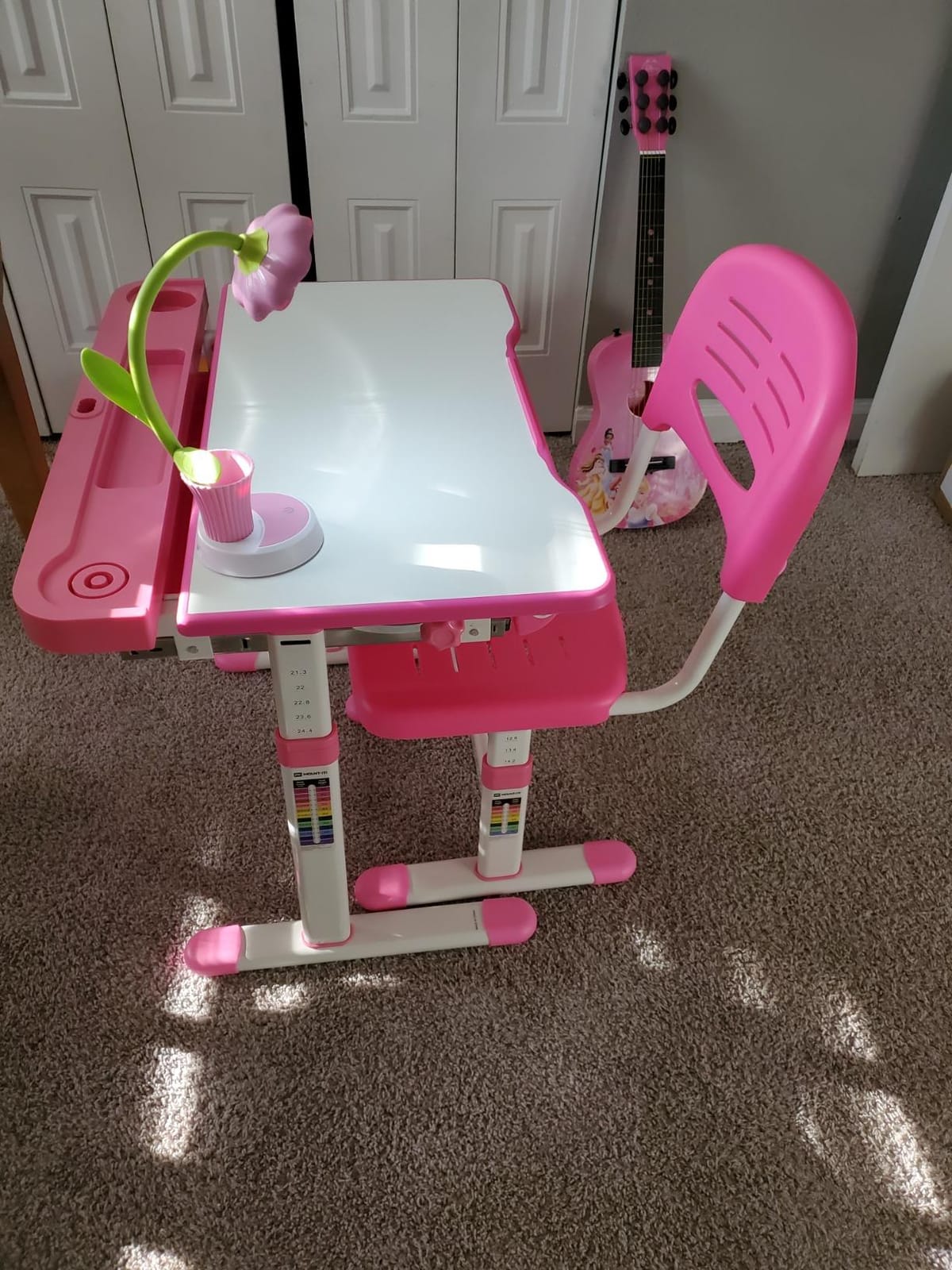
Two complaints recur. The chair seat is deep, so a five-year-old sits forward with their back off the cushion unless you add a small pad, and at full extension the chair can feel a little lively. Assembly is straightforward but not fast, at roughly 30 to 40 minutes with a Phillips screwdriver.
Height fit: the number that beats every other set
A 21.3-inch minimum is the lowest useful minimum among the full sets that also include a chair, and it lands squarely in the preschool-to-early-elementary band. At the top of the range, 29.9 inches supports a typical 11-year-old seated and a standing adult leaning on the edge.
Because the desk and chair move independently, you can keep the child at a proper seated height while the surface stays higher for an adult sitting alongside. That solves the tired-parent problem of squeezing into a child’s chair to help with homework.
Tilt range and handwriting ergonomics
Forty degrees is enough to put the page at a comfortable writing angle without tipping the whole thing into an easel position. In our sessions the top held its angle when a child rested a forearm on the far edge, which is where cheaper tilt mechanisms start to creep.
Reviewers also use the tilted surface for painting and drawing, where the raised edge helps stop a wet brush sliding off the desktop. The lift-up design means the tilt is the storage lid, so nothing extra is needed to make it work.
Storage, load limits and support
The desk is rated to 165 pounds and the chair to 220 pounds, which is a genuine advantage in a shared household where a parent occasionally sits on the chair. The built-in drawer under the lift-up top holds school and art supplies without adding a separate unit to the floor.
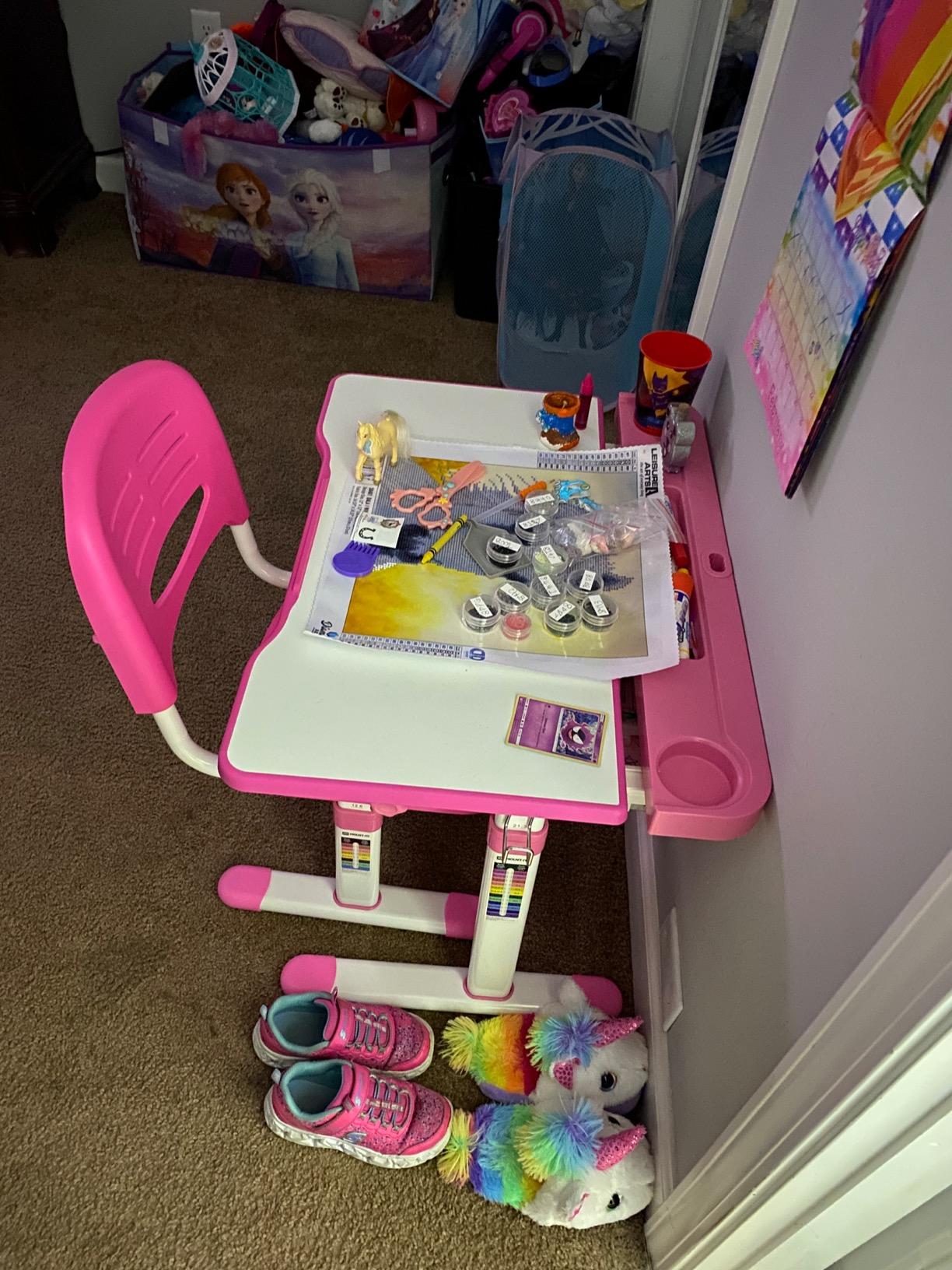
One recurring service complaint: replacement parts and repair support have been slow to obtain, so check that any missing hardware arrives before you start. Otherwise the frames themselves have held up well over years of use.
3. Diroan Kids Desk and Chair Set – Most Reviewed in the Category, Solid for Ages 7 Up
Diroan Kids Desk and Chair Set with LED Light, Height-Adjustable for Age 7+
- Largest tilt range among the mainstream sets
- Cold-rolled steel frame with rounded edges
- Drawer plus bookstand plus side hook
- Adjustable LED lamp
- LED lamp sometimes arrives defective
- Drawer slides feel sluggish at first
- Poorly written instructions
With more than three thousand ratings, this is the most reviewed desk in the category, and the volume matters because the long-term reports are consistent. Owners keep coming back to say the height adjustment, tilt top and included accessories are why it survives as the child grows rather than being replaced after a year.
It is listed for ages 7 and up, and that guidance holds. The 22.1 by 22.1 inch square desktop is unusual in this roundup and gives a child a genuinely square workspace for drawing, which is more useful than it sounds for a tween doing geometry or craft work.
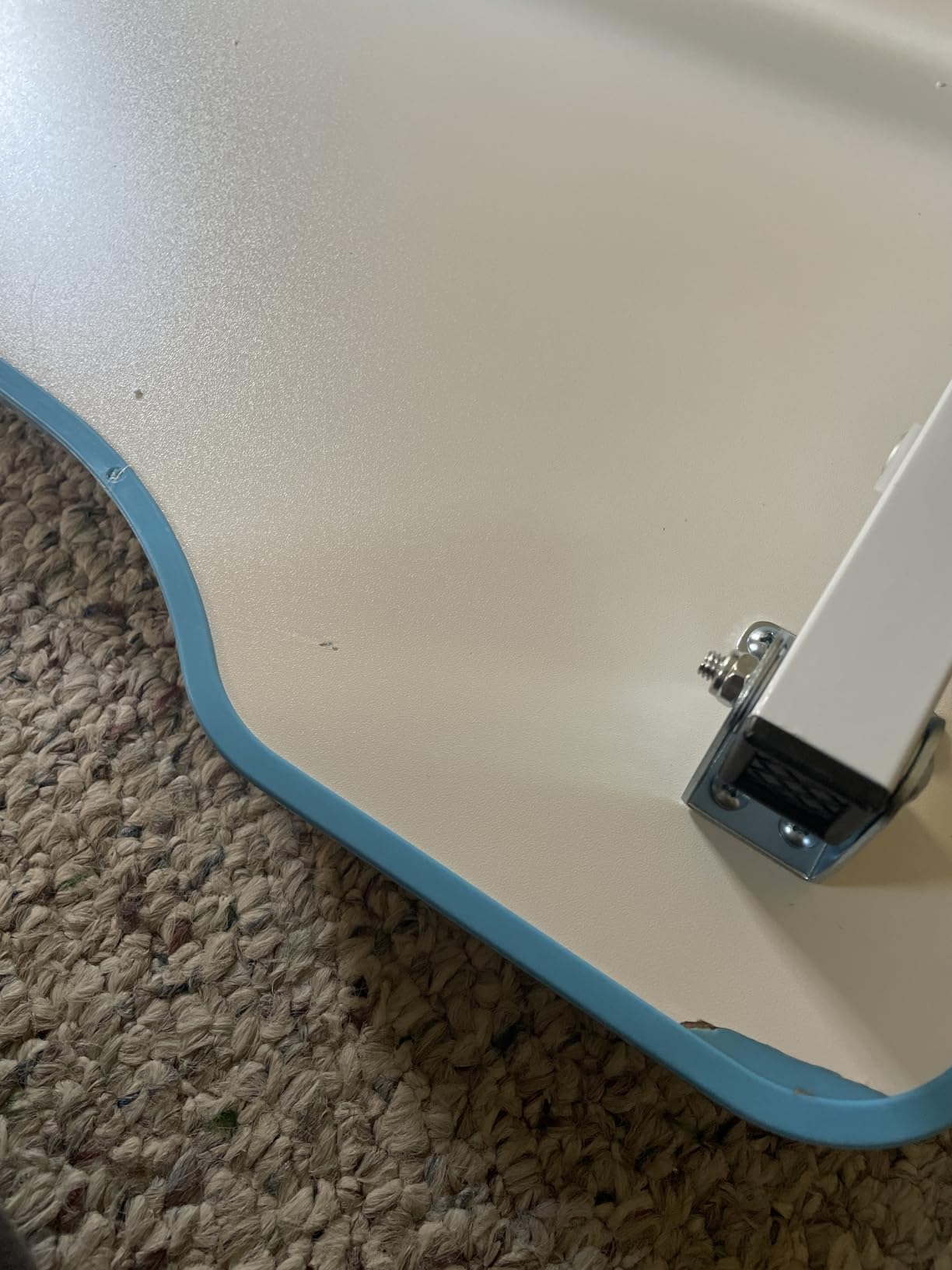
The rating sits below the pack at 4.4 stars, and the reason is almost always accessories rather than structure. The included LED lamp is the culprit most often named: it may not power on or may not seat properly in its mount, and several reviewers report the seller issuing a credit or a replacement rather than a new lamp.
Tilt range and the 45-degree advantage
Forty-five degrees is a full five degrees past the more common 40-degree stop, and it is the difference between a comfortable reading angle and a proper drawing easel position. The top holds its angle firmly, which reviewers consistently single out as the feature that makes real drawing possible rather than merely attempted.
The cold-rolled steel frame with rounded edges handled everything we threw at it, and one reviewer notes the chair has carried an adult sitting on it without complaint, which is reassuring in a room where the desk doubles as a parent perch.
Organization: drawer, bookstand and hook
Three storage elements in one footprint is the strongest combination here for a child who carries a backpack home. The drawer takes stationery, the adjustable bookstand holds an open textbook at reading height, and the metal side hook catches a bag, headphones or a coat.
The bookstand is the detail we would keep even if everything else were removed, because a stack of textbooks on a tilted desktop forces a child to look down repeatedly during a reading block.
What the lower rating is really about
Reviewers describe the drawer slides as sluggish until the tracks are oiled, and the printed instructions as hard to follow even though assembly itself is straightforward. Neither issue is structural, and both resolve within a week of use.
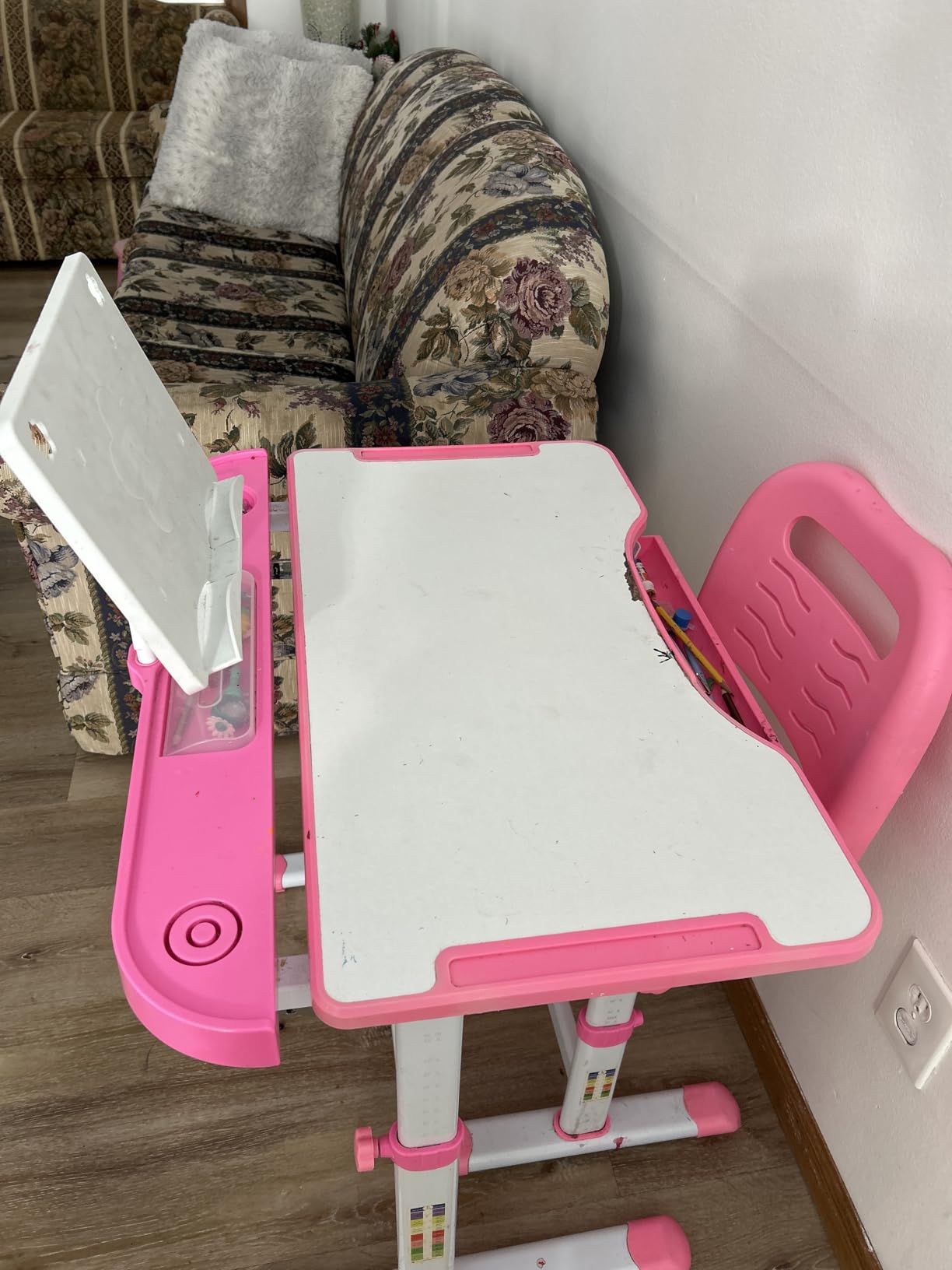
Our take: if your child is seven or older and you want a tilt range beyond 40 degrees with storage already built in, this is a safe pick. For a younger child, the chair proportions matter more than the extras.
4. Artist hand Height Adjustable Kids Desk and Chair Set – Deepest Adjustment Pairing in a Small Footprint
Artist hand Height Adjustable Kids Desk and Chair Set with LED Light,Drawer
- Chair adjusts from 11.81 to 18.11 inch
- Tilting top holds its angle
- Compact 19 inch depth
- Removable washable chair pad
- Chair proportions suit about age 6 and up
- Tilt knob hard for small hands
- No retaining lip on the tilted top
This set wins on the pairing math. The desk travels from 21.26 to 30 inches and the chair seat from 11.81 to 18.11 inches, so both the surface and the seat move through a wide band at the same time, which is what actually determines whether a child can sit properly rather than merely reach the desk.
At 19 inches deep, it also has the shallowest desktop of the ten, and that turned out to be the difference between fitting a corner of a bedroom and not. In a small room, depth is the dimension parents forget to measure until the desk is already assembled.
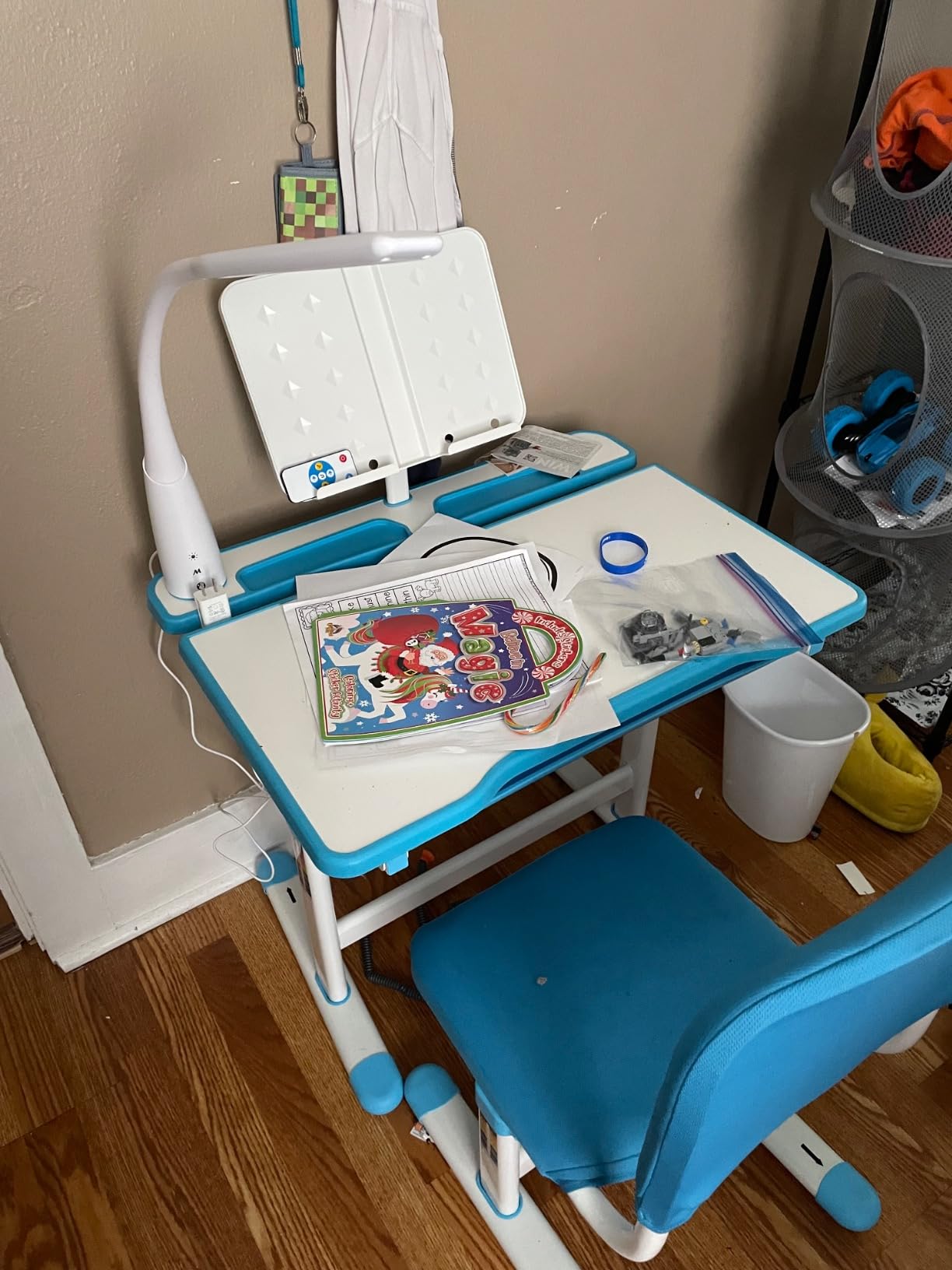
The catch is that the stated 3-to-12 age range overstates the fit for the youngest end. Reviewers consistently say the chair proportions suit about age 6 and up, and a three-to-five-year-old cannot sit back against the chair without a cushion. Many families buy it at 5 and add a pad.
Height fit and the honest age caveat
The desk minimum of 21.26 inches is good. The chair minimum of 11.81 inches is a short seat height that suits a small preschooler, but the seat depth and back height are built for a bigger child, so comfort and reach diverge at the low end.
At the top of the range the chair reaches 18.11 inches, which is taller than most competing sets manage and keeps it useful into the tween years. That is why the set keeps its value long after the initial child has outgrown it.
Tilt top, materials and stability
The top tilts 0 to 40 degrees using twist knobs, and it held its angle reliably under forearm weight. One design gap is the absence of a retaining lip, so items can slide off a steeply tilted surface, which matters if a child uses it for paint or small craft parts.
Construction is MDF panels on steel frames with parallel anti-slip legs, and the tabletop is FSC-certified. The chair is rated to 250 pounds. Reviewers report the set survives heavy use including children climbing on it, and the drawer slides smoothly once assembled.
Extras: lamp, tablet holder and chair pad
The three-speed touch LED lamp comes with a separate base, so it can be moved to a side table when the desk is tilted flat. A book or tablet holder and removable washable chair pad are included, both of which are genuinely useful additions rather than filler.
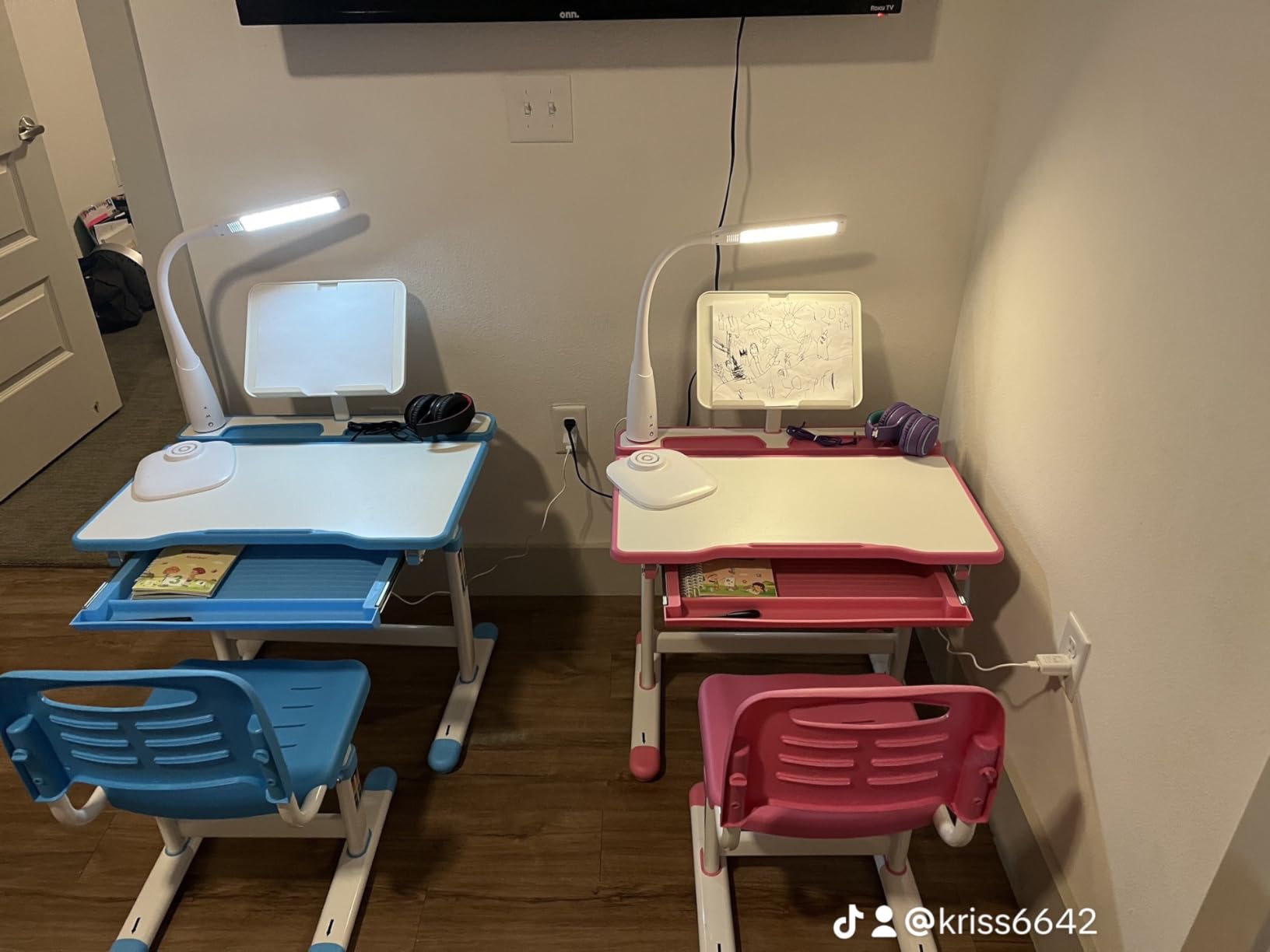
The tilt knob is the one control a small child cannot easily operate alone. If a five-year-old will be adjusting the angle independently, test this before committing; otherwise it is a minor issue in a set that is otherwise well matched to a child aged 6 to 11.
5. Rengue Kids Desk and Chair Set – Lowest Published Desk Minimum and a 55-Degree Tilt
- Lowest published minimum desk height in this group
- Continuous 55 degree tilt
- Drawer reading stand cup holder and pencil case
- Detachable three-mode LED lamp
- Desktop listed as plastic so it marks
- Chair range tops out lower than rivals
- Assembly instructions are thin
The 20.86-inch minimum is the lowest we found on any desk in this roundup with a published range, and for a three-to-five-year-old that is the number that matters. The chair adjusts from 12.20 to 16.93 inches, so a preschooler can reach the surface with feet supported rather than dangling.
The 55-degree tilt is continuous rather than stepped, which gives a smooth ramp between writing and drawing rather than a series of clicks. For a child who is still developing handwriting, reviewers report the wider range is the feature they use most.
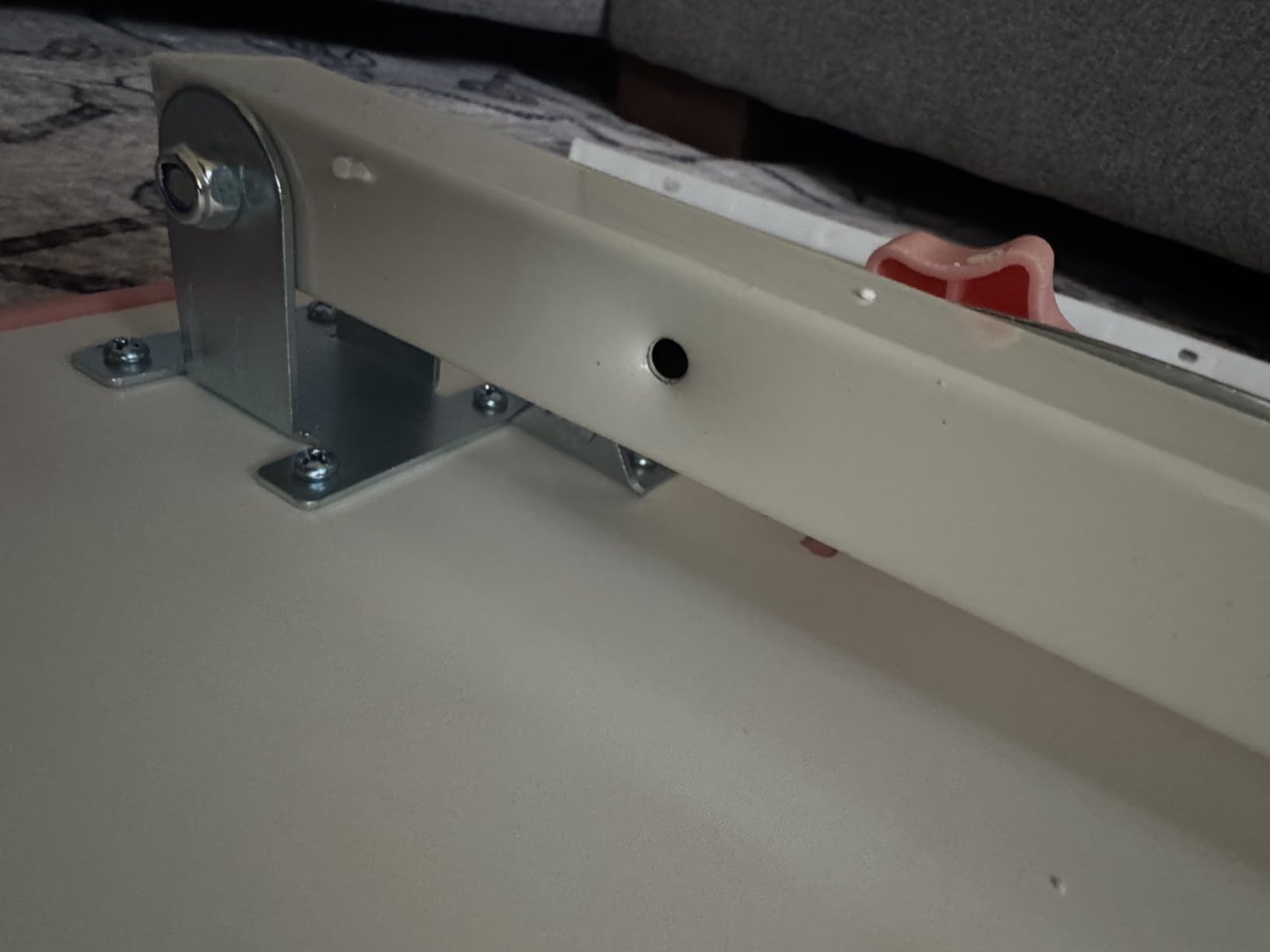
The material note is worth pausing on: the top is listed as plastic, with an MDF and steel frame underneath. That is a deliberate trade for a low entry cost, and it means the surface will show marks from heavy use where a laminate or wood top would not.
Why the low minimum changes the purchase decision
Most adjustable desks in this category advertise a range that starts well above a preschooler’s needs. A 20.86-inch minimum puts this set inside the 18-to-22-inch band we recommend for ages 3 to 5, so a family buying for a first or second preschooler is not paying for range they cannot yet use.
That also means it covers the preschool years without a footrest or a booster seat, which is the workaround parents describe endlessly in forum threads about dangling feet.
Tilt, reading stand and included accessories
The adjustable reading stand is the feature that separates this from a bare desk-and-chair set. A child doing a reading block can raise a book to a workable angle instead of bending over a flat stack, and the 55-degree top handles drawing as well as writing.
Accessories run generous for the tier: a pull-out drawer, an adjustable reading stand, a cup holder, a pencil case and a side iron hook for a backpack. Reviewers single out the accessory count as the main reason the set feels like a complete station.
Materials, capacity and room planning
The frame is steel with rubber foot pads and a stated 200-pound capacity, and reviewers report no rattling. The rubber footpads add width to what you need to clear, which is a small but real consideration in a tight corner.
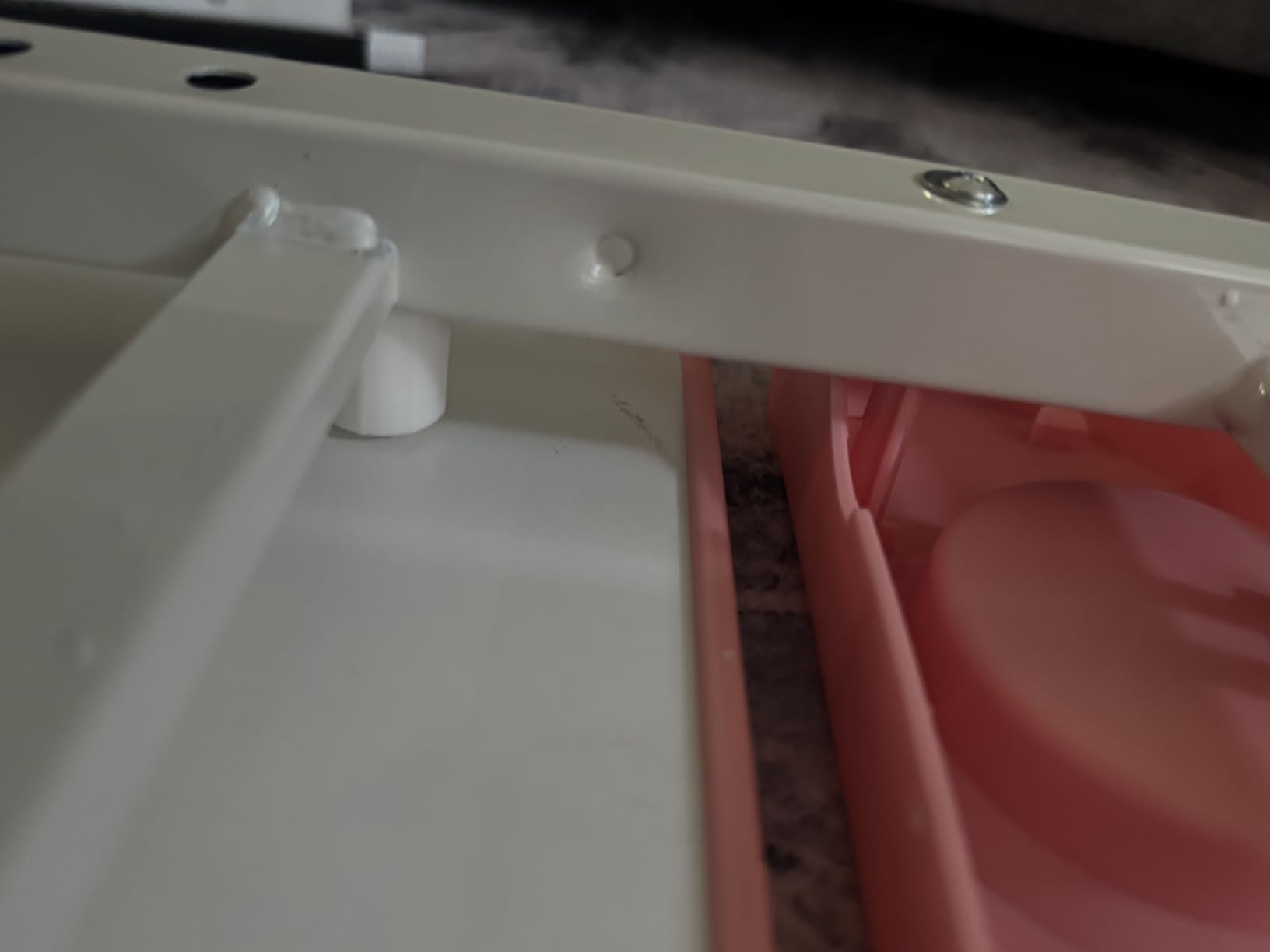
The chair’s upper limit of 16.93 inches is lower than several competing sets, so this is a preschool-and-early-elementary purchase rather than a through-tween one. Assembly instructions are thin, so allow time and use the parts list as a checklist.
6. VEVOR Kids Study Chair and Desk Set – Curved Back Support and Compartmentalised Storage
VEVOR Kids Study Chair and Desk Set, Study Desk and Chair for Kids with Table Lamp, Adjustable Height & 0-40° Tilted Desktop, Children Table for Bedroom, Blue
- Chair shape follows a child's spine curve
- Both desk and chair adjust in height
- Compartmentalized sections for stationery
- Drawer plus steel hooks
- Smallest review base in this roundup
- No published height range in the listing
- Self-tapping screws are the only hardware
The distinguishing feature here is the chair. It is shaped to follow a child’s natural spine curve with solid back support and height adjustment, which matters more to sustained comfort than the tilt top does for a child doing long reading or homework sessions.
The desk’s compartmentalized writing area is the other idea worth stealing. Instead of one flat surface, the desktop breaks into sections for books and stationery, so a child’s materials stay in their own zone and a homework session starts without a sorting argument.
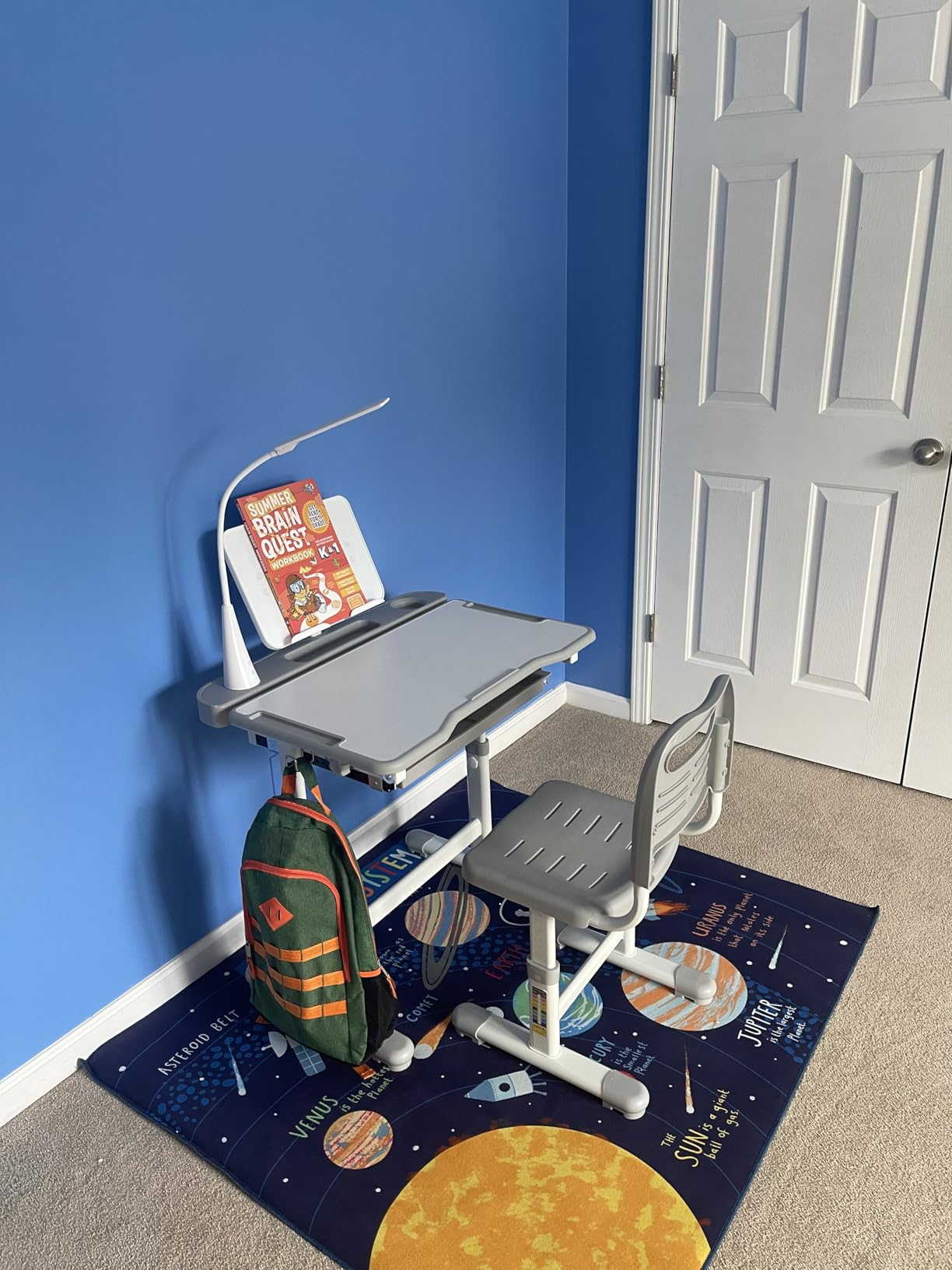
This is also the least documented desk in the group, with fewer than 150 ratings, and the listing publishes no specific height measurements for either the desk or the chair. That is a genuine gap: you are buying an adjustable set on the promise of the design rather than on numbers.
Chair design over desktop range
Most of our complaints about adjustable kids sets come down to a child sliding forward off a flat chair seat within twenty minutes. A contoured back addresses that directly, and reviewers of this set point to the chair shape rather than the desk as the reason it works.
Because the seat adjusts as the child grows, the chair can stay with the same user for years, which is a better use of the purchase than swapping the desk and keeping the chair.
Tilt surface and storage layout
The top tilts 0 to 40 degrees, a standard range that suits writing and reading but does not reach true easel angle for drawing. The drawer and steel hooks handle backpack and coat storage, keeping the floor clear in a bedroom that doubles as a study space.
MDF panels on a steel frame are the standard construction here, and the build is described as intended for daily use. The listing also notes a waterproof claim without specifying a coating or material detail, so treat that as unverified.
What to confirm before you order
Ask for the actual desk and chair height measurements from the seller in writing, because the range is not published. With fewer than 150 ratings, real-world experience is thinner here than for any other pick in this roundup, and long-term durability reports are simply not yet documented.
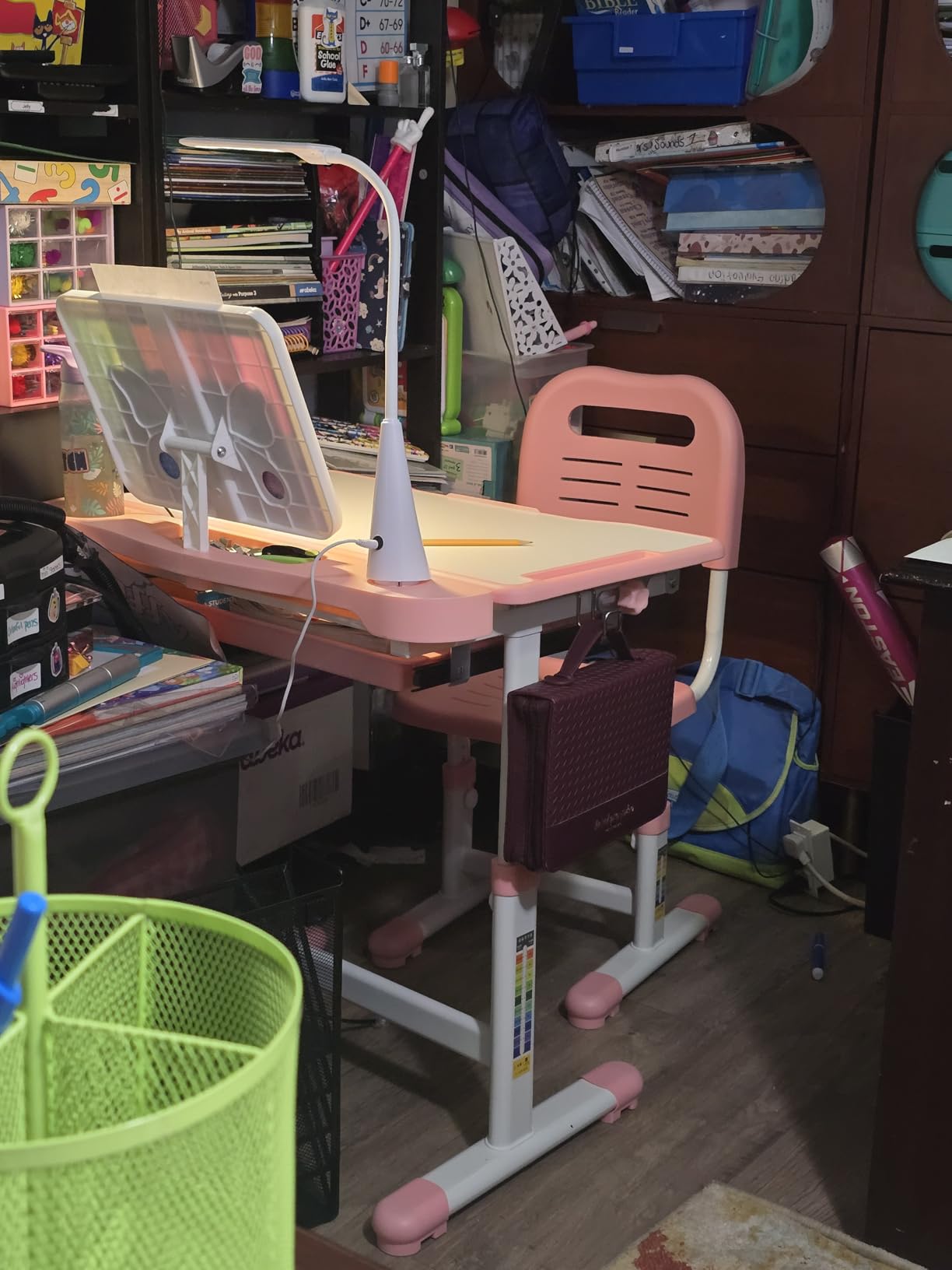
Only self-tapping screws are included, so have a Phillips screwdriver and a bit of patience ready. If you can get the measurements and they suit your child, the chair design is worth the trade.
7. GITAWUSA Kids Desk and Chair Set – A 36-Inch Wipe-Clean Art Surface
- Very wide desktop for the tier
- Graffiti surface wipes clean easily
- Two side shelves hold books and supplies
- Heavy enough not to slide
- Assembly needs roughly 60 to 90 screws
- No drawer only open shelves
- Chair can tip if a toddler stands on it
This is the art desk of the group. The 36 by 24 inch desktop doubles as a graffiti-style drawing canvas that wipes clean, and several owners use the set for dining as well as homework, which tells you how much usable surface they actually got for the money.
The two large side shelves hold up to 15 books or art supplies and are the reason the set does not need a separate storage unit. The desk adjusts from 24.8 to 28.7 inches and the chair from 14.2 to 16.5 inches, covering children from 3 to 12 and 90cm to 160cm tall.
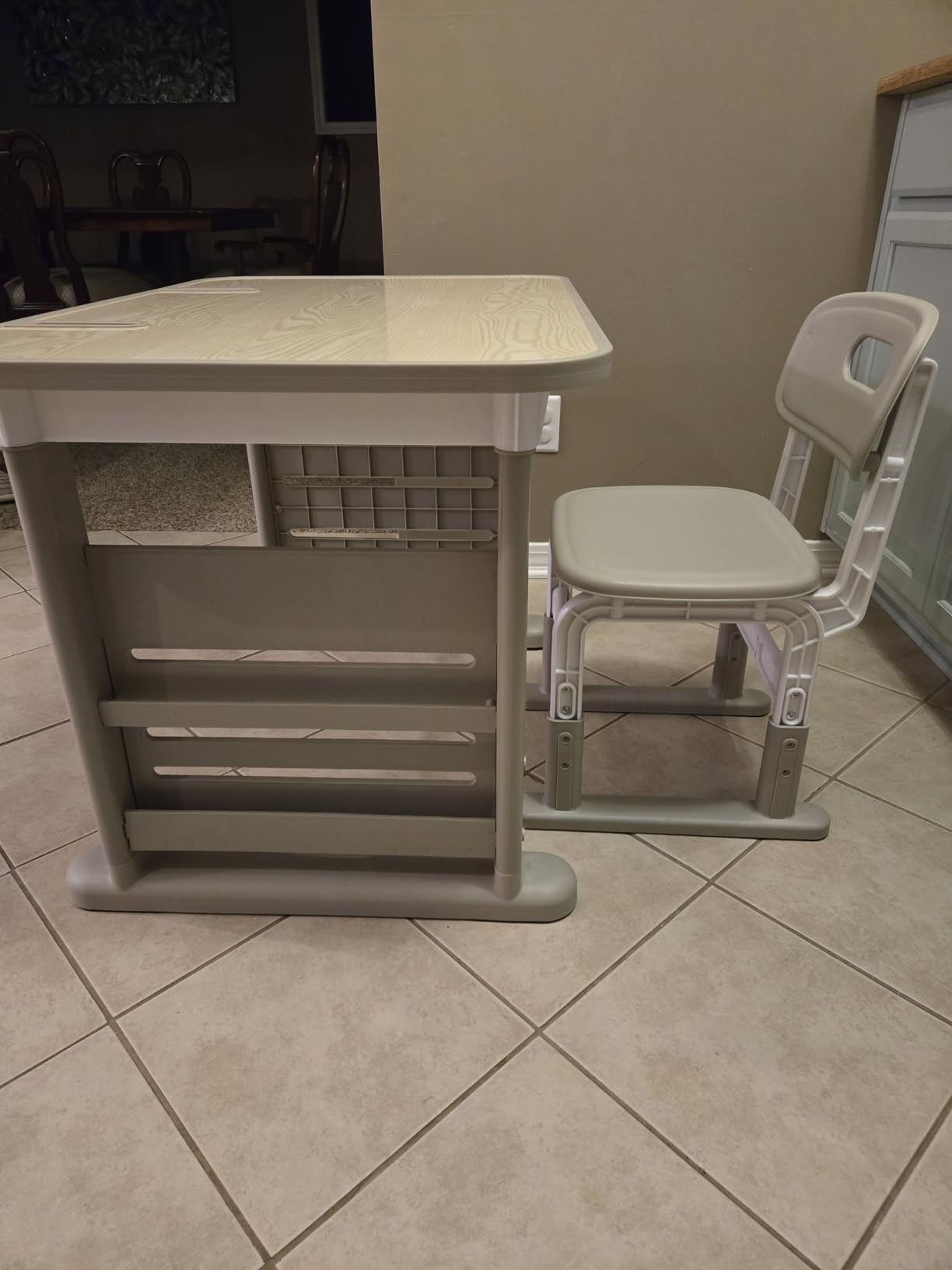
Assembly is the dominant complaint and it is a real one. Buyers report the desk needs 40 to 50 screws and the chair about 20, with leg alignment the tricky part, and a power screwdriver or impact driver is close to essential. The listing claims tool-free assembly in under 20 minutes; reviewers do not agree.
Desktop area: the reason to choose it
A 36 by 24 inch surface is big enough for a large sheet of paper spread out flat, which is exactly the situation where most kids desks fail. When a child is drawing, a surface that is too small becomes a scrap-catching tray rather than a workspace.
The wipe-clean finish is the second advantage. Crayon, marker and paint come off with a damp cloth, and that single property removes most of the objection parents have to putting a child’s desk in a bedroom.
Storage without a drawer
Two large side shelves give more visible, accessible storage than a single drawer, and a child can reach books without an adult opening anything. The trade is that the shelves are open, so the surface collects clutter unless you set a routine for clearing it.
There is no drawer at all, which is the most common specific complaint after assembly. For a family that already has a small storage cube in the room, the shelves are enough. For one that does not, factor in a separate unit.
Stability and a real safety note
The set weighs 38.6 pounds with rubber pads and rounded edges, and owners say it does not slide on the floor. One review does report the chair tipping when a toddler stands on it at the lowest setting, which is a behaviour worth ruling out in a house with a climber.
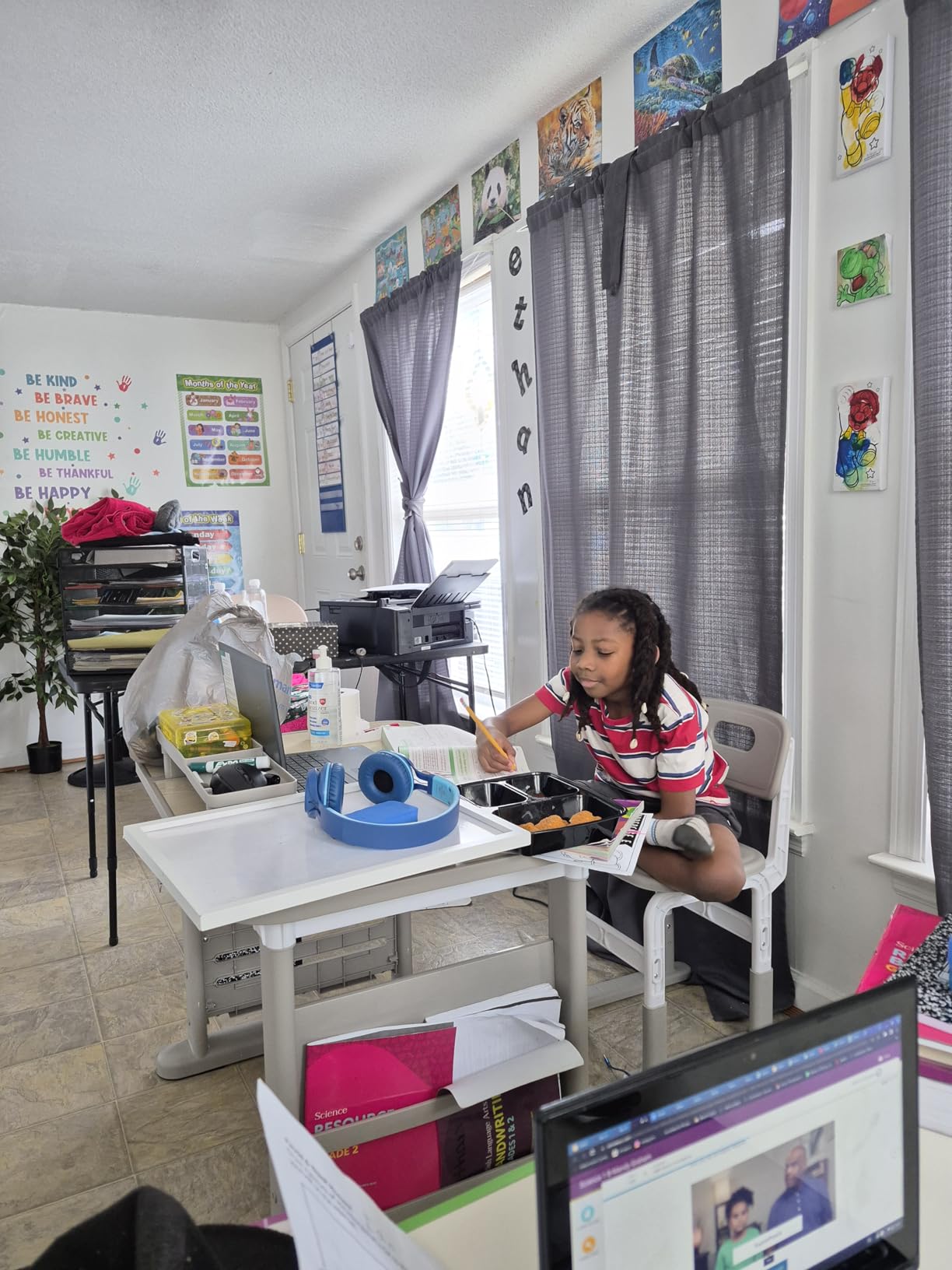
The wooden desktop on a plastic frame is a sensible construction for wipe-clean art use, and rounded edges are a genuine plus. Budget a proper afternoon for assembly and this becomes a strong choice for a child who draws more than they do.
8. Costzon Kids Study Desk – The Widest Tilt Range at 60 Degrees and an Independent Height Lever
- Tilt range reaches 60 degrees for drawing
- Child-operated lever height adjustment
- Safety hinge and anti-pinch handle
- Scale ruler printed along the desk edge
- Lowest average rating in this roundup
- Drawer and lower shelf stick or jam
- Top handle can detach
The Costzon is the only desk here whose height lever a child can operate independently, using a lever and locking knobs rather than a knob buried under the top. For a homeschool room where a parent is not in the room every minute, that is a practical advantage over designs that need an adult to loosen fasteners.
The tilt is the headline feature. Writing sits at 0 to 15 degrees, reading at 15 to 30 and drawing at 30 to 60, so the surface genuinely changes function rather than offering one alternate angle.
It has the lowest average rating in this group at 4.3 stars, and the reasons are consistent. The drawer and lower shelf stick or jam, the handle or clip that holds the top can detach, and the illustrated instructions are confusing, especially for the drawer.
Tilt angles mapped to real tasks
Splitting the tilt into task-specific bands is smarter than a single continuous ramp, because a child learns that writing, reading and drawing each have a position. At 60 degrees this reaches further than any other desk we tested, including the 55-degree Rengue set.
The soft-close hinge and safety hinge are thoughtful additions. Soft close matters in a house where a child’s hand is often on the edge of a moving desktop, and it prevents the slam that loosens cheap hinges over a year.
Height adjustment a child can do alone
The desktop runs from 20 to 29 inches on a lever and locking knobs. Twenty inches is low enough for a young elementary child, and the lever action means a small hand can raise it without the strength a twist knob under a heavy top demands.
That independence is what separates this from sets whose height changes require kneeling under the desk with a wrench. Parents on homeschooling forums consistently rate that single feature highest.
Storage, extras and what to watch
Multilayer open shelves on the tabletop, a large divided drawer below, a pen holder and a storage tray cover the categories of a school day well. The scale ruler printed along the desk edge is a small touch that turns the margin into a maths tool.
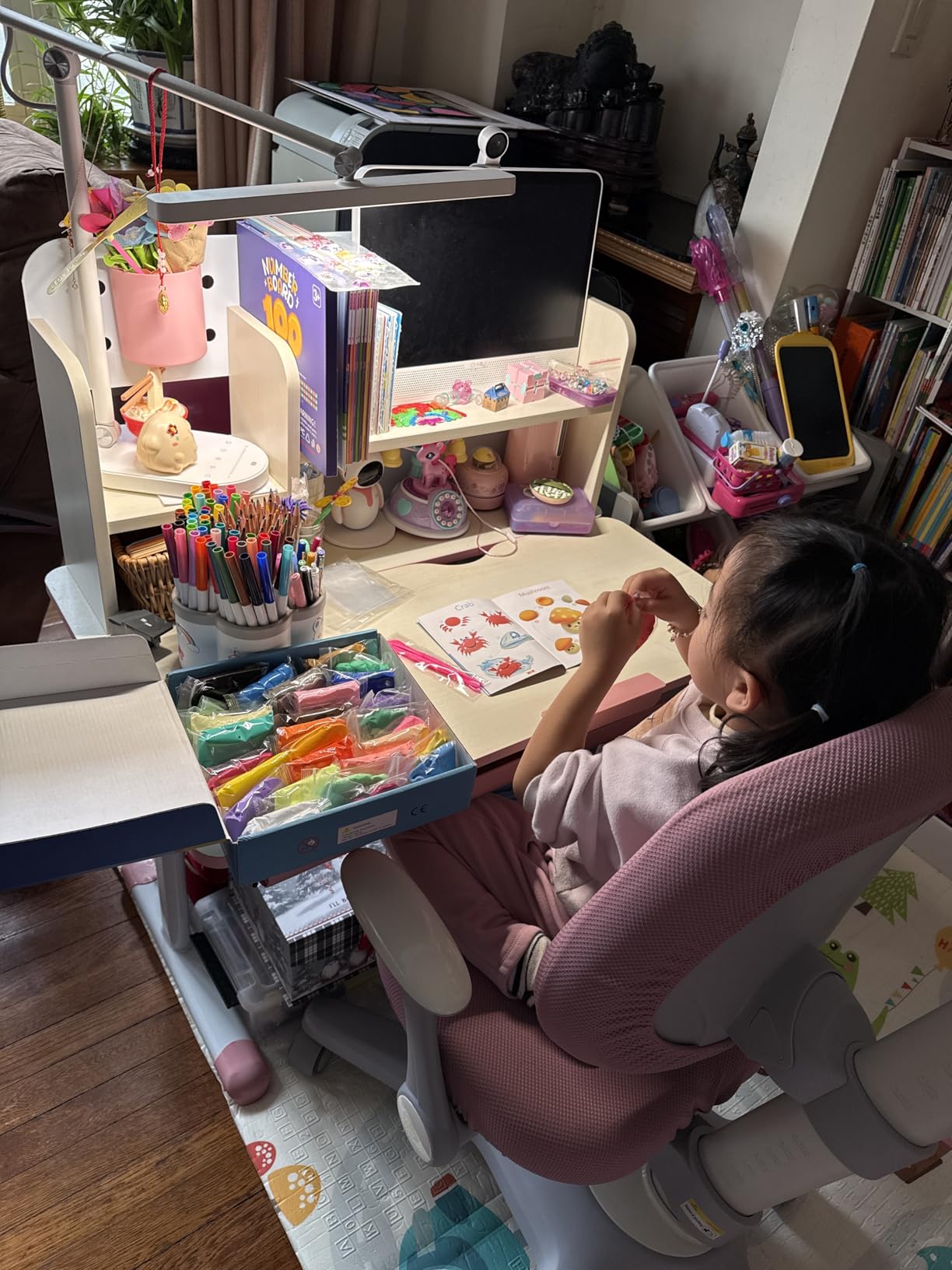
Check the top handle and clip after the first week of use, because detachment is the most repeated complaint and it is the part holding the surface in place. One reviewer also raised concerns about crumbling packaging foam as a choking hazard, so dispose of it before the child opens the box.
9. Xaperexi Kids Desk and Chair Set – The Longest Stated Age Span, Ages 3 to 15
- Stated 400 lb capacity for desk and chair
- Covers ages 3 to 15 on one set
- Non-slip foot pads remove wobble
- Anti-pinch device and rounded corners
- Tallest and longest footprint in the roundup
- Engined wood rather than solid wood
- Listing variants differ in configuration
The Xaperexi has the widest stated age span of anything here, from 3 to 15, and an unusually high 400-pound load rating for both the desk and the chair. That rating is a specification, not a promise, but it points to a frame specification that should handle a parent sitting on the chair or standing on the foot rails.
Reviews describe the adjustable range as genuinely fitting a child from preschool through early teens, which is the closest thing in this roundup to a single-desk solution for a family with a big age gap between siblings.
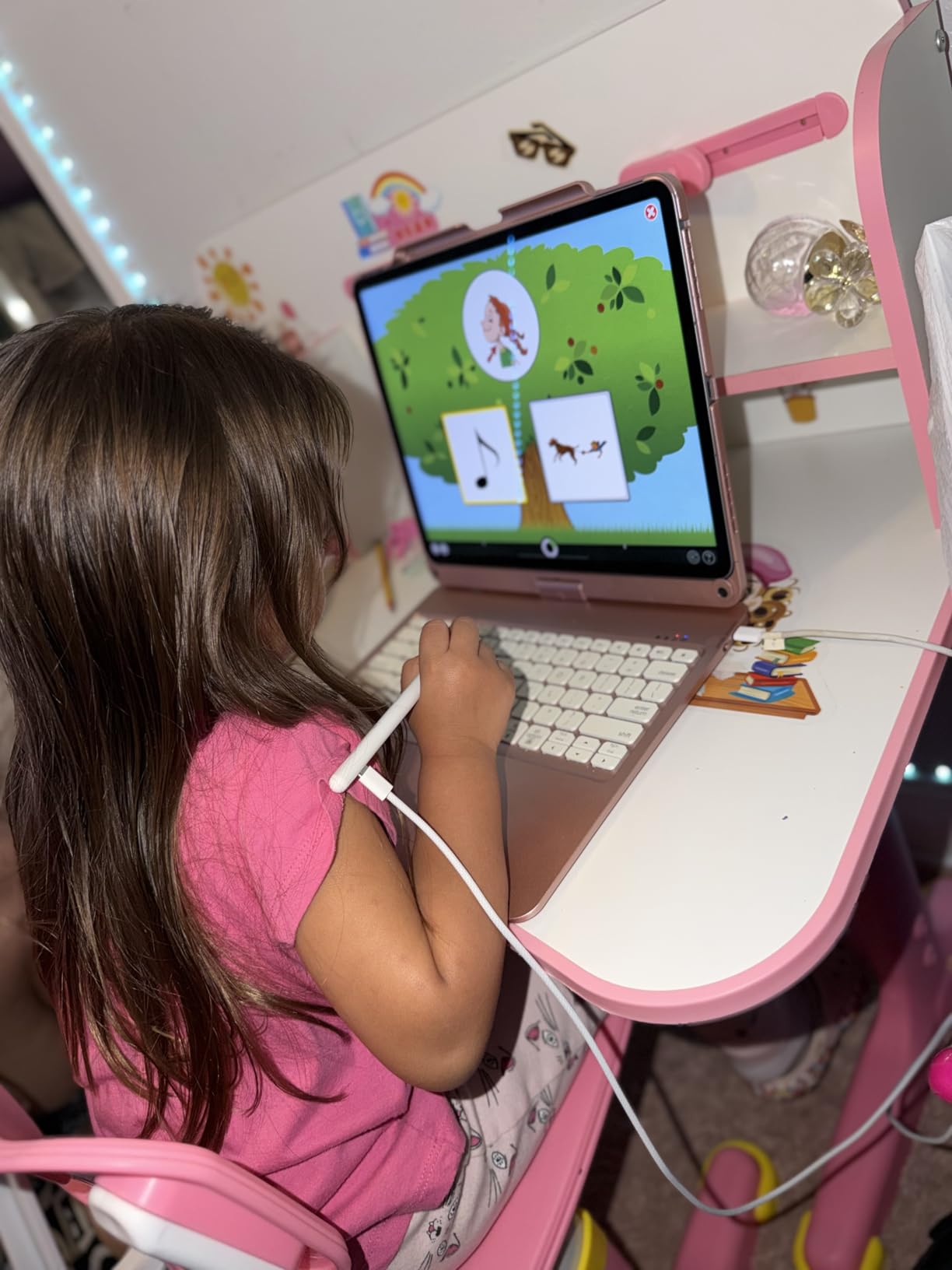
The footprint is the price of that range. At 29.7 inches long and 38.9 inches tall, it is the largest set we measured, and it needs a real wall rather than a corner. Measure the chair position too, not just the desk footprint, before ordering.
Load capacity and frame stiffness
A stated 400-pound capacity on both pieces is the highest figure in this roundup, and reviewers back up the practical claim by saying the non-slip foot pads eliminate wobble. If you plan to use the desk for a laptop plus a monitor arm, or you want an adult to sit alongside, the extra frame margin is useful.
The steel frame legs are the reason for that rating. Solid wood would be more premium, but engineered wood on a steel frame is the standard trade here, and FSC-certified bookcases and tabletops are a reasonable environmental floor.
Safety detailing: anti-pinch and rounded edges
The rounded corners, curved edges and an integrated anti-pinch device are the specific child-safety features to look for in this category, and this set includes all three. On a desk that a child will move themselves dozens of times a day, that matters more than a matching colourway.
Foot pads are non-slip, so the frame stays planted on carpet as well as laminate, which keeps the chair from skating when a child shifts weight while drawing.
Desktop, bookstand and drawer
The widened desktop gives real writing and drawing space, and the built-in bookstand plus storage drawer keep materials within reach. Reviewers like that the study area does not need a separate shelf to be functional.

Two practical cautions: the listing’s colour variants differ in shelf and desktop configuration, so confirm which one you are actually buying, and the 4.5-star average sits a little below the sets with simpler designs. Check the assembled dimensions against your room before it arrives.
10. GDLF Kids Desk and Chair Set – The Largest Work Surface and the Most Built-In Storage
GDLF Kids Desk and Chair Set, Height Adjustable Kids Study Table, Ages 5-12
- Largest desktop in the roundup
- Hutch plus two drawers plus side bag and shelf
- Padded chair seat and backrest
- Book stand whiteboard and hooks included
- Heaviest set at 85.1 pounds
- Costs more than every other set we tested
- Only three height settings
- Smallest review base at 70 ratings
At 44 by 23.6 inches, this is the largest work surface we tested, and the storage behind it is unmatched: a hutch, two drawers, a side fabric bag and a bottom shelf. If your child is moving into laptop homework or a tween needs a second monitor, this is the only desk in the roundup that handles the transition without another purchase.
The chair has a cushioned seat and backrest, which is the detail we would point to for a child doing 45-minute homework blocks. Standard flat-seated chairs on the cheaper sets are the first thing children slide off during long sessions.
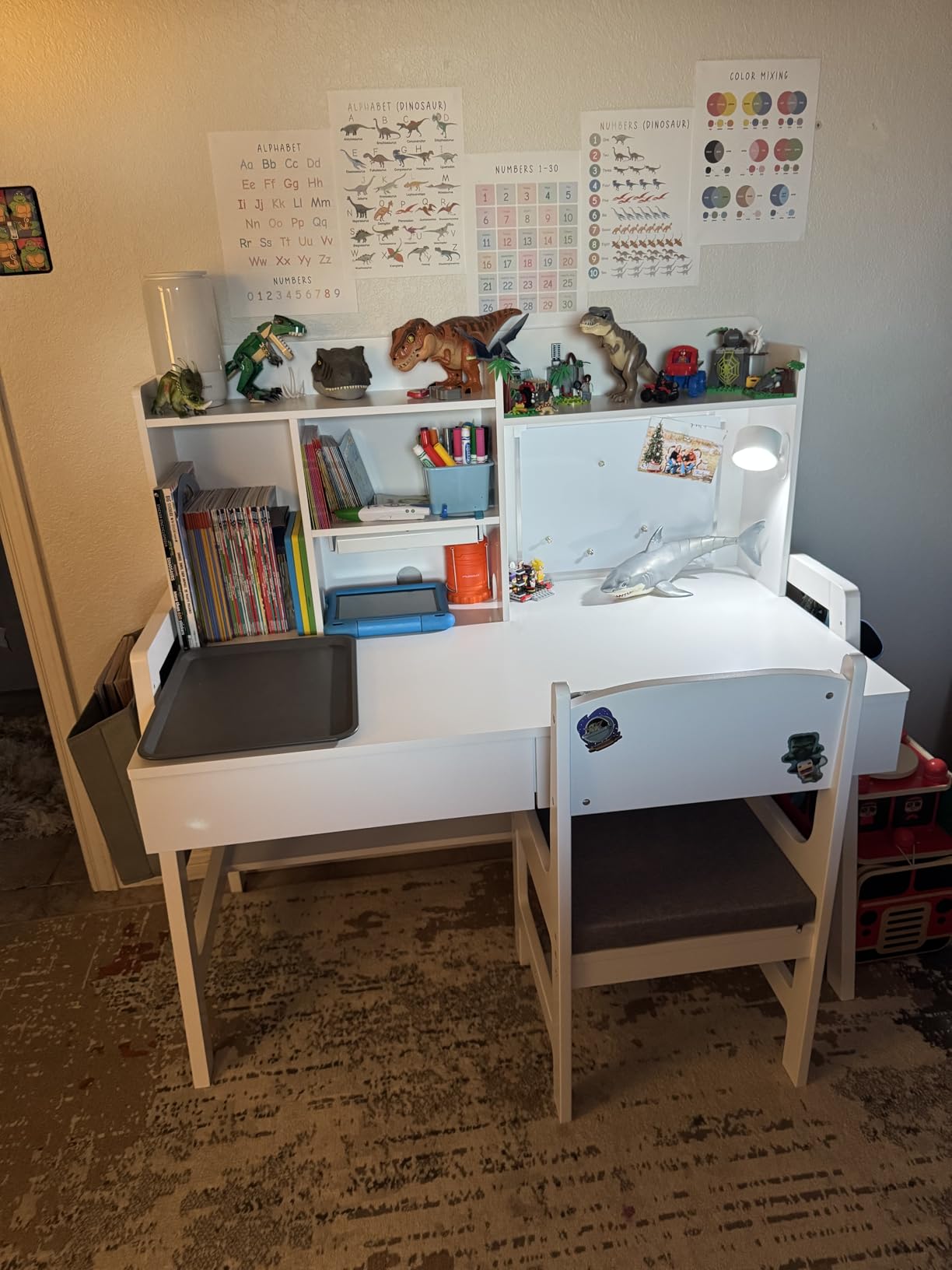
Two structural limits are worth planning around. Height adjustment is three discrete settings rather than a continuous range, so you cannot fine-tune to a specific child’s elbow angle, and at 85.1 pounds the set is hard to move between rooms once assembled. Measure the room you intend to keep it in.
Work surface and what it buys you
A 44-inch desktop changes the type of work possible. A tween can spread out a textbook, a notebook and a laptop at once, which is what a 20-inch kids desk forces into a stack. Several owners describe it as the desk that finally made homework work without constant clearing.
The scale matters in a shared room: this is a desk for a child aged 5 to 12 who is working alone at a laptop, not for a family eating at the table. The footprint is closer to an adult desk than a kids desk.
Storage depth and the hutch advantage
The hutch is the differentiator. Vertical storage above the desktop means supplies are in reach without taking up surface area, and the two drawers plus side fabric bag keep the desktop clear during a work session rather than after it.
Reviewers also like the foldable book stand, the whiteboard and the hooks as standard inclusions. That is real value in a category where accessories are usually sold separately.
Materials, certification and the three-setting limit
The engineered wood is CPSIA certified with a scratch-resistant laminated finish, which is the right filter for a child’s bedroom. Round-corner design is standard here, and the reinforced construction is what carries the 85-pound weight.
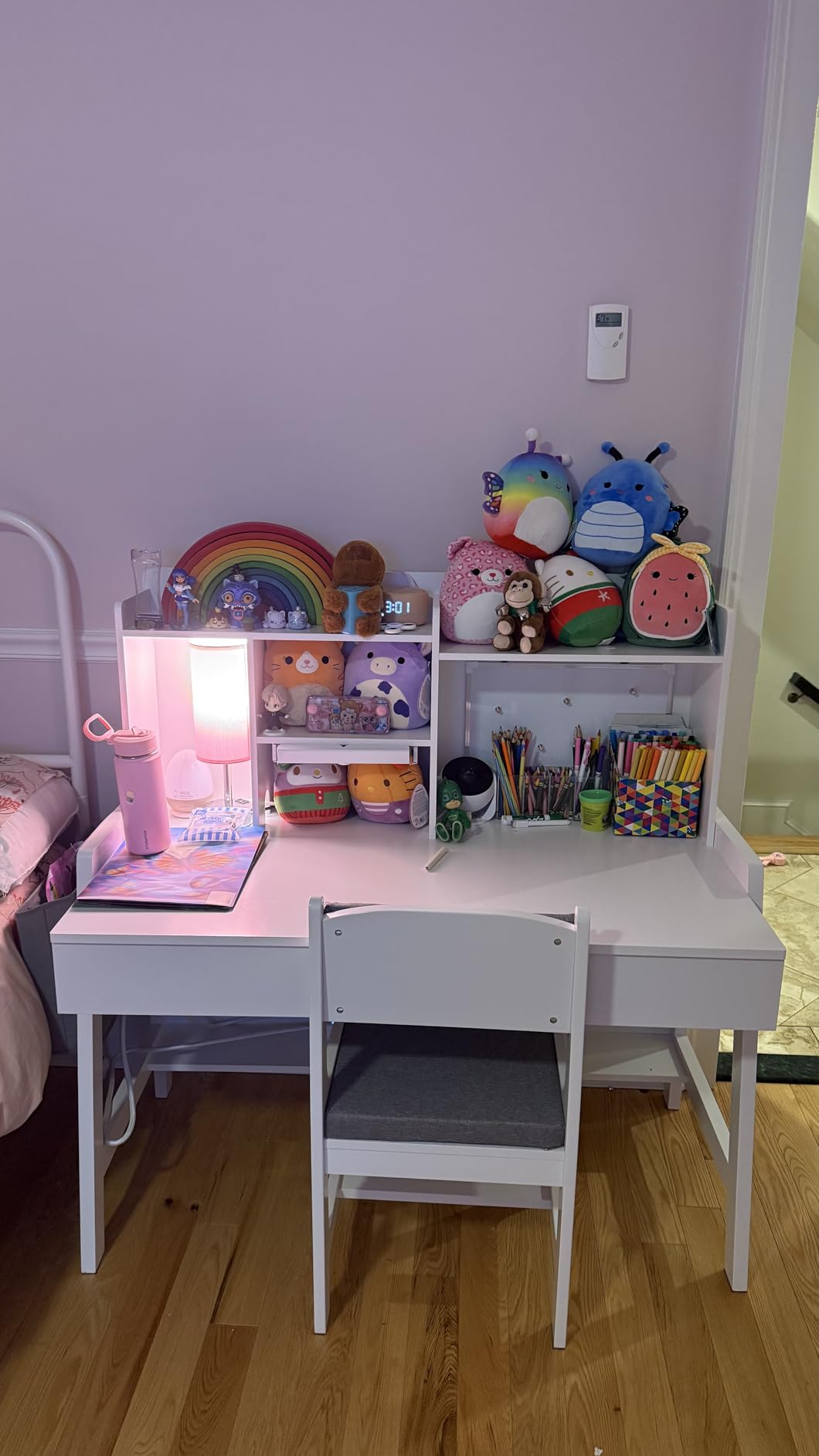
With 70 ratings it is the least-reviewed set here, and it also costs more than every other desk we tested, so treat long-term durability claims as unproven. For a child aged 9 or older with real homework, the surface size justifies it. For a kindergartner, it is far more desk than needed.
How to Choose an Adjustable Height Desk for Kids
The ten desks above all adjust. What separates a good one from a disappointing one is whether the adjustment range covers your child, whether the child can use it alone, and whether the desk fits the room. Work through these criteria in order and the choice usually makes itself.
How high should a child’s desk be by age?
Measure your child’s standing height with a tape measure and use the seated band below. Then set the chair first, sit the child in it, and adjust the desk until the elbows are at roughly 90 degrees with shoulders relaxed, feet flat on the floor and the desk surface about 8 inches above the chair seat. Mark that height with a piece of tape so you can return to it.
Two errors are common and easy to fix. Too high a desk with a low chair causes slouching; too low a desk with a high chair causes a child to perch on the front edge. The monitor riser principle applies at small sizes too: raise the screen, not the desk, for screen work.
Manual, pneumatic or electric: which mechanism fits your child
Every adjustable desk in this roundup uses one of three mechanisms, and the choice is mostly about who operates it and how often.
Manual crank and lever systems are the most common in kids desks. They are durable, quiet and need no power, and a child from about age 6 can usually work a lever or lift a column themselves. Pneumatic lift systems adjust with a lever and a gas spring, giving a smooth single-motion change but requiring the desk to be light enough to push down. Electric motors need a mains connection, produce some noise, and are almost never found on a child-height desk, though a parent may add one later to an adult desk in the same room.
Parents on homeschooling forums make the same point repeatedly: independent adjustability matters more than mechanism sophistication. A desk a child cannot change themselves creates a mid-lesson interruption every time their body outgrows the setting.
Tilt top, flat top, or both
A tilt top is worth it for handwriting, drawing and reading, and the useful ranges run from 0 to 40 degrees for a general-purpose set up to 55 or 60 degrees for a dedicated drawing easel. A continuous tilt is smoother than a stepped one, and a soft-close hinge prevents a child’s fingers being caught.
A flat top wins on laptop use and on anything a child places at the back edge, because there is nothing to catch. If a desk is going to hold a screen for online classes, a flat top with a separate riser is a legitimate choice; if it is going to hold a workbook, tilt.
Storage that survives a real school week
Judge storage by what it swallows, not by how many features it has. A single deep drawer that holds a week’s stationery is worth more than three shallow compartments. A book stand that holds an open textbook reduces the neck strain of looking down repeatedly, and a side hook stops a backpack becoming a floor obstacle.
Skip open shelves if your child does not clear them, and skip a drawer if the sliding mechanism has been reported as stiff in reviews. None of the drawers here require tools to remove, but a jammed drawer is the single most common reason a desk ends up unused.
Stability, pinch points and other child-safety checks
Push the loaded top hard at full extension. A frame that shifts or rocks under load will feel unstable to a child even if it does not tip. Non-slip foot pads and self-leveling glides are what stop a desk from racking on carpet, and locking casters matter if a younger sibling is in the room.
Look for rounded corners, an anti-pinch cut-out around the height adjustment handle, and a soft-close or safety hinge on a tilting top. A motorized adult desk in a house with a toddler is a genuine concern parents raise on forums, and the answer is to keep the desk out of reach and never leave a motor running unattended.
On materials, ask for low-VOC certification if the desk will be in a bedroom. UL GREENGUARD Gold, CPSIA compliance and FSC-certified panels are the specific marks worth looking for, and laminate is the easiest surface to wipe clean.
Pairing the desk with a chair, wobble stool or footrest
The desk height is only half the equation. If the chair is a fixed height and the desk adjusts, the child ends up dangling or perching, which defeats the purchase. That is why nine of the ten sets here adjust the chair as well, and why a desk-and-chair set usually costs less than solving the problem with two separate buys.
For a child who cannot sit still, an active seat such as a wobble stool or balance stool is reported by parents as making a measurable difference during video classes. A footrest solves the dangling-feet problem instantly when the desk minimum is too high, which is the standard workaround for adult desks in a shared room.
What we would skip and why
We would skip an adult electric sit-stand desk as a children’s solution. A minimum height around 27 inches is above what a child under about seven needs, and a footrest does not fix a surface that is 5 inches too high. We would also skip any fixed-height kids desk in a home with a child entering elementary school, because the outgrowing cycle is what drives repeat purchases.
We would avoid desks whose listings publish no height range at all. An adjustable desk with no stated minimum and maximum cannot be checked against your child, and it is the single most useful specification on the page.
One more filter: cost per year. A desk that lasts three elementary years at a higher price is often cheaper than a cheaper one replaced in year two, and parents on forums consistently frame the decision that way once they have been through one replacement cycle.
Frequently Asked Questions
How high should a child’s desk be?
Preschool children aged 3 to 5 need a desktop between 18 and 22 inches. Elementary-aged children aged 6 to 11 need 22 to 28 inches, and tweens need 28 to 30 inches. Set the chair first so the child sits with feet flat, then raise the desk until the elbows are at about 90 degrees and the surface sits about 8 inches above the chair seat.
What is the 20-8-2 rule for standing desks?
The 20-8-2 rule says that in every half hour of desk work a child should spend about 20 minutes sitting, 8 minutes standing and 2 minutes moving or stretching. The point is not to stand all day. It is to break up long sedentary stretches, which keeps a child more comfortable and alert during homework or online classes.
Is there an adjustable desk for kids?
Yes. Kids adjustable height desks come in manual lever and crank versions, pneumatic lift versions and electric motorised versions. Most are sold as a desk and chair set where both pieces adjust, and height ranges typically start between 20 and 21 inches and end between 28 and 30 inches, which covers preschool through elementary years.
What type of desk is best for kids?
For most families a manual lever or crank desk and chair set is the best balance, because a child can change the height without an adult and no power is needed. Choose a pneumatic lift if you want a single smooth push motion. Choose an electric desk only if a parent will also use the surface, since most electric models have a minimum height near 27 inches that is too high for a young child.
What height table does a 7 year old need?
A 7 year old typically needs a desk between 22 and 25 inches with a chair seat around 14 to 16 inches. Most children of that age are between 44 and 50 inches tall. Check that the desk minimum is below 22 inches, since a set that starts at 24 inches will leave the child perched on a high chair with dangling feet.
Are electric standing desks safe for toddlers?
A motorised desk is safe if it is used with supervision. Keep children away from the moving desktop, fit the keyboard tray and any loose cables, and never leave the motor running unattended. Many parents prefer a manual crank or lever desk in a room with a toddler precisely because there is no motor, no power cable and no pinch risk during movement.
Which Adjustable Desk Fits Your Child
If your child is under six and you want the widest possible span from one purchase, the Mount-It! set covers ages 3 to 10 with an adjustable desk and chair. If you need the lowest starting height we found for a preschooler, the Rengue set drops to 20.86 inches and pairs it with a 55-degree tilt. If you want one surface that goes from sitting to standing, and a child old enough to use it, the ECR4Kids mobile desk is the only option here with that range, and its casters let it move between rooms.
For a child aged seven or older who draws or does heavy handwriting, the Diroan set gives the best storage and accessories combination, and the Costzon desk offers the widest tilt range at 60 degrees with a lever a child can operate alone. When a tween starts laptop homework and the desktop becomes the bottleneck, the GDLF set has the largest work surface and the most built-in storage. For tight rooms, the Artist hand set has the shallowest desktop in the group.
Measure your child’s standing height, check the minimum and maximum against the chart above, and confirm the assembled footprint including the chair position before ordering. That three-minute check prevents nearly every regret we hear about. We have covered the child-height end of the market here, so if you are outfitting an adult workspace in the same room, our guide to the best standing desks covers the taller half of the problem, and the adjustable plyo box guide is worth a look if movement breaks are part of your plan.