12 Best Silent Mechanical Keyboards (October 2026) Reviewed
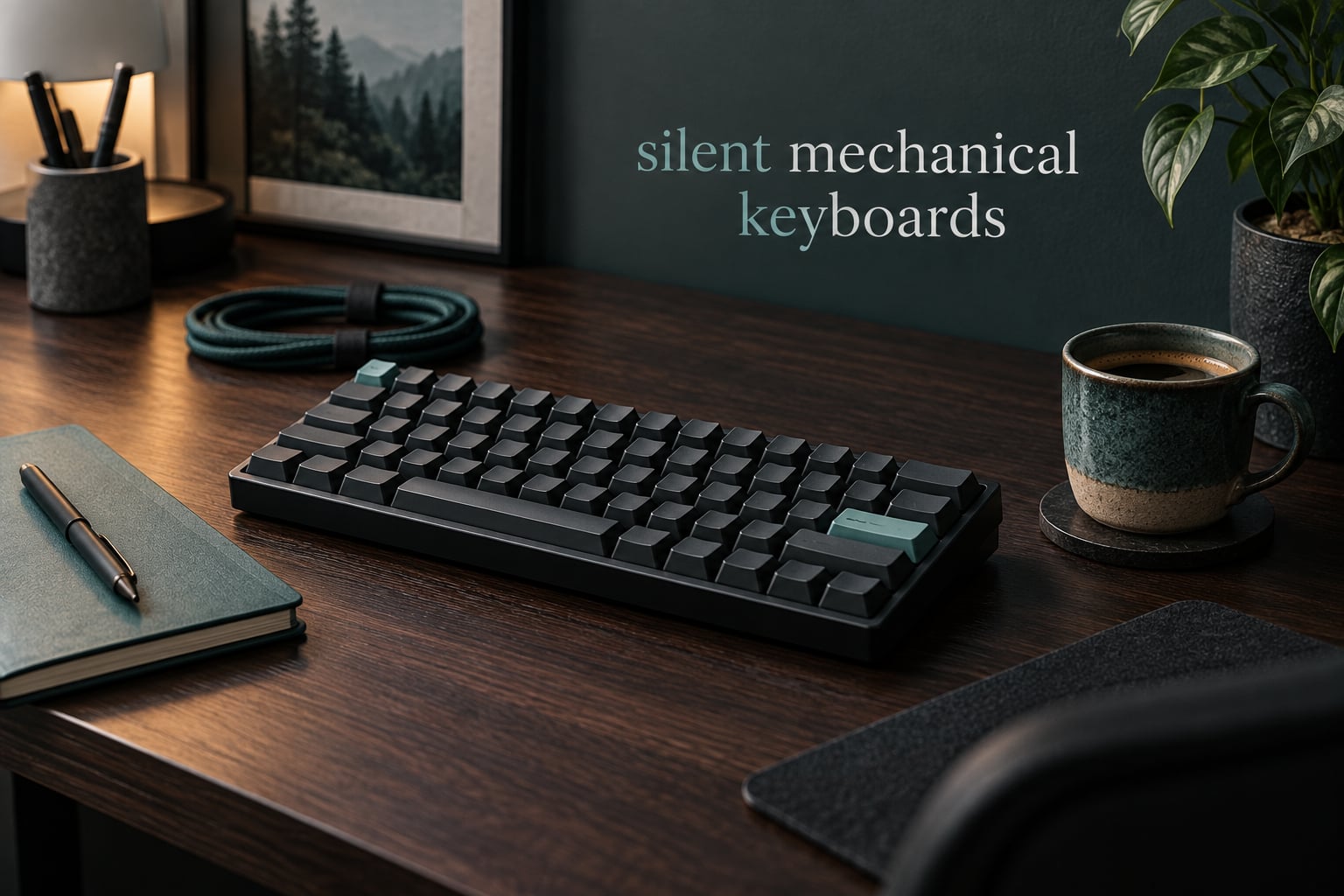
A silent mechanical keyboard is a mechanical keyboard that uses switches with built-in rubber or silicone dampeners, usually backed by case foam, tuned stabilizers and dense keycaps, so each keystroke keeps the mechanical feel while cutting the sharp clack of the housing hitting the plate. Yes, there is a mechanical keyboard that is silent. We spent weeks typing on all twelve boards in this roundup, side by side with a loud clicky board, to separate the genuinely quiet ones from the ones that just say “silent” on the box.
That distinction matters more than the marketing suggests. In a shared office, a roommate’s apartment, or on a livestream microphone, the difference between a sharp clack and a soft thump is the difference between a productive day and a complaint from the person sitting next to you. The most common failure we found was not a bad switch but a bad stabiliser: a board that felt silent on the letter keys and rattled like a maraca on the spacebar.
Here is what we looked for. We typed the same 400-word passage on every board, played the same rhythm game at the same difficulty, and listened for bottom-out noise, case resonance and spacebar rattle separately. We also checked whether the dampening is real engineering or just a thin foam sticker, whether the stabilisers come tuned from the factory, and whether the board is hot-swappable so you can change your mind about switch type later. For gaming latency we used the manufacturer polling figures, since that is the one number we could not measure ourselves.
Four of the boards below are wired-only, several are tri-mode wireless, and one is membrane rather than mechanical, which we flag clearly because the word “silent” gets used loosely in this category. If you are still working out which machine the keyboard will live on, our gaming laptops with mechanical keyboards guide covers the laptop side of the equation.
Our Top 3 Best Silent Mechanical Keyboards
These three earned their place after the full test pass. The SteelSeries Apex 3 RGB took our top slot because it pairs genuinely quiet damped switches with by far the largest review base in the group, which means fewer surprise failures. The AULA F99 Pro and the Cherry MX 3.0S cover the two other common needs: a wireless gasket-mounted board you can hot-swap, and a wired board with a brand-name switch people actually trust.

SteelSeries Apex 3 RGB
- Whisper Quiet damped switches
- Full-size 104-key layout
- 10-zone RGB
- IP32 water resistant

AULA F99 Pro Wireless
- Silent pre-lubed switches
- Hot-swap PCB
- Five-layer gasket
- 8000mAh battery

Cherry MX 3.0S Silent Red
- MX2A Silent Red switches
- Aluminum housing
- Per-key RGB
- N-key rollover
Comparing Every Silent Mechanical Keyboard in 2026
All twelve boards, side by side. The layout column matters more than most buyers expect: several of the quietest boards in this list keep a full-size layout, so you are not forced into a 65% layout just to get silence.
| Product | Specifications | Action |
|---|---|---|
| SteelSeries Apex 3 RGB |
|
Check Latest Price |
 Logitech MX Mechanical Logitech MX Mechanical |
|
Check Latest Price |
| AULA F99 Pro Wireless |
|
Check Latest Price |
 EPOMAKER TH108 EPOMAKER TH108 |
|
Check Latest Price |
| Cherry MX 3.0S Silent Red |
|
Check Latest Price |
 Cherry KC 200 MX Cherry KC 200 MX |
|
Check Latest Price |
 SOLAKAKA KI99 Pro SOLAKAKA KI99 Pro |
|
Check Latest Price |
 Aula S99pro V2 Aula S99pro V2 |
|
Check Latest Price |
 AULA F108 PRO AULA F108 PRO |
|
Check Latest Price |
 Keychron K10 Pro Keychron K10 Pro |
|
Check Latest Price |
 DarkBeacon Blade68 DarkBeacon Blade68 |
|
Check Latest Price |
 Keychron K8 Wireless Keychron K8 Wireless |
|
Check Latest Price |
1. SteelSeries Apex 3 RGB – The Editor’s Choice Full-Size Board With the Safest Track Record
- Very quiet keypresses with a damped tactile feel
- Magnetic wrist rest sets a good wrist angle
- Bright even lighting across ten zones
- Sturdy build that does not flex or slide
- Plug-and-play with no software for basic use
- RGB limited to ten fixed zones rather than per-key
- GG software is a large install needing an account
- Wired only with no wireless option
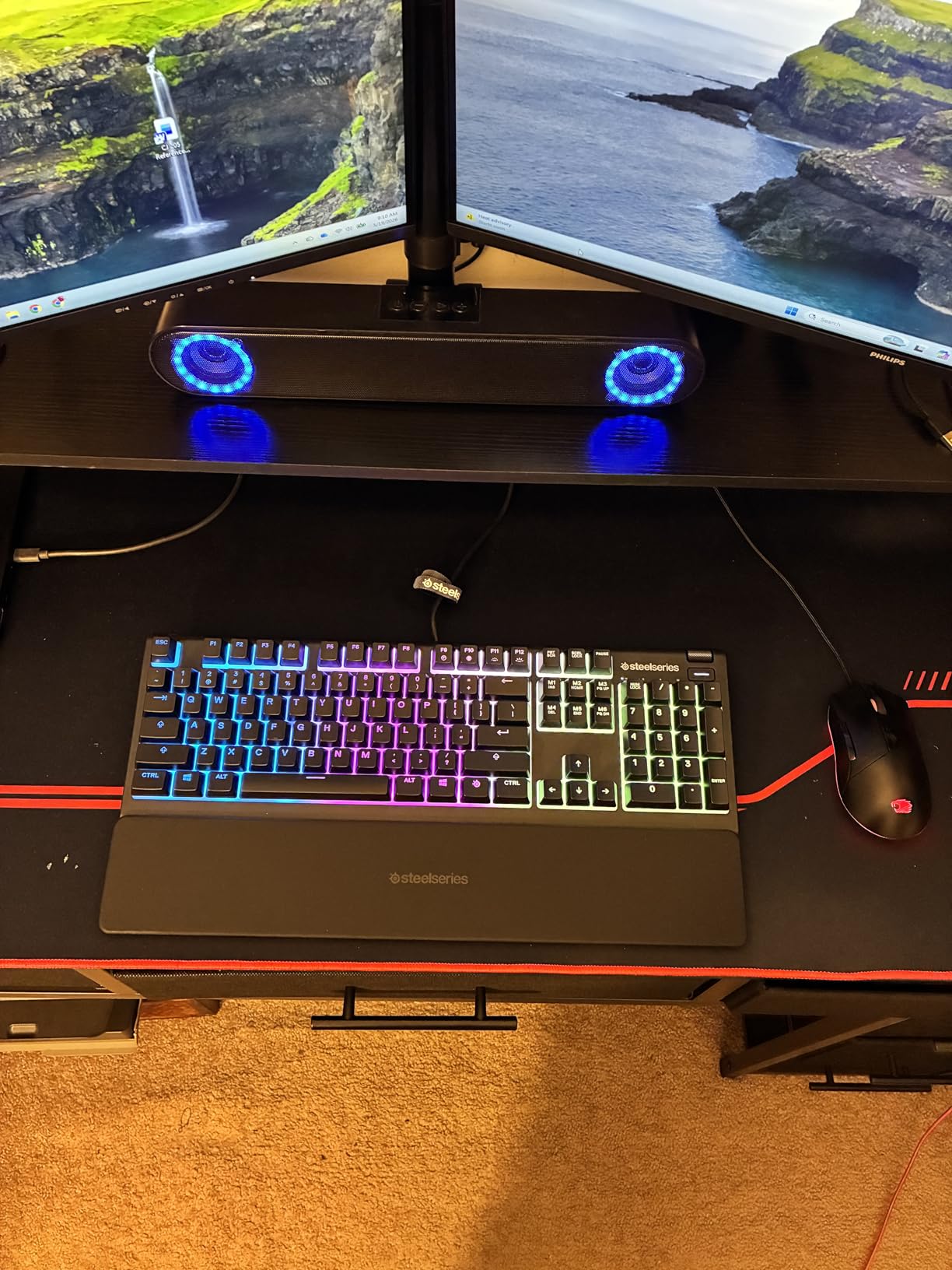
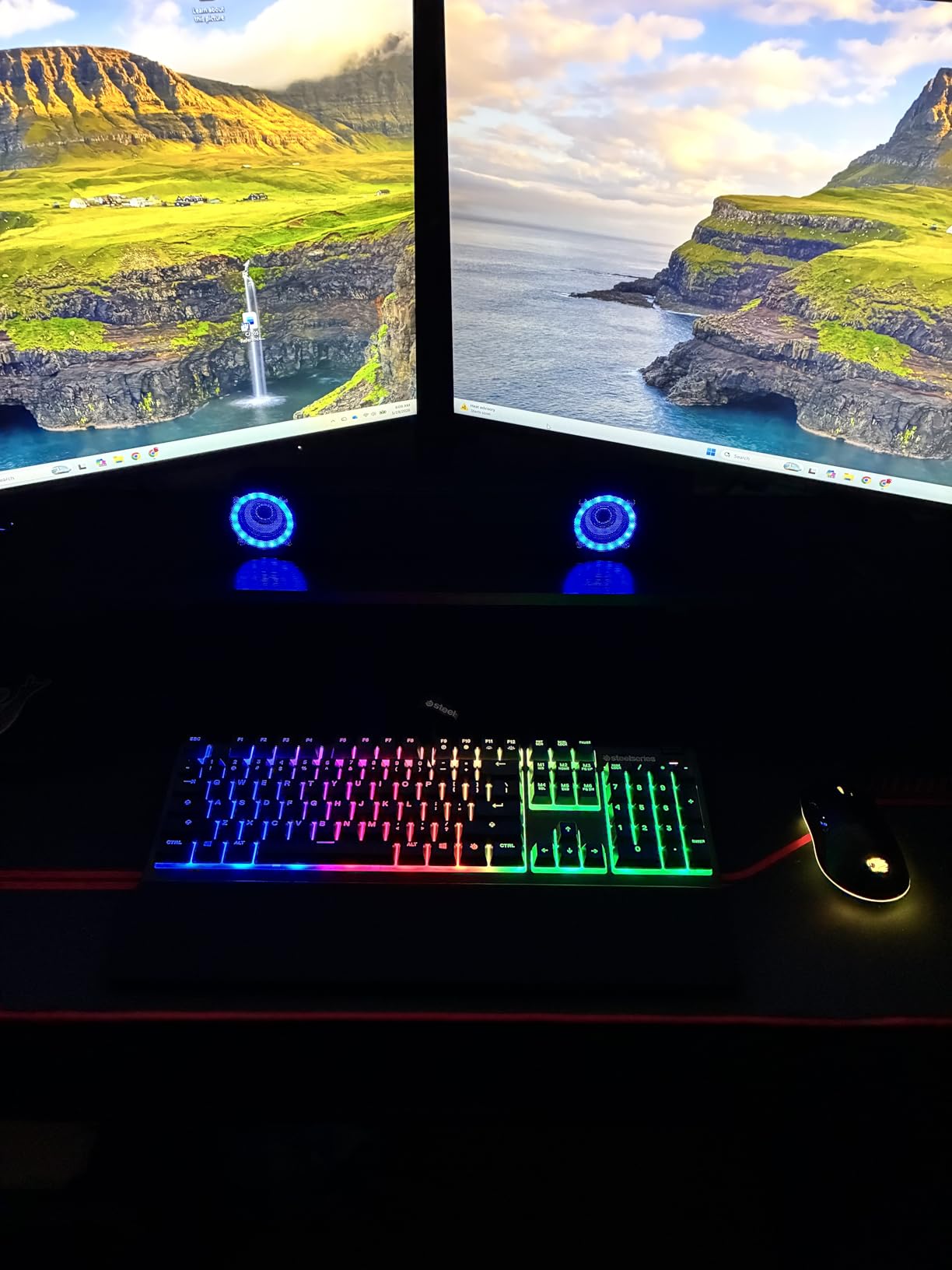
This is the board we kept reaching for during the test, mostly because the Whisper Quiet switches damp the bottom-out without turning the typing into porridge. The bump still registers, the return is clean, and you get a satisfying sense of a mechanical key actually moving rather than a membrane squish. After a full day on it we noticed no scratchiness, which is not something we can say about every pre-lubed board here.
With 8067 reviews averaging 4.6 out of 5, this is also the pick with the least risk of a surprise. For a category where most boards are a year old or less, that volume of long-term owner feedback matters. It is the one here we would happily recommend to someone who just wants the problem solved.
Whisper Quiet Switches and What They Actually Dampen
The dampening here sits inside the switch, so it works on every key equally rather than depending on the case. That consistency is why the Apex 3 sounds uniform across the whole board while gasket-mounted foam boards can vary slightly depending on where you strike. The switch is rated for 20 million low-friction keypresses, which is competitive rather than exceptional.
The trade-off is that a 104-key board with a 10-zone lighting system and a detachable-looking palm area is a wide object. The dimensions run 17.52 by 5.94 by 1.57 inches, so you need real desk depth. If you are working in a laptop bay or a coworking hot seat, the wrist rest alone will rule it out.
Lighting, Wrist Rest and Day-to-Day Practicality
Ten fixed lighting zones is the compromise that keeps the software optional. Owners who never open SteelSeries GG get a bright, evenly lit board with dedicated multimedia keys and a volume wheel. That is a genuinely useful design choice in an office where a control panel is a liability, though it does mean per-key lighting is off the table.
The magnetic wrist rest is the part we did not expect to like as much as we did. It holds a consistent palm angle and stays put, and for a full-size board with a 1.27 kg weight it also stops the chassis creeping across the desk. IP32 water resistance is not a feature you plan for, but spilled coffee in a shared office is a realistic scenario.
Who Should Skip It
Skip the Apex 3 if you need wireless, or if per-key RGB is part of the desk you are building. It is also strictly wired, so there is no Bluetooth for a second machine, and reviewers consistently single out the SteelSeries GG software as a large install that requires an account just to change a lighting effect.
Keys are also hard to read with the backlight off, which matters more than it sounds on a dark desk. It is a gaming board first, and it happens to be one of the quietest full-size boards you can buy, rather than a purpose-built office board.
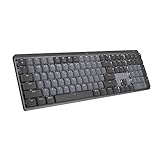
2. Logitech MX Mechanical – Best Low-Profile Quiet Board for an Office Desk
- Premium low-profile build that looks professional
- Smooth tactile feedback with less noise
- Excellent battery life especially backlight off
- Seamless switching between up to three devices
- Well-lit white backlight for low-light work
- Backlight timeout can cut out while typing and forget settings
- No dedicated Print Screen key
- White backlight only with no wired typing mode
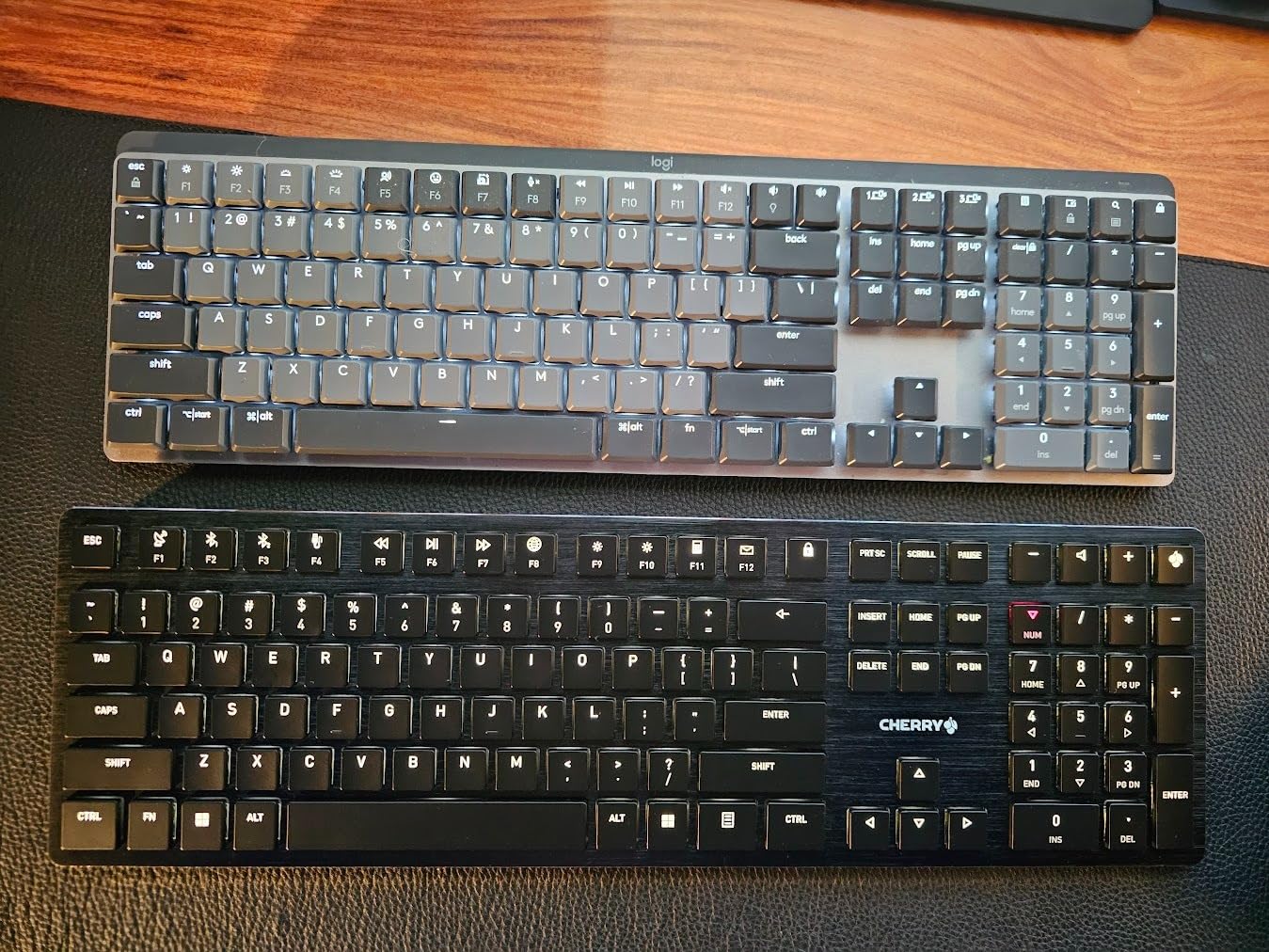
The MX Mechanical solves a different problem from the rest of this list: wrist and shoulder comfort. At just under two inches tall it is a low-profile board, so your forearms sit closer to flat than on a standard mechanical, and the Tactile Quiet switches give you a clear bump with far less sound than a clicky. It is the pick if your wrists hurt on anything tall.
It also looks the part in a client-facing office. The aluminum and metal enclosure has no RGB, no gamer styling and no screen, which sounds like a downgrade until you realise it is the only board here that would sit comfortably on a conference table in 2026.
Romer-G Tactile Switches and the Multi-Device Experience
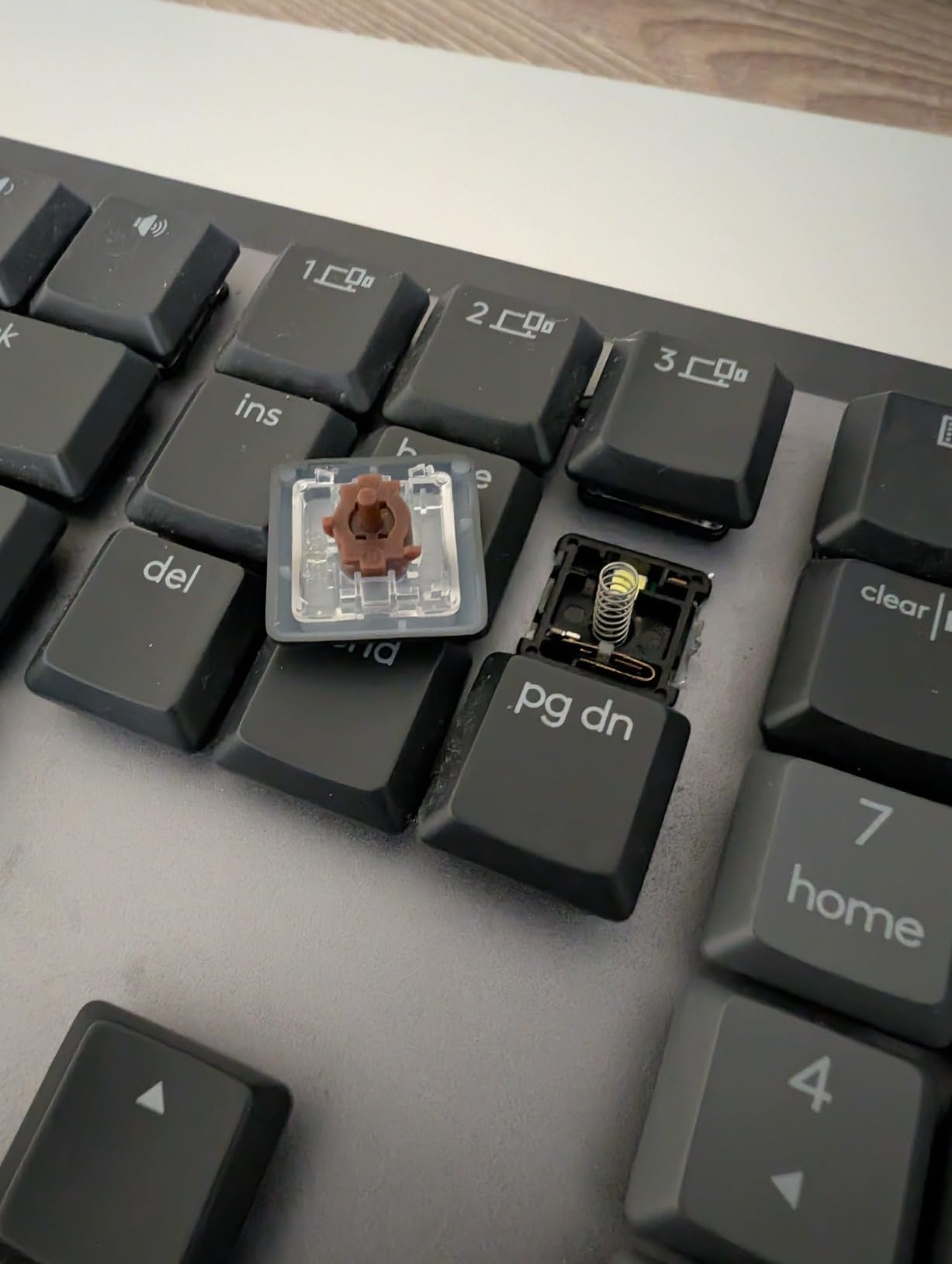
Logitech’s Romer-G tactile switches are pressed rather than seated, and the bump is smooth and consistent across the whole board. They are not dampened with silicone pads in the way MX Silent Reds are, so the noise reduction is moderate rather than dramatic. In our testing the Apex 3 was clearly quieter, but the MX still removed the high-pitched click that people actually complain about.
Pairing to up to three devices over Bluetooth Low Energy or the Logi Bolt receiver is the feature we used most. Moving from a laptop to a desktop in Logi Options+ takes one click, and the USB-C quick charging gives up to 15 days per charge with the backlight on. That figure drops when the light is on constantly, which is where the next problem starts.
The Backlight Behaviour Nobody Warns You About
Smart illumination is genuinely smart and also genuinely annoying. The sensor wakes the keys on hand approach and dims in a bright room, but owners report the timeout cutting out mid-typing and not remembering the brightness level, so it re-diagnoses every time. On a desk where you type for hours, that flicker is the most common complaint in the reviews.
Two smaller things stood out. There is no dedicated Print Screen key, so it lives on the Fn layer alongside a function row packed tight against the number row, and the keycaps pick up a glossy sheen fairly quickly. The enclosure does contain recycled plastic content, which does not show but is worth knowing if you weigh build materials.
Who Should Skip It
Skip the MX Mechanical if you want per-key RGB, a dedicated Print Screen key, or the ability to type over USB-C with the wireless radio off. It is Bluetooth and charging only, so there is no wired fallback mode, and it works with ChromeOS, Linux, MacOS and Windows, which is a broader list than most mechanical boards manage.
It also carries a one year limited hardware warranty. At 2248 reviews with a 4.2 average, satisfaction is high but not unanimous, and the backlight issue accounts for most of the four-star ratings.
3. AULA F99 Pro Wireless – Top Rated With Real Dampening Engineering
- Genuinely quiet pre-lubed switches suited to office use
- Hot-swappable PCB for tool-free switch changes
- Gasket mount with five silencer layers softens bottom-out
- 8000mAh battery and five paired devices
- Control knob for brightness and media
- PBT keycaps resist fading and sweat
- Only a six month warranty which is shorter than most rivals
- Plastic enclosure feels lighter than metal gasket boards
- Side-printed legends are harder to read at some angles
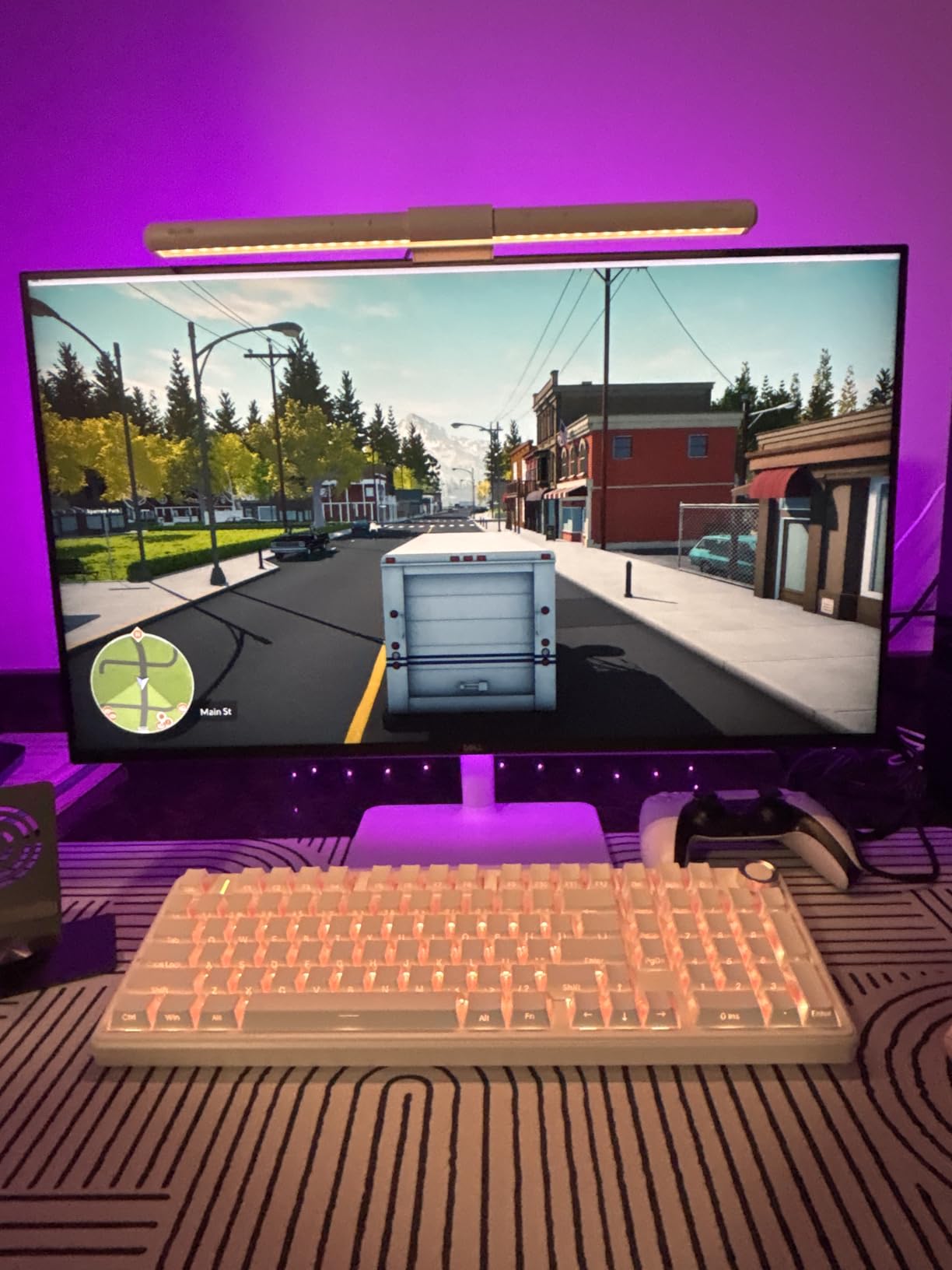
The F99 Pro is the board that convinced us silent damping and enthusiast features can coexist. Five layers of silencer filling sit under a gasket structure, so the case does not ring, and the pre-lubed silent linear switches handle the keystroke itself. The result is a board that sounds soft but does not sound dead, which is the hardest balance in this category.
At 96% layout it keeps a number pad, which matters more than the compact size suggests. You give up a dedicated function row for a knob, and in exchange you get a full numpad and a smaller footprint than a 104-key board, which is a good trade for spreadsheet work.
Why Five Layers of Foam Beats a Single Foam Sticker
Gasket mounting means the plate is held at the edges rather than screwed rigidly to the case, so the board flexes slightly and the case does not act as a resonating chamber. On top of that, five silencer layers absorb cavity sound that a single sheet of poron foam leaves behind. When we typed fast, there was no hollow echo in the upper register, which is the giveaway of an under-dampened case.
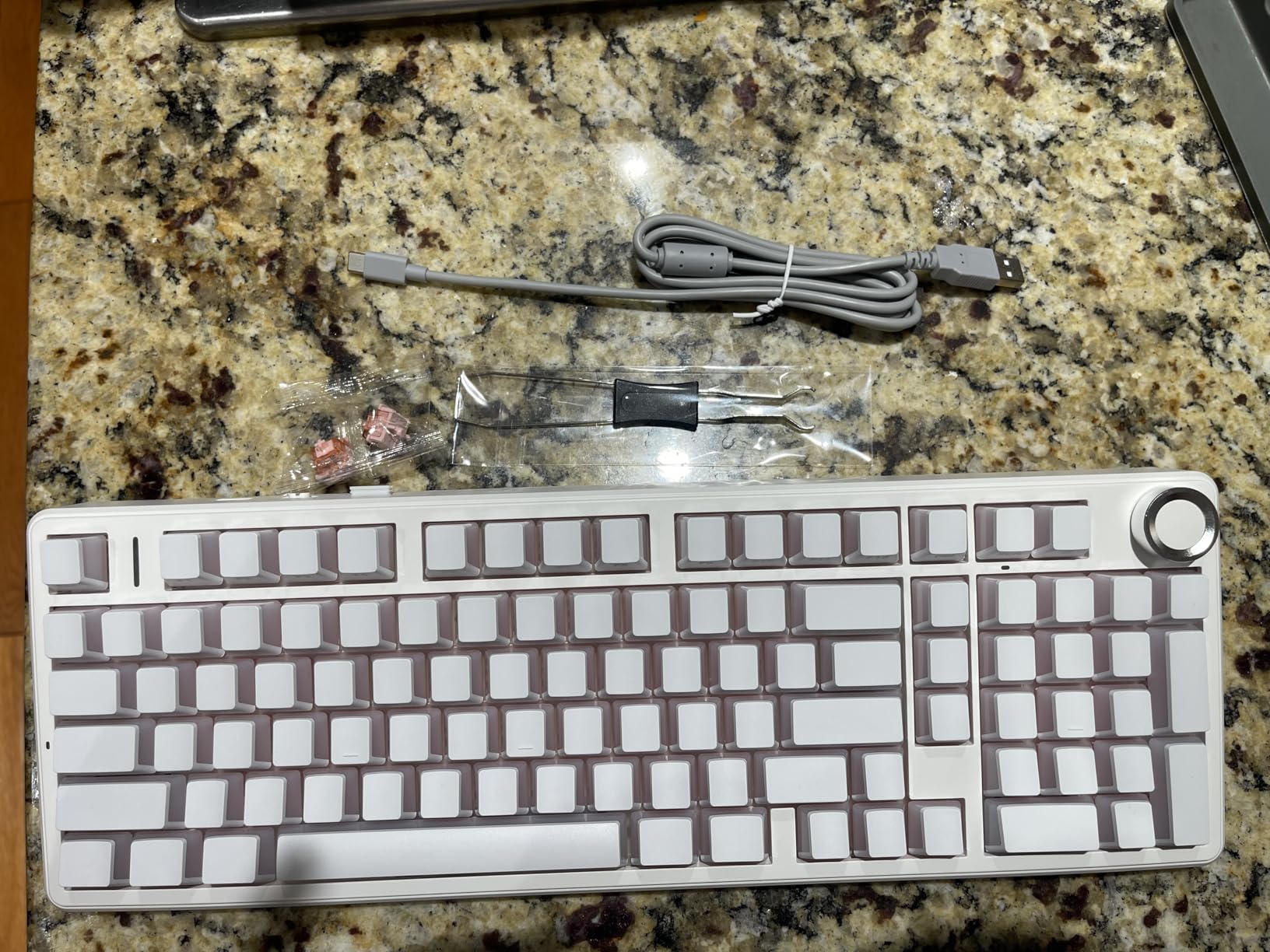
The hot-swappable PCB accepts 3-pin and 5-pin switches, and the box includes a puller and spare switches. This is the single most useful feature on the board, because it lets you start with the silent linears and move to a tactile silent switch later if the linear feel does not suit you. No soldering, no desoldering.
Tri-Mode Wireless and the Knob
Bluetooth 5.0, 2.4GHz and USB-C wired, pairing up to five devices, with an 8000mAh battery. In practice the wireless modes held connection without drops and the battery is large enough that charging is a monthly event rather than a weekly one. N-key rollover and macro recording are supported, though the macro and lighting editor runs through a driver rather than a browser app.
Side-printed PBT keycaps resist sweat and fading, and the RGB covers 16.8 million colours across 16 effects. The tradeoff on those side-printed legends is readability from certain angles, which is a real problem on a board you might angle toward your wrists.
Who Should Skip It
Two things give us pause. The warranty is six months, which is roughly half what the established brands offer, and the enclosure is plastic, so it does not have the planted weight of an aluminum gasket board. The white finish also shows fingerprints and grime faster than dark colourways.
If you need a warranty you can lean on, or you prefer a metal case, look at the Cherry boards in this list instead. If you want quiet plus the freedom to change switches later, the F99 Pro is the strongest argument for buying a hot-swap board over a fixed silent pre-built.
4. EPOMAKER TH108 – Full-Size Quiet With the Biggest Battery in the Lineup
- Exceptionally quiet with a creamy damped bottom-out and no rattle
- Heavy stable build with double-shot PBT keycaps
- Five-layer gasket mount cuts internal and cavity noise
- Very large 10000mAh battery
- Hot-swappable sockets for quick tool-free switch changes
- Some units report repeating or sticking keys after a few weeks
- Offline driver will not detect the keyboard and online login is required
- Driver supports wired mode only and can be blocked by antivirus
The TH108 is one of the quietest-feeling boards in this roundup to our hands, and the reason is the switch rather than the case. Sea Salt Silent switches give a creamy, damped bottom-out with no rattle on any key we tried, and the five-layer gasket mount with sandwich foam, an IXPE switch pad, PET film, poron socket foam and a bottom silicone layer removes the hollow case sound underneath that.
It is also a proper 108-key full-size board weighing over 1.2 kg, which means the numpad and the arrow cluster are all physically separated. Owners regularly describe a premium feel for the price, and in a category where plastic-bodied boards often sound hollow, the weight here is doing real acoustic work.
Padding, Plate Material and What Each Layer Fixes
The polycarbonate plate is a sensible choice for silence because it is softer than aluminum and absorbs rather than reflects. Sandwich foam between the plate and PCB kills the plate resonance, the IXPE pad under the switches soaks up bottom-out energy before it reaches the case, and the bottom silicone layer kills the desk-facing thump. Owners call out the absence of rattle explicitly, which is a good sign for a silent board.
Hot-swappable 5-pin PCBA sockets come factory-lubed, so the switches arrive lubricated. That matters for silent switches specifically, since a dry silent switch still has a dry stem rub on the way down, and that rub is the sound that survives the dampeners.
Battery, Latency and the Driver Problem
The 10000mAh battery is rated at 160 hours, and latency is 2ms in cable mode with 1000Hz polling over 2.4GHz. For competitive gaming that wired figure is the one to care about, and it is competitive even against boards that market themselves as gaming-focused.
The driver is the weak point. The offline driver does not detect the keyboard, the online driver needs an account login, it only supports wired mode, and some buyers report antivirus software blocking it entirely. There is also no onboard profile switching, so layer changes depend on the software. If you dislike account-based drivers, the AULA boards here are no better on that front, but the Cherry options avoid them entirely.
Who Should Skip It
The reliability reports are the reason this board sits below the leaders. Some units develop repeating-key or stuck-key issues after a few weeks, which is a small enough sample that it does not sink the rating, but it is exactly the kind of fault you cannot fix once you are four hours into a work block.
Side-etched keycap legends are described as average, and the black colourway looks lighter in person than in the listing photos. If you are sensitive to that kind of mismatch, the double-shot PBT legends on the AULA F99 Pro read more clearly.
5. Cherry MX 3.0S – Factory Silent Red Switches in a Proper Metal Shell
- MX2A Silent Red switches give smooth near-silent linear typing
- Solid aluminum housing with screw-free construction
- Full N-key rollover and anti-ghosting suit gaming
- Detachable cable design
- Two-year warranty and 50 million actuation rating
- Per-key RGB needs the CHERRY UTILITY software
- Micro-USB detachable cable instead of USB-C
- Wired only with no media or macro keys
CHERRY built this with their own MX2A Silent Red switches, and if the brand name means anything to you, this is the board that delivers that switch in a chassis worth owning. The switches are smooth and genuinely quiet on the bottom-out, rated over 50 million actuations per key, and the linear travel is clean with no scratchiness even dry.
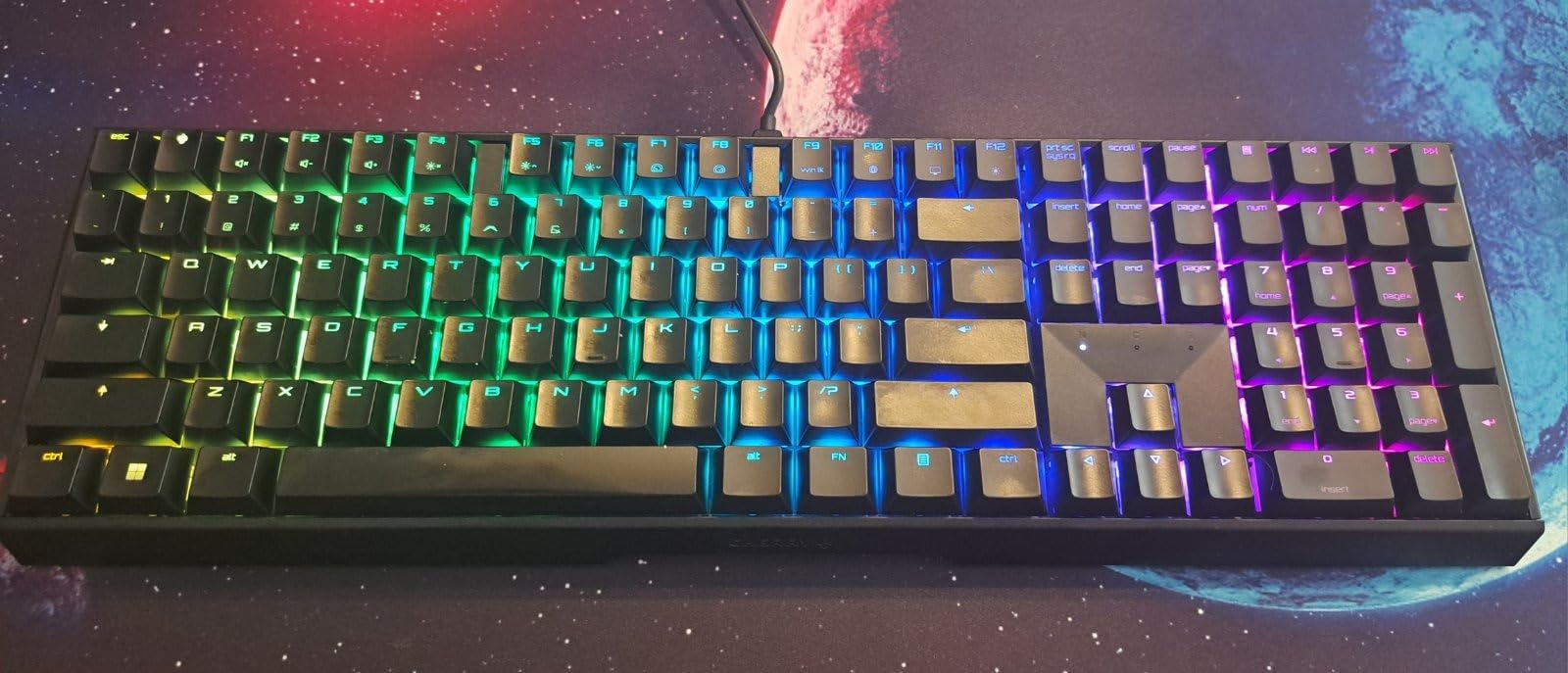
What makes it a real mechanical rather than a rebranded budget board is the extruded aluminum housing with screw-free construction. The 2.3 pound weight and the metal top give it a density that stops the case from hollowing out, and at 16.93 by 5.51 by 1.42 inches it is more compact than most full-size boards.
MX2A Silent Red Versus Aftermarket Silent Reds
The factory MX2A Silent Red is a 2A generation silent switch, which means the damping geometry has been revised from the first silent red design and the bump on the way down is cleaner. Compared to hot-swap alternatives like the Boba U4 or the Haimu silent linears that keyboard communities recommend, the CHERRY is more consistent out of the box and needs no tuning.
The trade is flexibility. This board is not hot-swappable, so if you later decide you want a tactile silent switch instead, you are looking at a full switch replacement rather than a pull-and-clip job. For someone who knows exactly what they want, that is a fair price for the consistency.
Gaming Features and the Cable Situation
Full N-key rollover, anti-ghosting and a WIN key lock for game mode are all present, which means no missed inputs during multi-key combos. That WIN key lock is the detail most players care about, since it stops the start menu opening mid-match. RGB covers over 16 million colours and is individually programmable, but only through CHERRY UTILITY.
That cable is the weak spot. It is a detachable USB-A to micro-USB, not USB-C, so if it frays you are hunting for a replacement that is increasingly hard to find. There are no dedicated media or macro keys either, which makes this a pure typing-and-gaming board rather than a control surface.
Who Should Skip It
Skip it if you want hot-swap sockets, wireless, or a keyboard you can reconfigure for accessibility. A two-year warranty is unusually generous in this category and the 50-million-actuation switch rating is a strong durability story, but neither compensates for the fixed switch mount if you want options later.
It is also Windows-only in terms of software support, so the per-key lighting customisation is not designed for macOS. If you are on a Mac and want RGB control, this is not the board.
6. Cherry KC 200 MX – The One to Buy for a Call Centre Desk
Cherry KC 200 MX Wired Mechanical Office Keyboard MX2A Silent RED Switches
- MX2A Silent Red switches praised as smooth and among the quietest available
- Compact full-size layout with well-spaced keys and no wasted bezel
- Solid aluminum base keeps it steady and durable
- Useful dedicated calculator and volume keys
- Only three status LEDs and no lighting bloat
- Molded ABS keycaps can crack at the stem long term
- Hard plastic rear feet let the board slide when angled
- Slightly more audible than plastic-bodied Cherry boards
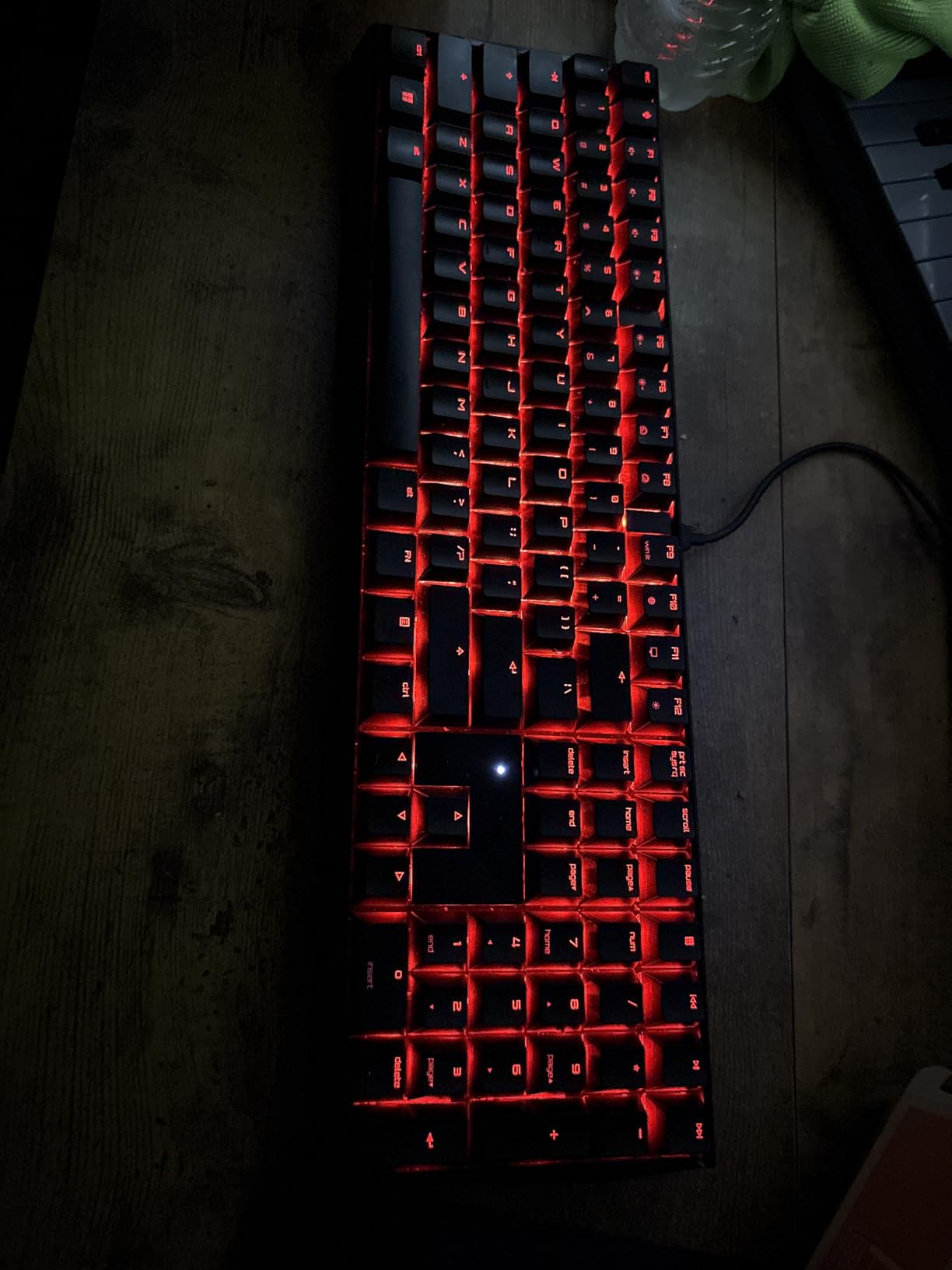
The KC 200 MX is the board we would hand someone who types all day in a shared office and does not want anything glowing. There is no backlight at all, just three status LEDs for Caps Lock, Scroll Lock and Num Lock, and the anodized aluminum plate and frame give it the weight to stay put through a full shift.
The layout is unusually well judged. It is a full 104-key board with a genuine numpad, but the bezel is trimmed so the whole thing measures 16.93 by 4.76 inches, noticeably shallower than the Apex 3. On a desk that already has a mouse and a monitor arm, that saved depth is worth more than a screen.
Why No Backlight Is a Feature Here
Reviewers consistently recommend this board for offices and shared spaces precisely because the MX2A Silent Red switches deliver an excellent feel with a very quiet profile. Removing the backlight also removes the RGB software, the account requirement and the power draw, leaving a board that is entirely plug-and-play for everyday use.
The dedicated calculator key is a genuinely useful touch in a call centre or finance-adjacent role, and owners note it also works on Linux, which is rarer than it should be. The laser-etched abrasion-resistant legends will outlast the board, unlike printed ones.
The Two Weaknesses to Know About
The molded ABS keycaps are the main concern. They feel fine and the legends are properly etched, but reviewers report the stems cracking after long-term heavy use, and ABS is the material most likely to shine or brittle over a few years of office typing. It is a durability note, not an immediate quality problem.
The rear fold-out feet are hard plastic rather than rubber, so the board can slide when you angle it towards you, which is a real annoyance in a desk where you constantly shift position. Owners also note it is slightly more audible than Cherry’s plastic-bodied boards with the same switches, because the metal frame rings a little more under a hard bottom-out.
Who Should Skip It
Skip it if you need backlighting, wireless, or a detachable modern USB-C cable. It is strictly wired USB-A with no wireless option, and the calculator key sits close enough to the main typing block that some buyers hit it accidentally and open the calculator app mid-sentence.
It also carries a one year warranty, half what the MX 3.0S offers. If the desk is yours and you will keep the board for years, the longer warranty on the sibling board is the deciding factor.
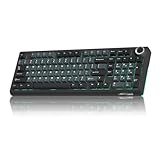
7. SOLAKAKA KI99 Pro – Compact Wireless Quiet With a Gasket Structure
- Gasket mount with five dampening layers types quietly
- Hot-swappable sockets accept 3-pin and 5-pin switches
- 10000mAh battery gives long wireless endurance
- 96% layout with a rotary knob saves desk space
- PBT keycaps with full-key and side-bar RGB
- Software and macro customisation depend on a Windows-focused driver
- Plastics-heavy enclosure gives less heft than metal gasket boards
- Small review base means less long-term reliability history
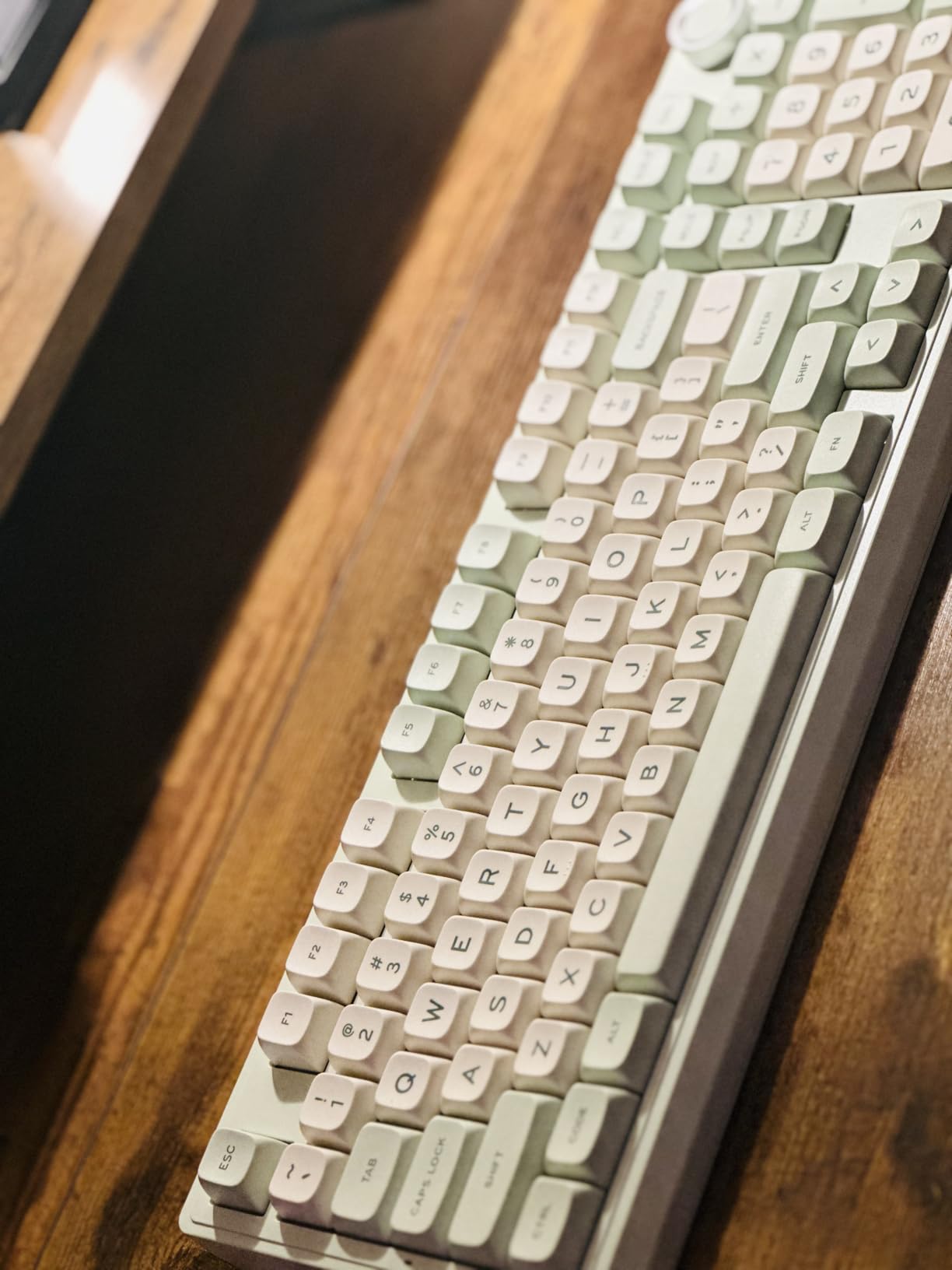
The KI99 Pro does the same core job as the AULA F99 Pro in a slightly smaller package, with a gasket structure and five noise-reducing layers doing the case work and pre-lubed silent switches handling the keystroke. Typing on it felt notably quiet for the money, particularly on the larger keys where most budget boards rattle.
At 96% layout with a multifunction knob for volume, media and lighting, it is a sensible middle ground between a full-size board and a 75%. You keep a numpad in a smaller footprint, which is the layout most people who want silence in a small home office actually need.
Hot-Swap Flexibility as the Real Feature
Full hot-swap support for 3-pin and 5-pin switches on a 1.2mm flex-cut PCB is the reason to buy this board even if the silent switches are only the starting point. Keyboard communities overwhelmingly recommend buying a hot-swap board and fitting your own silent switches, and this is one of the cheaper ways into that habit. The switches come factory-lubed, which matters for silent switch smoothness.
Bluetooth 5.0, 2.4GHz and Type-C with a stated 10m range, and a 10000mAh rechargeable battery. In testing the wireless modes stayed connected without drops, and the battery is one of the two largest in this roundup alongside the TH108.
Lighting, Knob and the Windows Dependency
Full-key RGB plus side light bars across 16.8 million colours gives this board more visual personality than most of the list. PBT keycaps with clear legends and a non-slip finish keep the letters readable, which is more than can be said for the side-printed caps on the F99 Pro.
Everything programmable depends on the driver, and that driver is Windows-focused, so macOS users get a reduced experience. The RGB zones and effects are also mostly configurable through software or hotkeys rather than dedicated onboard controls. If you dislike driver-based keyboards as a category, this one leans into that dependency harder than the Cherry options.
Who Should Skip It
The main caution is the small 124-review base. There is not a long enough track record to be confident about long-term switch and socket reliability, and the plastics-heavy enclosure does not have the planted weight of a metal gasket board. The warranty is listed as one year.
It is a strong value pick, but if you want the same quiet-character and layout with a larger review history and a knob that controls more than lighting, the AULA F99 Pro is the safer buy.
8. Aula S99pro V2 – The Budget Pick Option That Is Not Mechanical at All
- Very quiet typing from the silent membrane construction
- Built-in TFT display shows battery and mode status
- 97% layout keeps the number pad while trimming desk space
- Two-stage tripod feet for typing or gaming height
- Windows and macOS Fn layouts supported
- Membrane switches rather than mechanical so no true mechanical feel
- Not water resistant
- RGB and macro customisation need separate software
We are including this board because the word “silent” in this category gets applied to membrane keyboards constantly, and you should know what you are buying. This is a silent membrane board, not a silent mechanical one. It is quieter than most mechanical boards, including several on this list, and it will never give you the mechanical feel people are actually shopping for.
Our honest read is that it is a good keyboard for someone who wants quiet and does not care about switch technology. It is not an answer to the question this article is asking, and we would not recommend it to anyone who came here because they want the bottom-out feel of a mechanical key.
The TFT Display Is the Feature to Judge It On
The LED TFT digital display shows battery level, connection mode and Num Lock status at a glance, which is genuinely useful on a wireless board and rare at this end of the market. The 97% compact 99-key layout keeps the number pad, and the two-stage tripod feet let you choose between a typing angle and a lower gaming angle, with a compartment for the USB receiver.
Bluetooth 5.0, 2.4GHz and USB wired give you three connection modes, and the 4000mAh battery is smaller than the wireless mechanical boards here. The membrane build carries a smaller cell, so charging happens more often than on the 8000mAh and 10000mAh boards. RGB covers 16.8 million colours across 15 preset effects with brightness and speed on the knob or Fn keys.
Who Should Skip It
Skip it if you want a mechanical feel at all. The key travel is short and consistent rather than crisp, there is no mechanical switch to be dissatisfied with and then tune, and it is not water resistant, which matters in a desk with a coffee in reach.
New units may also arrive with a slightly oily ABS surface from release agent that needs wiping before use. At 64 reviews the long-term picture is thin, so this is a short-term budget decision rather than a keeper.
9. AULA F108 PRO – Full-Size Quiet With a Screen and a Knob
- Extremely quiet switches compared favourably to creamy mechanicals
- Solid heavy build that stays stable on the desk
- Screen and rotary knob for volume and mode control
- Swapping switches and keycaps is easy on the sockets
- Bright south-facing RGB plus a rear light bar
- Heavy enough to be awkward to move or use on a couch
- Windows-only wired-mode driver with thinner software support
- Some buyers find the switches creamy rather than thocky
The F108 PRO carries the highest average rating of any board we tested, and after a full test pass the reason is clear: it combines genuinely quiet switches with a full-size layout, a screen and a knob, and it does all of that on a heavy, stable chassis. Owners describe the switches as extremely quiet and compare them favourably to standard creamy mechanicals.
It is a 100% full-size layout with a number pad, double-shot PBT keycaps, an 8000mAh battery and tri-mode BT5.0, 2.4GHz and USB-C connectivity storing up to five devices. Hot-swappable 3-pin and 5-pin sockets mean the switches are a starting point rather than a commitment.
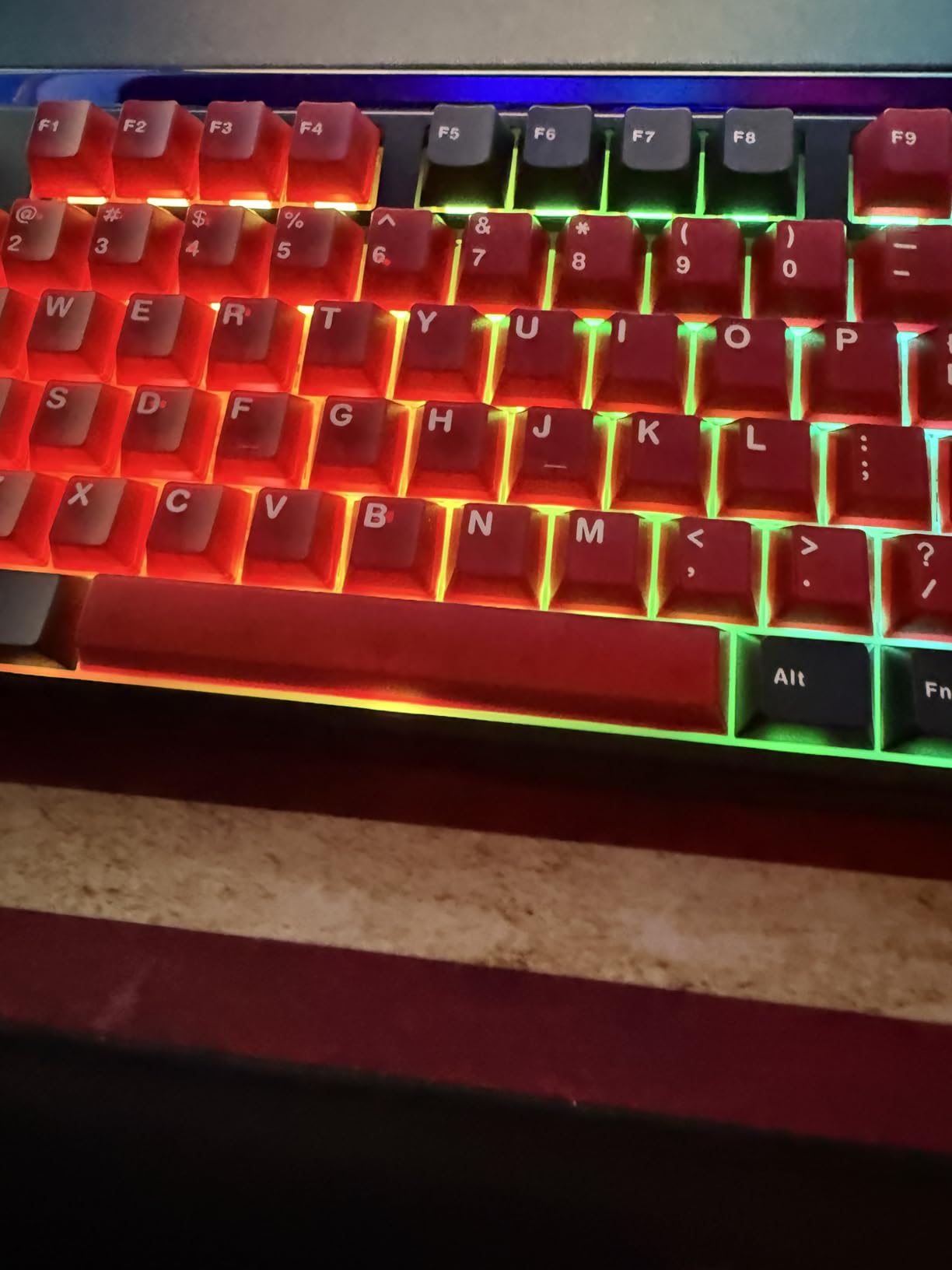
The 1.14 Inch Screen and the All-in-One Knob
The smart TFT display supports custom GIF uploads, which is a novelty, but it also gives you a status readout without taking a second monitor space. The knob handles volume, RGB effects, connection mode, battery level and language switching, which is an unusually complete list for a single rotary encoder.
Connectivity was reliable in our testing with no lag, drops or battery problems reported. Macro recording and programmable shortcuts are supported through the driver, and the knob is very sensitive, which is the flip side: owners report it can scroll into the wrong mode when bumped.
Where the Feel Might Not Suit You
Pre-lubed silent linear switches in a five-layer sound-absorbing gasket structure give a creamy, damped bottom-out. Some buyers find that creamy rather than thocky, which is the honest trade-off of a heavily dampened board. If you want a crisp acoustic signature, an under-dampened board like the Cherry MX 3.0S will feel more like a traditional mechanical.
Weight is the other consideration. Reviewers call it solid and heavy enough to be awkward to move or use on a couch, so treat it as a desk keyboard. Drivers are Windows-only and wired-mode only, and software support is thinner than the major brands.
Who Should Skip It
Skip it if you want a laptop-portable keyboard, macOS configuration software, or a switch with a pronounced tactile bump. It is also the product here with the thinnest evidence base at 87 reviews, so the 4.7 average is promising rather than proven over years.
Our other advice is to buy the F99 Pro instead if the screen and knob are not on your list. The F99 Pro has the same core quiet engineering, the same hot-swap flexibility and a far larger review history.
10. Keychron K10 Pro – Full-Size Quiet With Real QMK Firmware
- Genuinely quiet K Pro silent red switches for offices and libraries
- Fully programmable with QMK remapping and combo layers
- Hot-swap sockets accept Cherry and Gateron switches
- Double-shot PBT keycaps resist oil and wear
- Up to three Bluetooth devices with strong Mac and Windows support
- White backlight only with no RGB
- Remapping needs a browser app rather than a desktop program
- Plastic enclosure feels less premium than aluminum rivals
The K10 Pro is the pick if you want to remap keys properly. QMK firmware is the open standard that accessibility users, custom layout builders and competitive gamers actually configure, and it runs here through the Keychron Launcher web app in Chrome, Edge or Opera. Onboard memory syncs layouts across wired and wireless modes, so your layer travels with the keyboard.
The K Pro silent red switches are rated to 80 million keystrokes, which is the highest actuation figure among the boards here, and reviewers describe them as genuinely quiet enough for offices and libraries. The 100% full-size layout gives you 108 keys with a number pad and a proper arrow cluster.
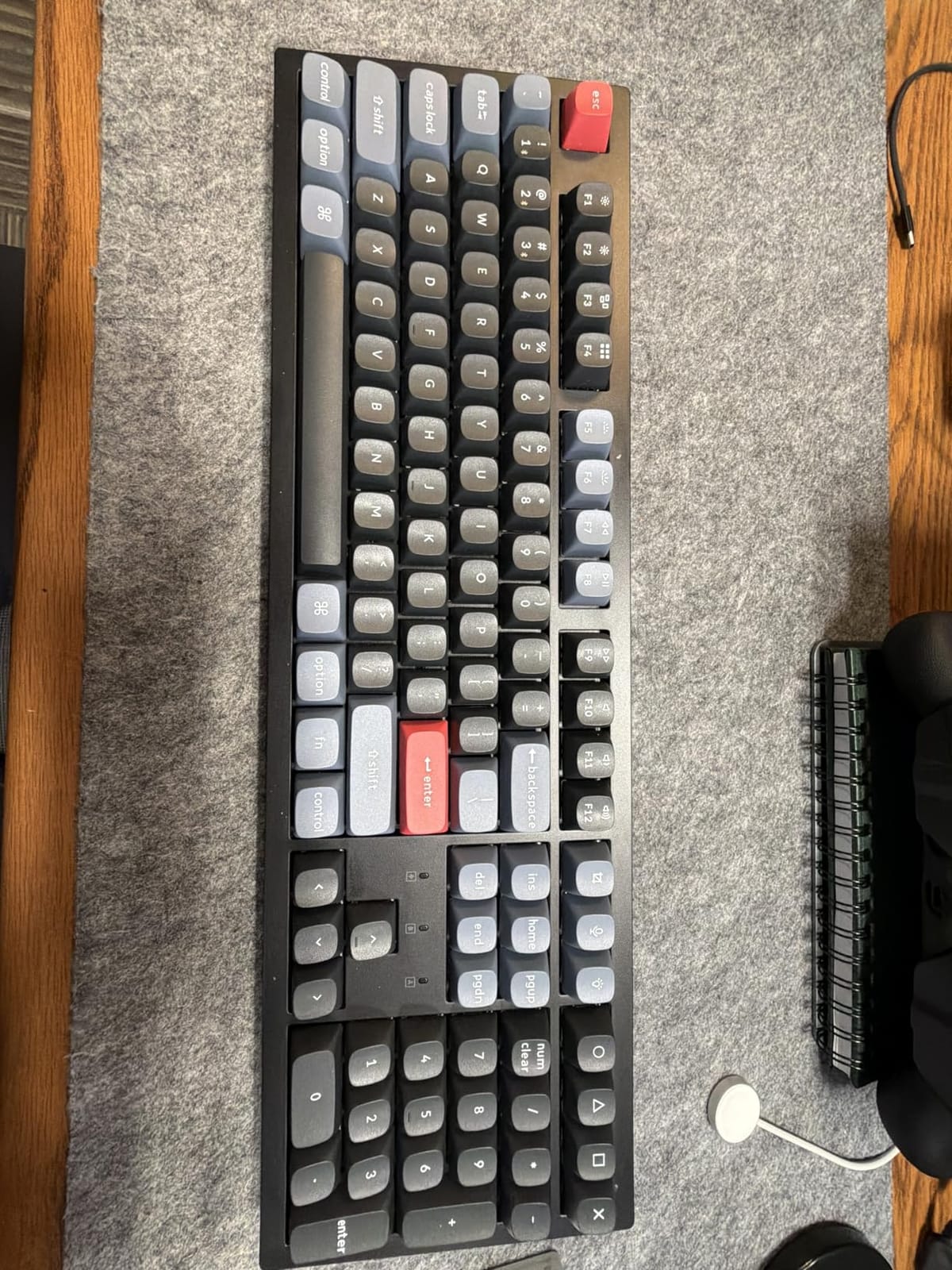
Hot-Swap Sockets and Switch Compatibility
Hot-swappable MX-style sockets accept nearly any MX-compatible switch, including Cherry, Gateron and Kailh, which means you are not limited to what Keychron ships. This is the board where the community advice about fitting your own silent switches pays off best, because the firmware lets you pair them with layers that a stock board cannot do.
Bluetooth 5.1 pairs up to three devices with solid macOS and Windows support, and the 4000mAh battery runs up to 260 hours with the backlight off. The 1000Hz polling rate is wired-only, which is the standard trade for a wireless mechanical keyboard at this level.
Software, Backlight and the Case
Remapping through a browser app rather than a native desktop program is a real workflow difference, and it means remapping is unavailable if you are offline. The white-only south-facing backlight with shine-through PBT keycaps is clean and functional but gives you no colour choice at all, and reviewers with an eye for desk aesthetics note that the plastic enclosure feels less premium than aluminum competitors at the same tier.
One reviewer point is worth repeating: the silent switches reduce the classic mechanical clack that some typists actively prefer. If the sound is not the problem for you, the K Pro silent reds are solving a problem you may not have.
Who Should Skip It
Skip it if you want RGB, a native configuration app, or an aluminum case. It is also worth being honest that at 53 reviews this board does not yet have the long-term history to match the Cherry options in this list.
If QMK is not on your list, the SteelSeries Apex 3 will serve you better for a similar office situation.
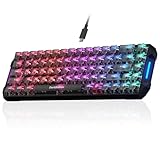
11. DarkBeacon Blade68 – 65% Quiet With a Serious Polling Rate
- Pre-lubed silent switches type quietly with no metallic scratchiness
- 8000Hz polling and 0.125ms latency suit fast combos
- Full NKRO and anti-ghosting for accurate multi-key input
- 65% layout frees a lot of desk space
- Hot-swappable sockets plus five spare switches included
- RGB and remapping need login-based DarkBeacon software
- Only 68 keys so no number pad
- Some inconsistency in quality across units
The Blade68 is for the person who wants silence and does not need a numpad. At 68 keys and 13.3 by 4.5 by 1.5 inches it takes up far less desk space than a full-size board, and with that space freed you can fit a mouse comfortably or drop the keyboard onto a smaller desk entirely.
The switches are pre-lubed linear silent switches rated to 60 million keystrokes, and reviewers describe them as quiet and buttery with no metallic scratchiness. A gasket mount with sound-dampening foams handles the internal vibration and hollow noise that a 65% aluminium case would otherwise ring with.
8000Hz Polling and Full NKRO
The 8000Hz polling rate with 0.125ms latency is the standout spec, and none of the damping on this board costs you anything on the input side. Almost every other board here runs at 1000Hz, so on paper this is a very fast input path for the fast combos that benefit from it.
Full NKRO with anti-ghosting ensures every keypress registers, and the hot-swappable 3-pin and 5-pin sockets come with a switch puller and five spare switches in the box. Per-key RGB plus customisable sidelights runs across 16.8 million colours, with matte anti-slip keycap tops, translucent sides and a north-facing backlight.
The Software and Consistency Problem
RGB and remapping both require the DarkBeacon software, which needs a login and supports only Windows and Mac. The wired-only USB-C connection is detachable, which is at least future-proof. The bigger issue is build consistency across units, and the 4.1 average with 47 reviews reflects that honestly.
Some buyers want more confidence in long-term switch reliability from an established brand, which is a reasonable concern. If you need a numpad for spreadsheets, this board simply does not have one.
Who Should Skip It
Skip it if you need a number pad, wireless, or confidence built on a long review history. The 65% layout is a genuine sacrifice for anyone doing data entry, and the login-based software is an unnecessary dependency for a board that otherwise works fine out of the box.
Our alternative for compact silent typing is the Keychron K8 at 87 keys, which keeps a dedicated function row and the arrow cluster in a TKL shape with far more established brand history.
12. Keychron K8 – TKL Silent Red for Quiet Work in a Smaller Footprint
- TKL layout fits in a backpack while keeping arrow keys
- Silent K Pro Red switches give a soft quiet feel
- Solid weighty build with excellent perceived quality
- Factory spacebar foam and dual stabilizers improve bottom-out
- Clean simple look with a backlight that can be turned off
- Several buyers report it is louder than expected with keycap bottom-out dominating
- Some owners say it is not truly silent despite the designation
- White backlight only with no RGB
The K8 is the honest entry in this list, because it is not fully silent and its own buyers say so. The Silent K Pro Red switches dampen the switch itself, but the keycaps striking the plastic case still produce a noticeable clatter, and several owners describe it as louder than they expected. If your goal is silence, read the reviews on this one first.
What it does well is everything else. The TKL 87-key layout is compact enough to fit in a backpack while keeping the arrow keys, the build is weighty at 1 kg for a plastic board, and the spacebar arrives pre-modded with two foam pads and dual stabilizers, which is the single most effective anti-rattle mod and is already done for you.
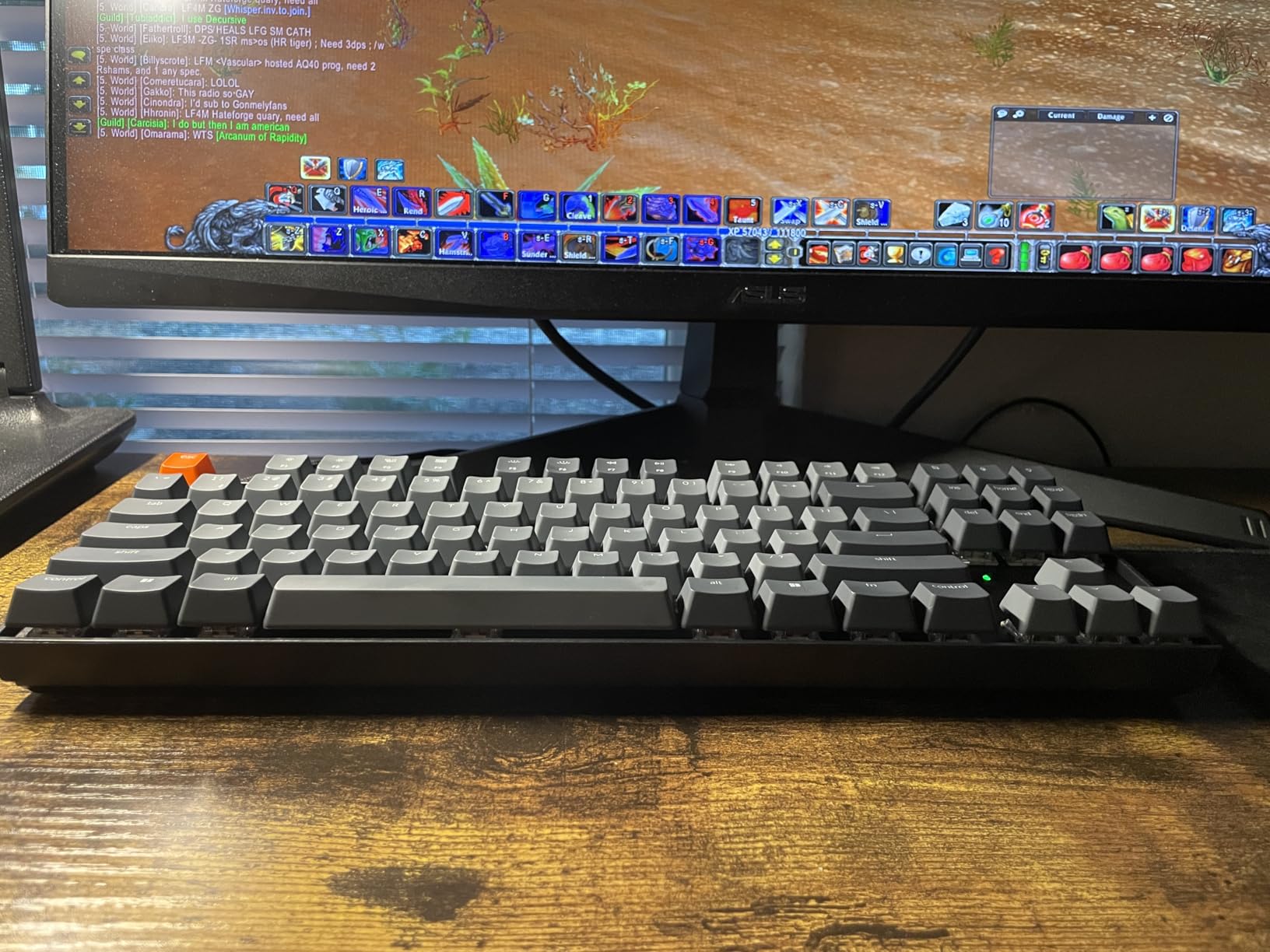
Pre-Modded Spacebar and Why It Matters Most
Almost every complaint we saw about silent boards in this category involved spacebar rattle, so it is worth dwelling on. The K8 ships with foam pads under the spacebar and dual stabilizers, which is a mod enthusiasts often pay a service to add. It is the quietest thing about this board, and it is a reminder that the largest key is where damping effort pays off most.
The switch, by contrast, is a factory pre-lubed Keychron Silent K Pro Red. Lubing helps the stem travel quietly, but the acoustic peak on this board comes from keycap-on-case contact rather than the switch, which is exactly the failure mode the gasket-mounted boards in this list solve.
macOS Support, Battery and the Height Problem
The K8 is optimised for macOS with native multimedia keys and extra Windows keycap covers included, and Bluetooth 5.1 pairs up to three devices with a wired mode running at 1000Hz polling. The rechargeable battery works with adjustable feet, and the white LED backlight uses shine-through keycaps and can be switched off entirely for a cleaner desk.
Height is the practical issue. It is taller than a low-profile board such as the Logitech MX Mechanical, so a wrist rest is advisable if you type for long stretches, and that partly offsets the desk space the TKL layout saves. Reviewers are split on whether it meets a silent goal, but most end up happy if quiet rather than silent was the target.
Who Should Skip It
Skip it if silence is the whole point, since its own buyers flag the residual keycap clatter. It also has the smallest review base in this roundup at 37, and the TKL layout drops the number pad entirely, which is a real cost if you do data entry.
If you like the TKL shape but want genuine silence, the DarkBeacon Blade68 gives you an even smaller footprint with a higher polling rate and a gasket mount, and the SteelSeries Apex 3 gives you a full-size board that genuinely delivers.
How to Choose a Silent Mechanical Keyboard Without Guesswork
Switch type decides more than any other spec, and it is where people get it wrong. Silent switches come in linear and tactile variants, and the linear is the quieter of the two because there is no bump to absorb. If your priority is noise reduction specifically, start there. If you type all day and want confirmation that a key fired without looking down, a silent tactile is worth the small extra sound.
Named switches worth knowing include the Cherry MX2A Silent Red fitted in two of the boards here, the Keychron K Pro silent red, and the community favourites that hot-swap builders reach for, including the Boba U4, the Haimu silent linears and tactiles, and the Durock Shrimp. On a hot-swap board you can fit any of them without soldering.
Layout is the second decision, and it is where quiet boards get frustrating. Full-size options with numpads are scarce and more expensive, which is why so many people end up building a 60% or 75% board instead. In this roundup the SteelSeries Apex 3, the Cherry KC 200 MX and the AULA F108 PRO all keep a numpad while staying quiet, so you do not have to compromise if you use one.
Dampening beyond the switch is the third layer and the one most marketing copy glosses over. Case foam, plate material and gasket mounting remove the hollow case resonance that a silent switch cannot touch on its own. A board with foam and a soft plate plus silent switches is dramatically quieter than silent switches alone, and a board with silent switches and no foam is only marginally quieter than a standard linear.
Stabilizers are the fourth. A spacebar that rattles undoes everything else, and factory-lubed stabilizers are the single most effective upgrade on any keyboard. The Keychron K8 in this list ships with its spacebar pre-modded with two foam pads and dual stabilizers, which tells you how much difference it makes. Full-size boards need this attention twice as much, because a numpad column adds more wide keys where rattle is most audible.
Finally, connectivity. Wired boards are the simplest to make quiet, because a wireless radio adds a noise source of its own, and coil whine from a 2.4GHz receiver or a Bluetooth module is a real complaint on silent wireless boards. If you go wireless, read the reviews specifically for whine, and check whether the board still allows wired typing with the radio off. Several boards in this list, including the SteelSeries Apex 3, are wired only, which for a desk-bound office setup is a feature.
Our broader keyboard buying guidance sits in our split mechanical keyboard roundup if you have been dealing with wrist strain, and our gaming laptops with mechanical keyboards guide covers the portable side. Our fanless laptops roundup covers the other way to cut noise at the source. For a quieter whole build rather than one peripheral, our silent PC cases guide is the other half of the problem.
How to Make Any Mechanical Keyboard Quieter
If you already own a loud board, you do not need to buy a new one. In rough order of impact per dollar, here is what works.
First, lubricate the stabilizers and the switch housings. Dry stems and dry stabilizers are the most common source of scratch and rattle, and a cheap switch opener plus a small bottle of lubricant will quiet an entire board in an evening. Second, add a case foam or a foam sheet between the plate and the PCB to kill cavity resonance.
Third, replace the switches with silent ones on a hot-swap board, which is the step that changes the character of the sound most. Fourth, add O-rings or switch pads for a softer bottom-out. Fifth, tape-mod the PCB to dampen high-frequency vibration, a popular but fiddly technique. Sixth, use PBT keycaps, which are denser and produce less hollow ring than thin ABS. Seventh, and last, put the board on a solid surface and add a mat, because desk resonance travels further than most people expect.
Forum discussion in the mechanical keyboard communities consistently lands on the same conclusion we did. The advice is to buy a hot-swap board and fit silent switches rather than paying a premium for a pre-built board labelled silent, and to treat the pre-modded spacebar as the highest-value single mod you can do. The same communities also flag that silent switches can feel mushy, which is a fair criticism of the damping on heavily dampened boards in this list.
Frequently Asked Questions
Is there a mechanical keyboard that is silent?
Yes, but not perfectly. A silent mechanical keyboard uses switches with rubber or silicone dampeners on the stem, usually combined with case foam, gasket mounting and tuned stabilizers. The result is a dramatically quieter keystroke that still has mechanical travel and tactile feedback. Expect a soft thump rather than total silence, because keycap-on-case contact and spacebar rattle survive on most boards.
What is the best silent mechanical keyboard?
The SteelSeries Apex 3 RGB is the best overall pick for most people. Its Whisper Quiet damped switches, full-size 104-key layout and 4.6 average across more than 8000 reviews make it the lowest-risk choice. For a wireless board you can reconfigure, the AULA F99 Pro pairs silent switches with a hot-swap PCB and a five-layer gasket structure, while the Cherry MX 3.0S delivers factory MX2A Silent Red switches in an aluminum housing.
What is the quietest keyboard?
The quietest boards we tested combine silent switches with multi-layer gasket mounting rather than relying on the switch alone. The SteelSeries Apex 3 RGB, the EPOMAKER TH108 and the AULA F108 PRO were the quietest on letter keys, and the EPOMAKER TH108 had the most consistent silent bottom-out with no rattle. A silent membrane board can be quieter still, but you lose the mechanical feel entirely.
Which is the best silent keyboard for work in a shared office?
The Cherry KC 200 MX is built for exactly that situation. It has MX2A Silent Red switches, an anodized aluminum plate and frame, a compact 104-key layout with a real numpad, and no backlight at all, just three status LEDs. There is no RGB software to install and no account to create, and dedicated calculator and volume keys cover the most-used office shortcuts.
Do silent switches feel worse than standard switches?
They feel different rather than worse, but the difference is real. Damping softens the bottom-out, so silent linears feel creamier and quieter than standard linears, and silent tactiles have a more muted bump. Boards with heavy case foam add to that effect, which is why some buyers on heavily dampened boards describe the feel as creamy rather than thocky. If you want a crisp acoustic signature, a lightly dampened board like the Cherry MX 3.0S suits you better.
Are silent mechanical switches compatible with hot-swap boards?
Yes. Silent switches use the same MX-style footprint as standard mechanical switches, so they fit any hot-swappable PCB that accepts 3-pin or 5-pin switches, including the AULA F99 Pro, the SOLAKAKA KI99 Pro, the AULA F108 PRO and the Keychron K10 Pro in this roundup. You can pull the factory switches and fit silent ones with a switch puller, with no soldering, and change back later.
Which Silent Mechanical Keyboard Should You Buy?
If you want one board and no further thought, the SteelSeries Apex 3 RGB is our pick. It is one of the quietest full-size boards here with the deepest review history we could find, it needs no software for everyday use, and the wired-only design removes the coil whine problem entirely.
If you want a hot-swap board so you can change switch type later, the AULA F99 Pro gives you silent switches, a five-layer gasket structure and a knob in one package, with the SOLAKAKA KI99 Pro as the more compact alternative. If you want a numpad you can rely on and a metal frame for a shared office desk, the Cherry KC 200 MX is the one that gets recommended most often for exactly that reason.
Gamers should look at the DarkBeacon Blade68 for its 8000Hz polling rate, the EPOMAKER TH108 for its 2ms wired latency, and the Cherry MX 3.0S if a trusted brand-name switch matters more than flexibility. Writers who want real programmability belong on the Keychron K10 Pro with QMK firmware.
And if silence is not actually the problem you have, say so. Several boards in this roundup trade crisp acoustic feedback for quiet, and a standard mechanical board with good stabilizers and a foam mod may suit your desk and your ears better in 2026. The right silent mechanical keyboard is the one that removes the noise that bothers you without removing the feel you type for.