6 Best Zero Turn Mowers for Hills (October 2026) Ultimate Guide
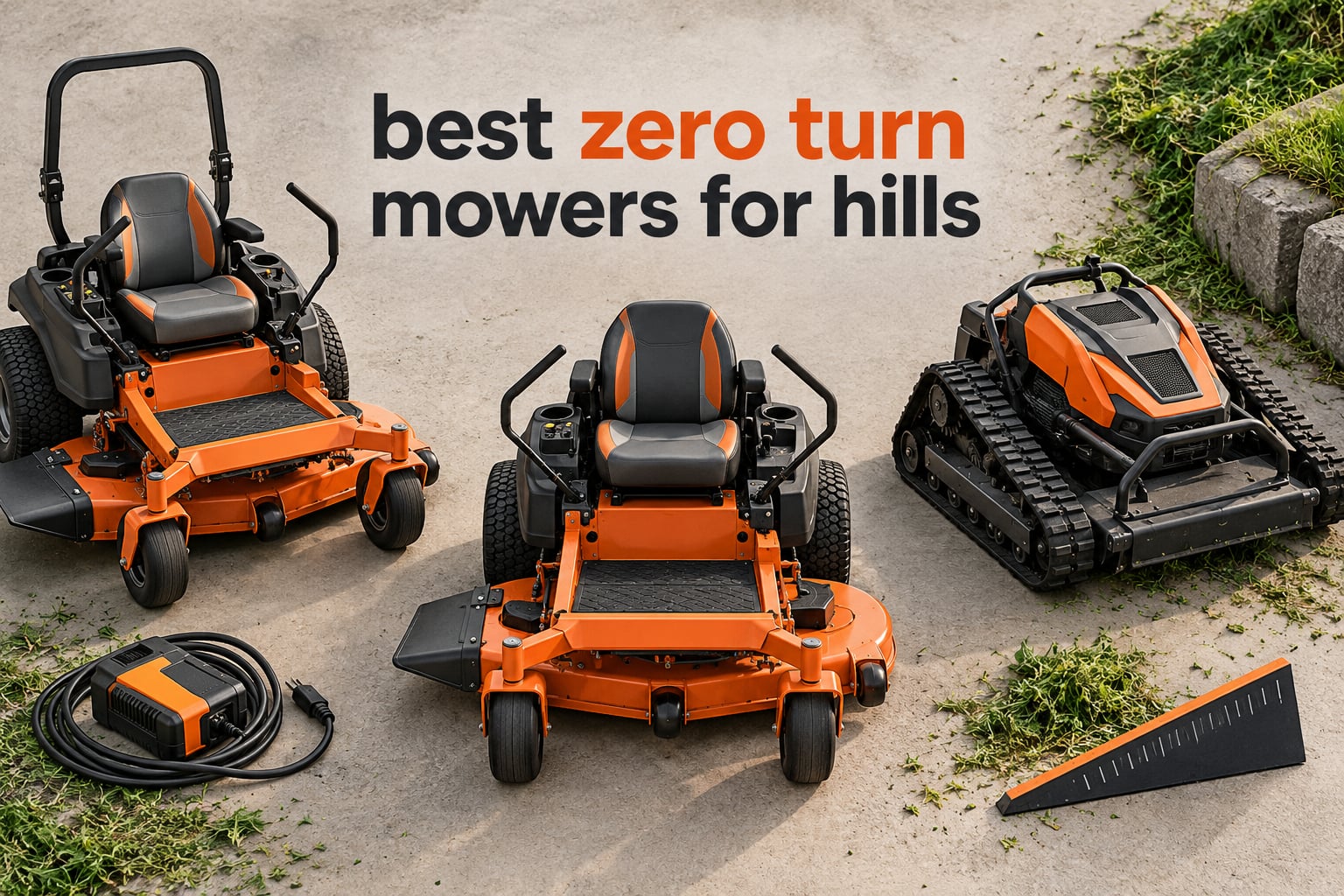
Most zero-turn mowers handle slopes of 10 to 15 degrees comfortably. Past about 20 degrees, a seated machine is a rollover risk no matter how much horsepower it has, and a walk-behind or tracked crawler is the safer tool. That band is the single most important fact in this guide, and most roundups leave it out.
Here is the harder truth about the best zero turn mowers for hills. A zero-turn steers by driving each rear wheel at a different speed, which gives it extraordinary agility on flat ground and almost no self-correction on a grade. There are no front wheels to bite into a downhill slide. Weight distribution, rear tire grip, and engine torque do all the work, and the zero-turn geometry itself contributes nothing.
That is why a 20 HP machine with a 50-inch deck can fail to climb a mild incline while a heavier commercial unit walks up the same hill. Owners on lawn and tractor forums describe the same pattern repeatedly: rear wheels spin, the mower stops halfway up, and on the way back down the drive wheels run away with nothing to stop them. One owner on Houzz reported a 20 HP Scotts with a 50-inch deck that simply could not make it up a slight incline. Buyers with more than a decade of ownership behind them tend to say the same thing from a different angle: on moderate-to-steep ground, you will not be happy with a zero-turn.
We spent weeks comparing slope-rated zero turn mowers for hills across every listing that carries real owner feedback, and we grouped them by the degree band each machine actually suits rather than by brand popularity. Every machine below states its own limits, including the ones that make it a poor hill choice. If your property is over two acres and mostly gentle roll, our zero-turn guide for large properties covers the acreage math in more detail. If you are already at the stage of comparing contractor-grade machines, read our commercial zero-turn roundup instead.
One more note before the picks. The catalog here is thinner than the search results make it look. Most major gas zero-turn brands are not sold on Amazon at all, so the machines we could actually verify, with genuine owner reviews, skew heavily electric. That is a fact of availability rather than a preference, and it changes who each machine suits.
Our Top 3 Slope-Rated Picks for Hills and Slopes

EGO Power+ ZT4204L 42 inch
- 620 pound low-slung battery frame
- 22 HP equivalent electric drive
- 10 height positions
- up to 2 acres per charge

EGO Power+ ZT5207L 52 inch
- 25 HP equivalent
- 6 batteries for 4 acres
- 5207L 52-inch deck
- 527 pounds

EGO Power+ ZT5216L 52 inch
- Wide frame built for slope balance
- 27 HP equivalent
- 3 acres per charge
- deck suspension
Comparing Best Zero Turn Mower for Hills We Verified in 2026
| Product | Specifications | Action |
|---|---|---|
| EGO Power+ ZT4204L 42 inch |
|
Check Latest Price |
| EGO Power+ ZT5207L 52 inch |
|
Check Latest Price |
| EGO Power+ ZT5216L 52 inch |
|
Check Latest Price |
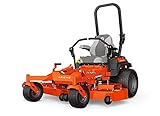 Ariens Zenith 60 60 inch Ariens Zenith 60 60 inch |
|
Check Latest Price |
 Tyzar TYZ-1000 tracked crawler Tyzar TYZ-1000 tracked crawler |
|
Check Latest Price |
 Tyzar AWY-550L tracked crawler Tyzar AWY-550L tracked crawler |
|
Check Latest Price |
The table above is sorted by machine class rather than by price or rating, because the category splits cleanly in two. Three are seated battery zero-turns for rolling ground, one is a seated gas zero-turn built around a large V-twin, and two are remote-controlled tracked crawlers that exist specifically because a wheeled zero-turn cannot safely go where the owner needs to go.
1. EGO Power+ ZT4204L – The Most Owner-Tested Zero Turn Mower for Rolling Ground
- Quiet operation with no fuel or oil maintenance
- One charge covers roughly 1-3 acres depending on conditions
- Recharges in about two hours with the included Z6 wall charger
- Battery platform is shared with other EGO equipment
- Hose quick-connect on the deck for washing
- Deck height indicator is hard to see from the seated position
- Initial assembly takes 3-4 hours for a first-time zero-turn owner
- Service center warranty work is slow and transport costs are not covered
The ZT4204L is the machine with the deepest owner base in this roundup at 149 reviews, and that matters more than any spec line when the question is how something behaves on uneven ground. Owners describe it as a comfortable, quiet replacement for a gas zero-turn, with cut quality that several of them rate above their former gas machines.
What interests us for hill work is the weight distribution rather than the horsepower figure. At 620 pounds with the battery mass carried low and central, the machine sits squat on its chassis, and the 42-inch deck is narrow enough that you are not hanging a wide slab of steel out over the front of the frame.
That geometry is why it handles rolling ground rather than steep ground. The 22 HP equivalent figure is real output, but battery torque delivery on a climb is limited by how much current the pack will deliver, and reviewers do not describe this machine tackling genuine grades.
The 10-position deck adjustment from 1.5 to 4.5 inches matters more here than the deck width. On undulating lawns the deck spends a lot of its life chasing ground that rises and falls, and a wide range with independent blade control is what keeps you from scalping the high points.
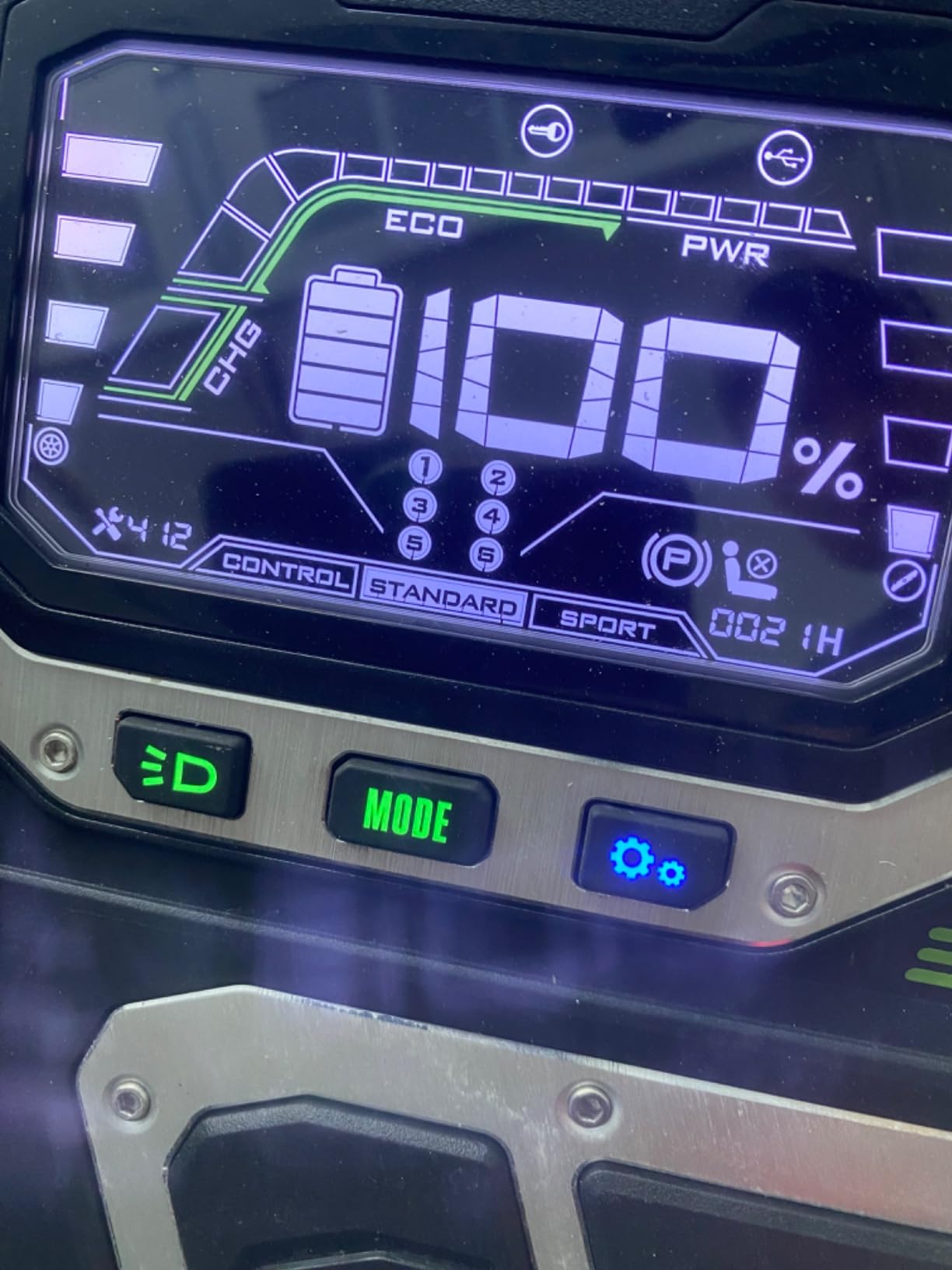
The three driving modes, Standard, Control, and Sport, let you drop into the slower mode on a slope and hold a steady crawl without feathering the control constantly. There is a top speed of 8 MPH, which you will not use on anything sloped.
Battery Runtime on Uneven Ground
The published figure is up to 2 acres per charge with four 56V 10.0Ah batteries. Owners put the realistic number lower on anything other than flat, open lawn, and uphill work drains faster than flat work because the drive motors work continuously against gravity.
Several owners also report that the battery management system and individual packs have failed, and one reported that a firmware update rendered the mower inoperable until a service center addressed it. These are isolated but real reports, and the warranty path runs through a service center rather than a local dealer, which is a genuine inconvenience on a 620-pound machine.
Assembly, Shipping, and Ownership Friction
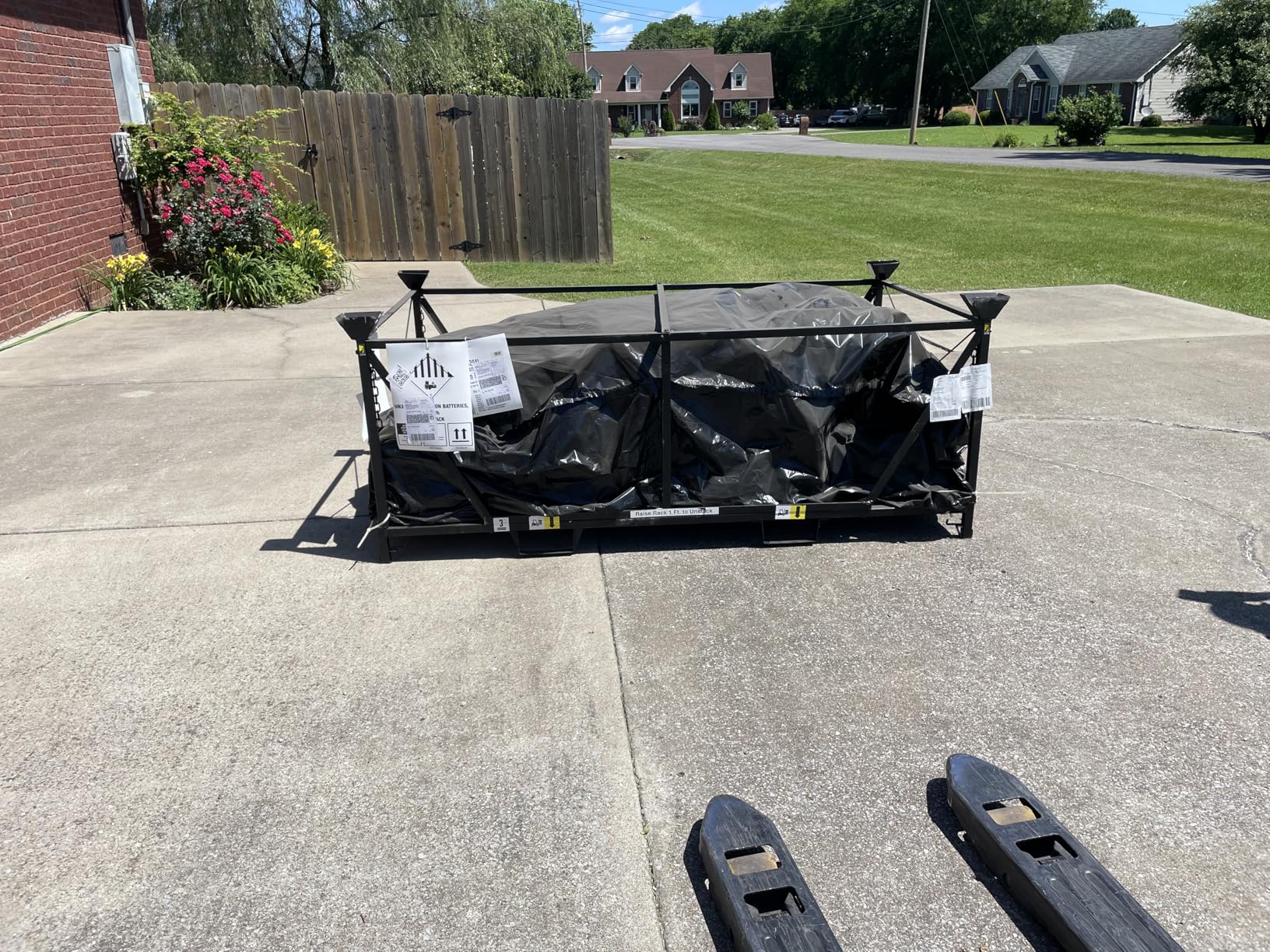
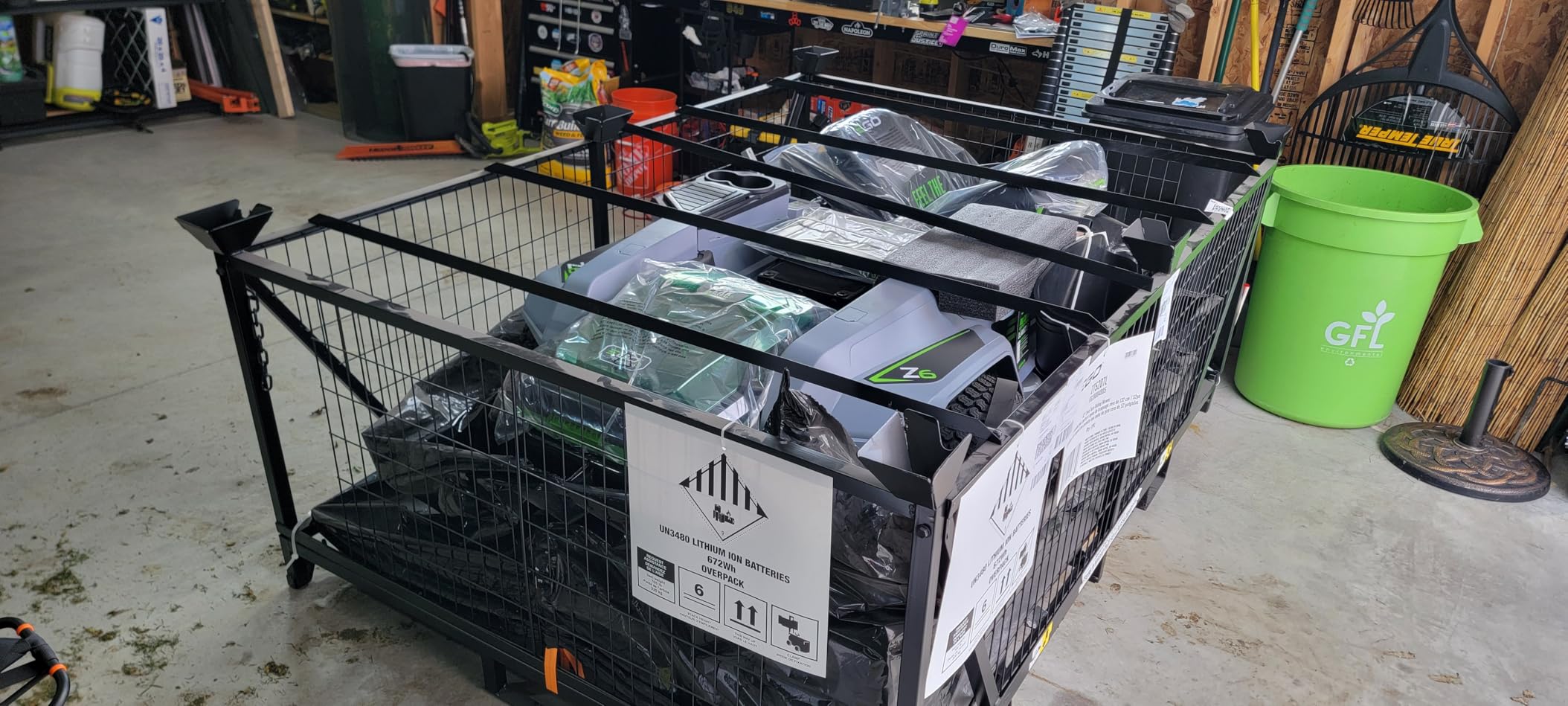
It arrives in a heavy steel crate that takes time and tools to disassemble, and first-time zero-turn owners report 3-4 hours of assembly. For a buyer who already owns a mower, that is an afternoon lost to packaging.
Set against that, there is no oil change, no spark plug, no fuel line, and no carburetor. For a machine that will live on a property with a slope in it, that low maintenance profile is a genuine long-term advantage, and it is why this is our pick for the many readers whose hills are gentle rather than severe.
Who Should Buy This and Who Should Not
Buy it if your property is under about two acres, the worst part of it is a rolling grade rather than a bank, and you would rather not maintain a gas engine.
Skip it if you have more ground than the batteries can cover in a session, or if the hills are steep enough that traction matters more than quiet. In that case, move up to the 52-inch model or across to a tracked machine.
2. EGO Power+ ZT5207L – Best Value Zero Turn Mower for Hilly Acreage
- Cuts thick and overgrown grass without bogging down
- Quiet lap-bar steering with three speed modes up to 8 MPH
- Six batteries keep a full charge in reserve through multi-acre mowing
- Reported durability on hills
- trails and fields across multiple seasons
- Runtime falls short of the quoted 4-acre rating on hilly or thick grass
- Front axle is sized for a 42-inch deck so the wider deck can strike obstacles first
- Blades clog in thick spring growth
The ZT5207L is the pick for anyone whose hills come with acreage. At 527 pounds it is the lightest machine in this roundup, and it pairs a 52-inch deck with six 12.0Ah batteries, which is the combination that lets you cover ground you would otherwise need a second machine for.
Owners consistently describe it as powerful enough for overgrown acreage and for dense grass over septic systems, which is a meaningful claim on a machine that has no engine. The 25 HP equivalent figure comes from Peak Power Plus combining the six packs.
Because it is lighter than the 42-inch ZT4204L while carrying a wider deck, it also feels more agile around obstacles. That is a real advantage on a property with trees, shrubs, and narrow corridors, where a wider machine has to be steered more carefully on every pass.
Six Batteries and What They Really Cover
The published rating is up to 4 acres on a single charge. Owners on hilly or thick ground report landing noticeably short of that, which is the expected outcome because every incline converts stored energy into heat rather than forward motion.
There is a practical mitigation: because the machine accepts EGO 56V ARC Lithium packs, you can carry a second set of batteries and swap mid-session. That is the one genuine advantage an electric platform has over gas on a large sloped property, where fuel logistics matter.
The Front Axle Problem on a 52-Inch Deck
This is the flaw to know about before you buy. The front axle is dimensioned for a 42-inch deck, so on this 52-inch machine the deck can reach an obstacle before the front wheels clear it. On open lawn that never matters, but on rough or wooded ground it means you have to see the ground ahead of the deck rather than ahead of the machine.
It is also the reason the machine can scuff a rock or a stump that a 42-inch deck would have cleared. If your property is mostly open with a few hills, it is a minor caution. If it is wooded and rocky, it is a real limitation.
Deck Height Range on Undulating Lawns
Ten positions from 1.5 to 4.5 inches, the same range as the 42-inch machine, and blade speed is adjustable through the EGO app. On rolling ground that range is what keeps the cut even, and the owners who report the cleanest results tend to be the ones running a higher blade speed in thicker grass.
The recurring complaint is blade clogging in thick spring growth, and a few owners report needing to slow down in heavy stands. If you mow early in the season when the grass has just started to run, plan on shorter passes.
Who This Suits Best
This is the machine for a property of two to four acres with hills, a lot of growth to get through, and no interest in fuel or oil maintenance. The lighter weight and the battery swap system make it the most workable large-property option here.
It is the wrong choice for a wooded lot with rock and stumps, because of the front axle geometry, and for anyone who needs to haul a trailer regularly, since a mower with no hitch and no rear drawbar is a dead end for that job.
3. EGO Power+ ZT5216L – Widest Frame and Best Balance on a Grade
EGO Power+ Z6 Zero Turn Electric Riding Lawn Mower, 52″ Deck – ZT5216L
- Wide frame gives strong balance and stability on sloped ground
- Cuts thick grass that stalls gas riding mowers with blade speed to 3600 RPM
- Quiet operation much quieter than a gas tractor
- Side-mounted charger avoids handling batteries
- Five-year mower battery and charger warranty
- 10.0Ah packs deliver closer to 1.5-2 acres on sloped ground than the quoted 3
- Weak traction in mud on soft ground
- Seat sits too low with no visible height adjustment for taller riders
The ZT5216L is the one in this roundup built for a grade on purpose. The manufacturer states the wide frame design gives exceptional balance on slopes, and owners who have used it on steep Appalachian ground report the machine holding where lighter zero-turns would not.
It is also the newest of the three EGO machines here, which means the 14 reviews are recent and the 4.6 average is encouraging but thin. Owners are rating the slope stability and the cut quality, not long-term durability, and that distinction should shape how much weight you put on the number.
Why Frame Width Beats Deck Width on a Slope
This is the concept most buyers get backwards. A wider deck is not automatically better on a grade, because deck width adds mass out at the front of the machine and pushes the front of the chassis lighter as you descend. A wide rear frame does the opposite: it widens the contact footprint at the drive wheels, which are the only wheels doing any work on a hill.
At 685 pounds with a wide frame, this machine carries more mass low and wide than the other EGO zero-turns. One owner reports hauling small trailers of logs with it without difficulty, which tells you something about how much traction it has available when the drive wheels are loaded.
The trade-off is weight. At 685 pounds it is the heaviest seated machine here, and the extra mass is exactly what gives you stability while making the machine harder to reposition by hand.
Triple Blade System and the 3600 RPM Setting
The triple-blade system runs between 2,500 and 3,600 RPM with 10 height settings from 1.5 to 4.5 inches. The top blade speed is the interesting number on a hill, because faster blades throw clippings forward and away rather than letting them pack under the deck, and packed clippings on wet ground are a traction hazard.
Owners report it cutting thick grass that stalls gas riding mowers. One note applies to first use: blades can overload in heavy growth, so start on a shorter pass and open up from there.
Where the Battery Configuration Falls Short
This model ships with six 10.0Ah batteries rather than the six 12.0Ah packs on the ZT5207L. The 27 HP equivalent output is the highest in the roundup, but owners report the capacity falls well short of the quoted 3 acres on sloped or soft ground, landing closer to 1.5 to 2 acres.
Traction on soft ground is the other weak point. Reviewers describe weak grip in mud and the machine getting stuck, which is consistent with a wide, heavy chassis on low-grip soil. If your hills hold moisture, the deck suspension that keeps the cut quiet will not help you get out of a soft spot.
Other reported issues: the seat sits low with no visible height adjustment, the brake pedal combined with sensitive steering feels awkward until you learn it, and the charger is slow with a housing that is not waterproof. At least one owner also found the EGO Connect app confusing.
Who This Suits Best
Buy it if slope stability is the deciding factor and your property is a couple of acres or less. The wide frame is a real, deliberate engineering answer to the hill problem, and the five-year warranty on mower, batteries, and charger is the longest in this roundup.
Skip it if you have soft, wet, or sandy ground, if you are tall and the low seat will bother you, or if you need more than about two acres covered per charge with no swap.
4. Ariens Zenith 60 – Most Engine Torque for Large Rolling Property
- Kawasaki 23.5 HP V-twin delivers commercial-class power
- 60 inch deck covers large acreage quickly
- Gas power means no battery capacity ceiling on a long job
- Only 2 customer reviews leave almost no long-term owner feedback
- Gasoline engine requires fuel and oil maintenance
- 930 pound weight and a 60 inch deck make tight-slope maneuvering hard
The Zenith 60 is the only gas zero-turn we could verify with real listing data, and it is a genuinely different proposition from the three electric machines. A 23.5 HP 726cc Kawasaki FX730 V-twin does not have a capacity ceiling, so a long slope day is limited by fuel and daylight rather than by a battery.
The 60-inch deck covers ground quickly on open property. At 930 pounds it is also by a wide margin the heaviest machine here, and weight is the single most reliable hill asset a mower can have: it keeps the drive wheels loaded, which is what traction on a grade is made of.
Here is the honest problem. There are two customer reviews on this listing, both 5-star, and they contain almost no detail. We can tell you what the machine is specced to do. We cannot tell you how it behaves after three seasons of hill work, and for this particular question that is the only data that matters.
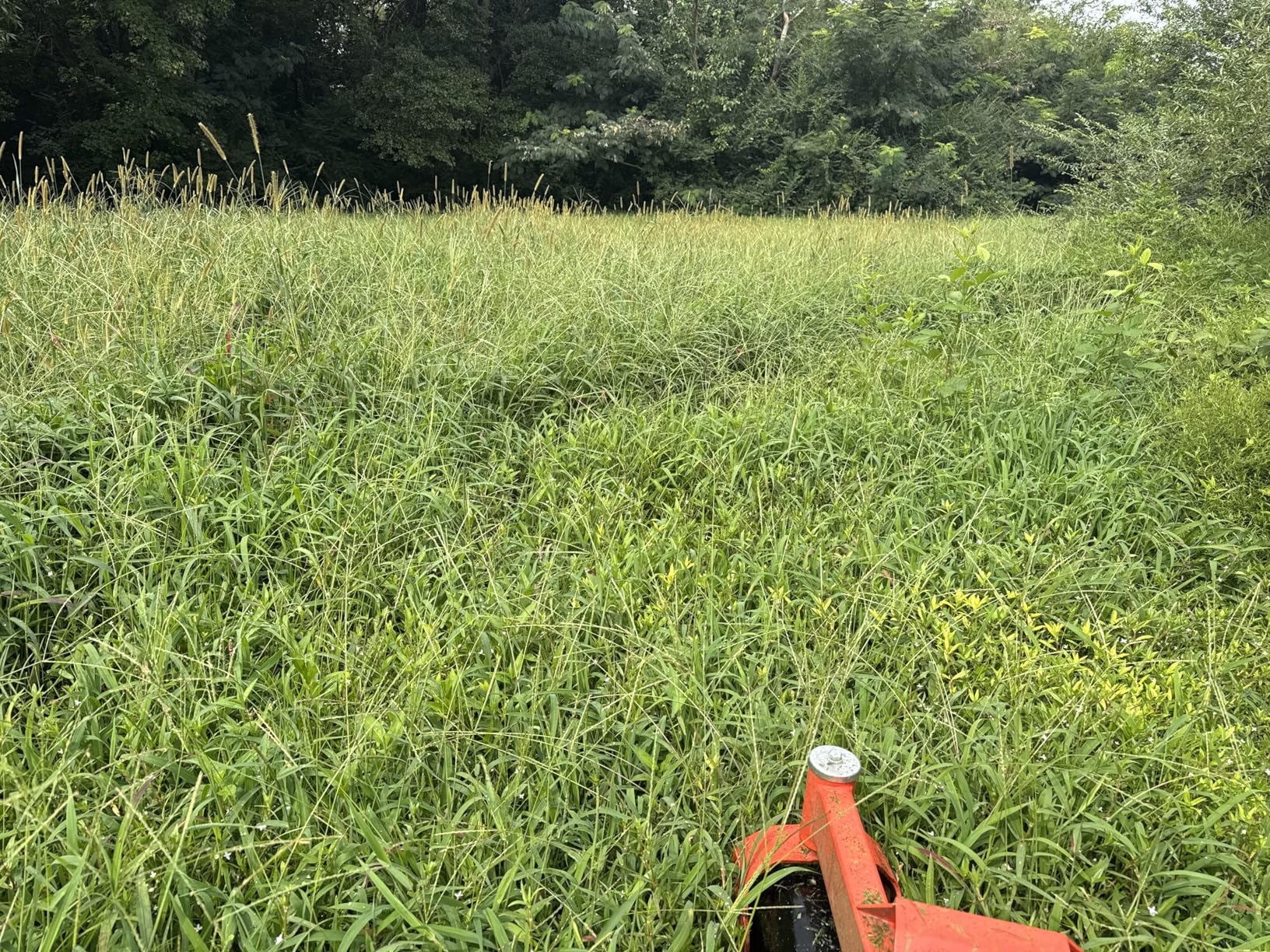
Why 930 Pounds Cuts Both Ways on Hills
Mass helps a mower climb and helps it resist being pushed sideways. It also makes the machine harder to control when something goes wrong, and harder to recover. A heavy zero-turn going downhill on wet grass does not drift gently, it accelerates.
Three cutting height positions is a thin range for undulating ground, and that is a real mismatch for a property with hills. The 1.5-to-4.5-inch range on the EGO machines lets you compensate for ground that rises and falls under the deck. Three fixed positions do not, which means more scalping on the high points and longer passes to clean up the low ones.
Gas Versus Electric for Long Slope Days
On a large property with hills, the gas argument is straightforward. A 23.5 HP V-twin has torque to spare on a climb, which is precisely the failure owners report in small-engine zero-turns, and it refuels in a couple of minutes at any station.
Against that, the V-twin needs oil changes, a fuel system, air filters, and spark plugs, and it is loud enough that early-morning mowing on a slope may not suit every neighborhood. Dealer service is the other factor: forum owners consistently weight whether a mower can be serviced locally far more heavily than spec sheets suggest, and a gas zero-turn is far easier to service locally than a battery platform.
Who This Suits Best
Consider it if you have several acres of open ground with hills, you want the coverage per hour of a 60-inch deck, and you have a dealer within reach who carries parts. The engine is the strongest in this roundup and the weight is the highest, and on rolling property those two facts matter more than the review count.
Do not buy it sight unseen if your property is tight, wooded, or steep. A 930-pound machine with a 60-inch deck on a narrow slope is a handful to control, and the near-total absence of owner feedback means you are the first person on your property to find out how it handles your specific grade.
5. Tyzar TYZ-1000 Crawler – Rated for the Steepest Slopes in This Roundup
- Tracks hold on 55 degree slopes
- ditches and rocky ground
- Solid metal frame and hardware that runs straight from the crate
- Remote operation with zero-turn style maneuverability
- Tracks stay under 5 psi ground pressure
- One-touch emergency stop cuts power to blades and tracks
- Only 4 recent reviews so long-term durability is unproven
- 826 pound machine is heavy to reposition or service
- Remote operation removes tactile control for precision edging
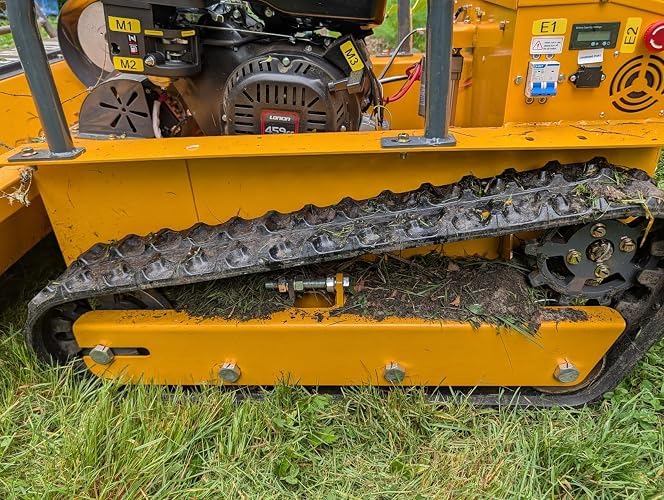
This is where the honest answer to steep slopes actually lives, and it is not a seated zero-turn. The TYZ-1000 is a tracked crawler with a 459cc engine, and the manufacturer rates it for 55-degree slopes. That is the steepest claim anywhere in this roundup by a wide margin.
The mechanism is not subtle. Tracks distribute weight across a contact patch instead of concentrating it on two round wheels, which keeps ground pressure under 5 psi so the machine floats over soft ground rather than sinking. There is no operator riding it at all, because it runs by remote control from up to 2,000 feet away.
That last point is the entire safety argument. On a slope steep enough to hurt someone, removing the person from the machine removes the rollover problem completely, and it is why this class exists.
Flail Head Versus a Mowing Deck
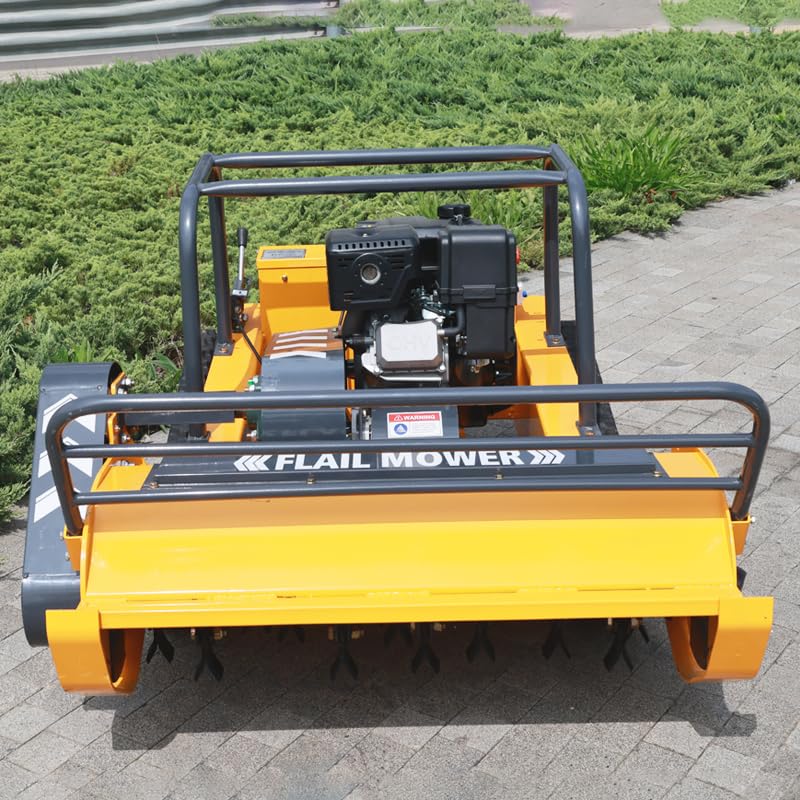
The cutting head is a reinforced flail, not a spinning blade deck, and flail blades are available in three hardness grades. A flail swings on a pivot and takes far more abuse than a fixed blade, which is why this class survives saplings and rock that would bend a conventional deck.
Owners report rocks through tall grass, thistles, and dense overgrowth on the first pass, and one ran a full eight-hour session on rough land without incident. It shreds dense grass, weeds, and light saplings to fine mulch in a single pass.
The tradeoff is finish. A flail head is a vegetation-clearing tool that can also mow lawn. If your priority is a clean striped lawn rather than reclaiming ground, the cut quality will not match a stamped steel deck, and cutting height adjustment of 1.1 to 5.9 inches reflects that broader range of purpose.
Hybrid Drive and the Emergency Stop
A smart system syncs the gas engine cutting with electric track drive, which the manufacturer claims saves up to 25 percent fuel. The one-touch emergency stop cuts power to both the blades and the tracks, which is a genuinely useful control when a machine weighing 826 pounds is moving on ground you cannot see.
One owner reported an eight-hour work session without a breakdown, but with four reviews, all recent, the durability evidence is thin. The manufacturer is the source for the 55-degree figure, not independent owners, and we would want to see that claim tested on your specific slope before you rely on it.
When This Machine Earns Its Price
At 826 pounds it is heavy to reposition or service, and remote operation is slower for precision edging because you are steering by sight. Neither matters if your ground is a bank, a ditch line, or a hillside thick with brush. Both matter if you want lawn stripes.
The realistic buyer is someone with a steep property or an overgrown bank who has been told, correctly, that no seated mower should go there. This is the machine that goes there instead.
6. Tyzar AWY-550L Crawler – Lightest Machine for Steep, Narrow Ground
- Handles 45 degree inclines that stall conventional mowers
- Cuts dense briars
- kudzu
- straw
- vines and small saplings
- Runs out of the box with no setup
- Only 286 pounds so it is easy to reposition
- Tracks grip mud
- gravel and wet marsh ground
- Only 4 recent reviews so long-term track durability is unproven
- Narrow 21.6 inch cutting width is slow on open acreage
- Owners report going slowly for dense kudzu and thick saplings
The AWY-550L is the same idea as the TYZ-1000 at roughly a third of the weight, 286 pounds against 826, with a manufacturer slope rating of 45 degrees. That is still far past the 20-degree line where a seated machine stops making sense.
It is also the machine in this roundup you can put in a truck by yourself. A 224cc engine and gearbox drive rubber tracks, and the whole unit is remote operated with 360-degree rotation, start, and stop.
Owners report using it on a 23-acre property with briars and kudzu, on steep slopes, and on five-acre spreads with thorny weeds, and they describe consistent power and reliability. One owner puts it this way: it runs out of the box with no setup beyond unboxing.
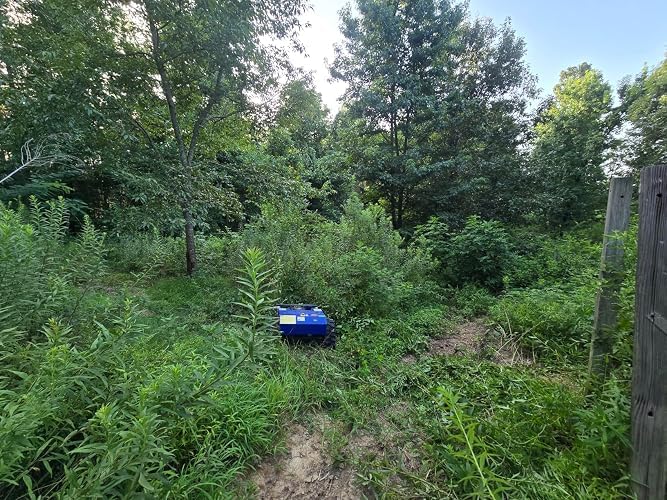
The Width Trade-Off That Decides This Purchase
The cutting width is 21.6 inches. On a half-acre of open lawn that is painfully slow, and owners reviewing the machine specifically say they wish they had chosen a larger model for big properties with wide open grass.
On a narrow hillside corridor, a fence line, or a bank between two structures, that narrow deck is the entire reason the machine works. A 60-inch deck on a 20-degree slope is not a mowing tool, it is a problem. A 21.6-inch deck on the same slope is a manageable machine.
Remote chassis height adjustment from 1.1 to 5.9 inches lets you set the cut height from the ground without climbing into the slope, which matters when the ground you are cutting is the ground you cannot stand on safely.
Twin Manganese Rebound Blades
The cutting head uses twin manganese rebound blades, which pivot on impact rather than snapping. That is the design that lets the machine cut vines, straw, briars, and inch-thick saplings that would stop a fixed blade cold.
Reviewers caution that thick vines and saplings require slow travel. That is a physical limit, not a defect, and it is worth knowing before you buy a machine expecting it to clear an overgrowth field at walking pace.
Who This Suits Best
It suits a homeowner with steep, overgrown, or awkwardly shaped ground who can carry it themselves and will not be mowing much open lawn. The 286-pound weight also means you can bring it to a problem area in a car rather than needing a trailer, which no other machine on this list allows.
With four recent reviews, long-term track and engine durability is unproven. If your property is mostly gentle lawn with one bad corner, this is the wrong machine and the ZT4204L is the right one.
Buying Guide: Nine Specs That Decide How a Mower Handles a Grade
Steering control is the first spec to check, and it is the one most buyers read past. Lap bars and steering wheels both drive the same independent rear-wheel system, but a steering wheel lets you hold a precise speed on one wheel while the other works, and lap bars rely on lever feel. On a slope, precise differential speed is the difference between correcting a slide and starting one. Where a steering wheel is available, it is the safer choice on hills.
Measure Your Slope Before You Buy Anything
Most people cannot tell whether their property is inside a machine’s safe envelope, so measure it. Place a level or a straightedge on the ground, set one end on the high point, and use a tape to read the horizontal run. Rise over run converted to a percentage, then compare that to 10 percent, which is about 6 degrees.
For a rough visual check, a 6-inch level held on end spans about 10.8 inches of ground at 6 degrees and about 21.6 inches at 11 degrees. If you can stand a 4-foot level on end and the ground beneath it looks close to level, you are near 15 degrees, which is where we would stop shopping for a seated zero-turn.
Understand Degrees Versus Percent Grade
They are different measurements and the confusion causes real mistakes. Percent grade is rise over run multiplied by 100, so a 45-degree slope equals a 100 percent grade. Mower slope ratings are stated in degrees, and a 10-degree slope is roughly a 17.6 percent grade.
What matters is that slope difficulty rises faster than the number does. Going from 10 to 15 degrees is a meaningful step, and going from 15 to 20 is where traction loss starts to bite. Use degrees, and treat a machine rated to 15 as a machine you keep inside 15.
Traction Comes From Rear Tire Diameter and Lug Depth
On a zero-turn the rear drive wheels are the only contact with the ground, so traction is entirely their business. Larger rear tires with deeper lug put more rubber on the ground and deform more of it, which is what creates grip. Wide rear frames help by spreading the load, and true dual rear wheels add a second contact patch on the downhill side.
Wet grass removes most of that. Grip drops sharply on a damp slope, which is why the rule is dry grass only, and why a machine that climbs fine in the morning may not climb at all after rain.
Torque Matters More Than Horsepower on a Climb
Horsepower is a rate of work, not a measure of what happens when the drive wheels start to slip. On an incline you need torque at the wheels, and the reason small-engine zero-turns fail on hills is that they have neither enough torque nor enough weight on the drive wheels.
A 20 HP engine with a 50-inch deck that cannot climb a slight incline, as one Houzz owner reported, is not a defective machine. It is a machine whose deck and weight exceed what its drive system can pull. Match deck size to engine output, and match both to the weight of the machine.
Center of Gravity and Why a Wide Deck Hurts
You sit high on a zero-turn, and your mass is the single largest factor in rollover risk. A 60-inch deck puts a wide slab of steel out in front of the front wheels. Heading downhill, that front end gets light, and on a side slope the deck’s inertia works against the chassis.
Wider frame helps, wider deck hurts. Buyers instinctively assume a bigger deck means a better mower, and on a slope that assumption is backwards. The machines in this roundup that hold a grade do it with a wide rear chassis and a narrower deck.
Hydrostatic Drive and Why It Beats Manual on Hills
A hydrostatic transmission uses a pump and motor at each drive wheel, so speed is a smooth continuous function of the control position rather than a set of gears with a shift lever between them. That continuous control is what lets you creep uphill at walking pace without surging.
Manual and automatic transaxles can work on gentle ground, but the discrete steps make fine speed control on an incline harder. Every machine in this roundup uses a continuously variable electric drive or a hydrostatic-equivalent setup for that reason.
Deck Height Range for Undulating Lawns
On rolling ground the deck spends much of its life out of level with the world. A wide cutting-height range, ideally 1.5 to 4.5 inches across at least ten positions, is what lets you follow the ground and avoid scalping the high points.
The Ariens Zenith 60 has three cutting height positions, which is the narrowest range here and the reason it suits open, even property better than rolling property. Deck suspension, which floats the deck over ground changes independently, helps in the same way.
Roll-Over Protection, Seat Belts, and Rollover History
On any slope, a roll bar and a seat belt are the difference between an incident and a serious injury. Every machine rated for hills should have both, and you should wear the belt every single time, because the failure mode on a slope is sudden and gives you no time to react.
Forum owners describe losing control when turning on a grade, stopping partway up a hill, and rear wheels running away downhill. None of those are brake failures. All of them are geometry and traction events, which is why technique matters as much as machine choice.
Trailer and Attachment Limits on Hilly Property
Hauling trailers is a repeatedly cited concern among owners on hilly ground, and it deserves a paragraph of its own. A tongue weight behind a zero-turn pushes down on the steering mechanism, which on this class is the lap bar or wheel, and that is a control you do not want loaded unpredictably on a descent.
None of the battery machines here have a rear hitch, which removes the temptation. If you need to haul on your property, budget for a dedicated utility vehicle or trailer rather than a mower that doubles as a hauler.
Service Network and Brand Familiarity
The factor owners weight most heavily is whether the mower can be serviced locally and whether the dealer carries parts. On a battery platform, a battery or controller failure can mean a service-center trip and a machine that weighs more than 500 pounds. On a gas zero-turn, almost any part is available at a local dealer or shipped directly.
Long ownership tenure matters in the other direction too. Owners with 10-plus years of experience on a machine trust it, and they trust the brand in the shed. If you already own a brand and it has been reliable, that counts for more than a spec sheet advantage of two horsepower.
How to Mow Hills Safely With a Zero Turn Mower
These steps come from what owners across lawn, tractor, and mower forums consistently say works, and from how the physics of an independent-wheel drive actually behaves.
Walk the property first. Find the steepest section, the softest ground, and any spot where the slope changes direction. Know where you will stop before you start.
Mow across the slope, not up and down it. Across-slope passes let the machine’s weight sit over the drive wheels. Straight up-and-down passes put the entire load on the downhill wheels, which is where traction runs out first.
Never turn on a grade. A turn on a slope swaps the fast wheel and the slow wheel, and the machine pivots about a rear tire. Slow down to a walk before the slope changes direction.
Never stop on a slope. With no parking brake holding a zero-turn on a grade, drive to level ground before you release the control or lift off the pedal.
Mow dry grass only. Wet grass on a slope is the single most common way this goes wrong. Grip falls away exactly when you need it most.
Wear the seat belt. Every time, including on the gentle rolls where nothing feels dangerous.
Use the slow driving mode on inclines. Less speed means less momentum to lose, and less momentum means a slide that recovers before it becomes a run.
Skip the trailer and attachments on hills. Tongue weight behind a zero-turn changes the steering balance on a descent.
One more habit worth naming: when you finish, check the deck bolts and the tire pressure. Hill work puts unusual loads on both, and a loose deck bolt is much more likely to show up on a slope than on flat ground.
When a Zero Turn Mower Is the Wrong Tool for Your Ground
There is a point past which a zero-turn is not just a mediocre choice, it is the wrong machine, and we would rather tell you that than sell you one.
The reason is the failure mode. A zero-turn steers by varying rear wheel speed with no front wheels to correct a slide. When the downhill rear wheel loses grip, the machine does not drift, it rotates. The operator is high, the deck is wide, and neither helps.
Past about 20 degrees, the right answers are a front-wheel-drive lawn tractor with a low center of gravity and wheels that can steer into a slide, a walk-behind with no operator mass at all, or a remote-controlled tracked crawler where no one is riding the machine. Forum owners with long tenure point to deck-out-front designs for exactly this reason: keeping the weight over the drive wheels is what makes a machine hold a grade.
Rubber track conversion kits come up in forum discussion as a real improvement over wheeled zero-turns on sloped ground, and they do help traction. They do not fix the seated-operator problem. If your slope is steep enough to make you consider tracks, the honest answer is to stop riding it.
Frequently Asked Questions
What is the steepest slope a zero-turn mower can handle?
Most zero-turn mowers are manufacturer-rated for slopes of 10 to 15 degrees. Above roughly 20 degrees, a seated operator is at real rollover risk no matter the horsepower, and a walk-behind, front-wheel-drive lawn tractor, or remote-controlled tracked crawler is the safer machine.
Are zero-turn mowers good for hilly terrain?
Yes for gentle rolling grades, no past about 15 degrees. On moderate slopes a properly specced zero-turn handles them well, but on steep ground it can be worse than a front-wheel-drive lawn tractor because steering by wheel speed means a downhill slide spins the machine sideways with no front wheels to correct it.
Which zero-turn mower is best for hilly terrain?
For rolling hills under 15 degrees, the EGO Power+ ZT4204L has the deepest owner base and a low, weighty frame. For hills across several acres, the EGO Power+ ZT5207L covers more ground per charge. For the steepest ground, a remote-controlled tracked crawler rather than any seated machine.
What zero-turn mower has the best traction?
Traction comes from rear tire diameter, lug depth, and frame width rather than brand. The EGO Power+ ZT5216L pairs a wide frame with a 27 HP equivalent drive for stability on grades, while tracked crawlers such as the Tyzar TYZ-1000 hold a traction advantage on slopes past 20 degrees.
How do you mow a steep hill with a zero-turn mower?
Mow across the slope rather than up and down it, never turn on a grade, never stop while parked on a slope, mow dry grass only, and wear the seat belt. Walk the property first to find the steepest section and the softest ground before you start cutting.
What is the most reliable zero-turn mower brand?
Reliability is better judged by local dealer and parts support than by brand loyalty alone. Gas zero-turns with a Kawasaki or Kohler V-twin are serviceable by almost any dealer, while battery platforms such as EGO are serviced through a network where warranty work can involve shipping a 500-pound-plus machine.
The Verdict on Zero Turn Mowers for Hills
There is no universal best zero turn mower for hills, because the useful question is not which machine is best but which slope band your land falls into. That is the decision that should drive your purchase, not the badge on the box.
If your hills are rolling ground under about 15 degrees, the EGO Power+ ZT4204L is the pick we keep coming back to. It has the deepest owner record in this roundup, a low and weighty frame, and no engine maintenance at all. If you have two to four acres with hills and a lot of growth to get through, the ZT5207L covers more ground per charge and weighs less, with the caveat about its front axle on wooded ground. If slope stability is the deciding factor on a couple of acres, the wide-frame ZT5216L is engineered for exactly that and carries the longest warranty here.
For open rolling acreage where you want raw coverage and a local dealer, the Ariens Zenith 60 has the strongest engine and the most weight, which is real hill capability, but almost no owner history to judge it by. For ground past 20 degrees, stop shopping among seated mowers. The Tyzar TYZ-1000 at 45 to 55 rated degrees or the 286-pound AWY-550L for narrow plots will get the job done with nobody riding the machine.
Measure your slope before you spend anything, keep your hills inside 15 degrees if you want a seated zero-turn, and mow across the grade rather than up it. You can also read our picks for cordless lawn mowers with long battery life if you are covering smaller ground, or our robot mower guide for large yards if your slope is gentle enough for one to handle unattended.